

Credit Guides
The 45V tax credit pays up to $3.28 per kg of clean hydrogen in 2026 for 10 years. Tiers, the 2028 deadline, emissions rules and how to claim or sell it.
Author -
Paulestini Francois
Published -
READ TIME
The 45V tax credit can pay a clean hydrogen producer more than the hydrogen itself sells for. It's also one of the hardest credits to earn, with emissions modeling, power-sourcing rules and a construction deadline that moved up five years in 2025. Here's how the credit works in 2026, who qualifies, what it's worth, and how producers turn it into cash.
QUICK ANSWER
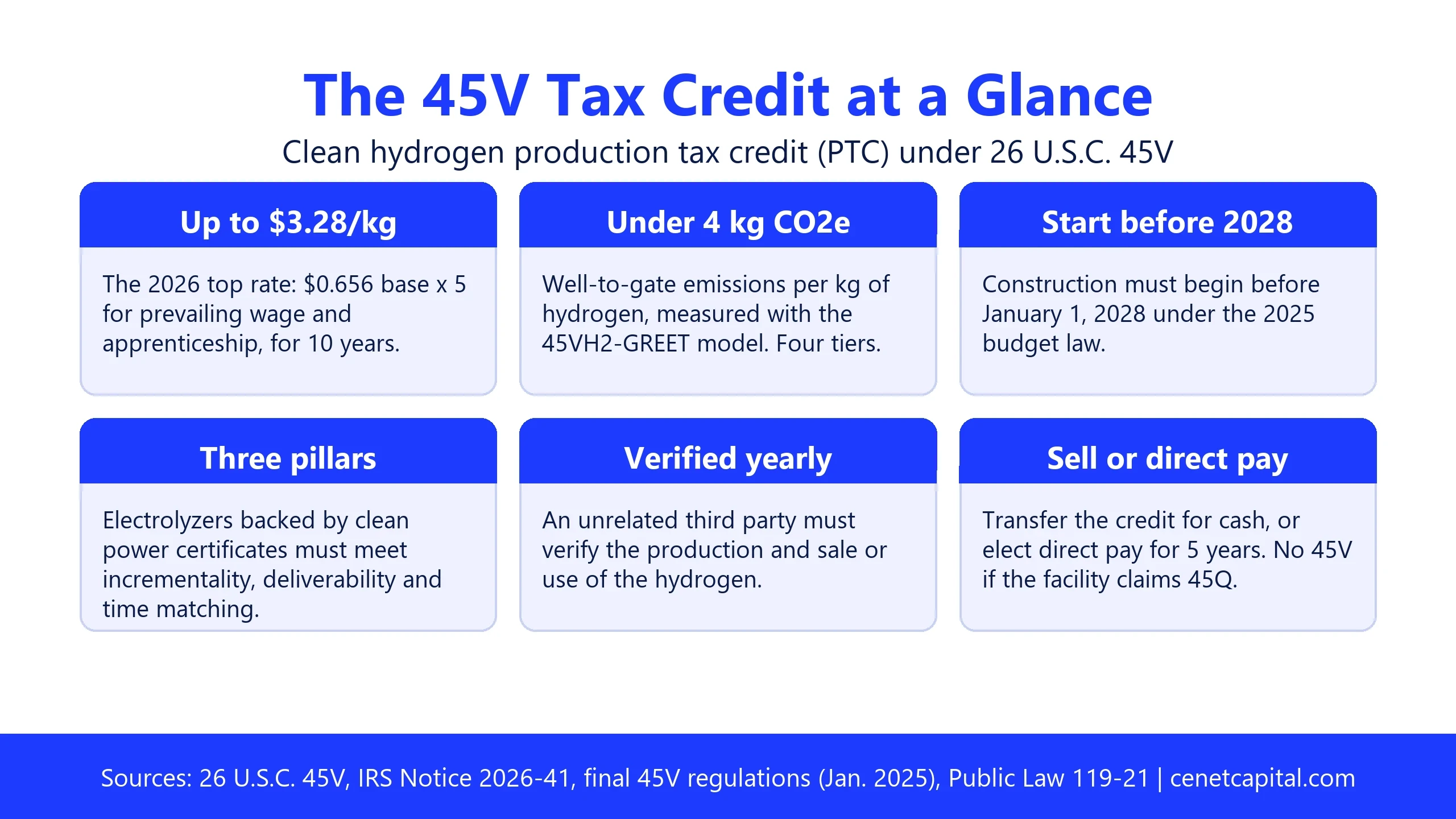
The 45V tax credit is the federal clean hydrogen production tax credit (PTC). It pays up to $3.28 per kg in 2026 for hydrogen with lifecycle emissions under 0.45 kg CO2e per kg, for 10 years. Facilities must begin construction before January 1, 2028 and can sell the credit or take direct pay.
KEY FACTS
What is the 45V tax credit? The clean hydrogen production tax credit (PTC) under section 45V, paid per kg of qualified clean hydrogen for 10 years.
What are the 45V tax credit tiers? Under 0.45 kg CO2e: 100%. 0.45 to 1.5 kg: 33.4%. 1.5 to 2.5 kg: 25%. 2.5 to 4 kg: 20%. Above 4 kg: no credit.
How much is the 45V PTC in 2026? $0.656 per kg base at the top tier, or $3.28 with prevailing wage and apprenticeship, per IRS Notice 2026-41.
What is the 45V construction deadline? Construction must begin before January 1, 2028, under the One Big Beautiful Bill Act.
Can you combine 45V and 45Q? No. Section 45V(d)(2) denies 45V at a facility whose carbon capture equipment has earned 45Q.
Is the hydrogen tax credit transferable? Yes. The 45V production tax credit can be sold for cash under section 6418, or taken as direct pay for five years under section 6417.
What is the 45V tax credit?
The 45V tax credit is the federal clean hydrogen production tax credit (PTC). It pays a producer for each kilogram of qualified clean hydrogen made at a U.S. facility during its first 10 years in service. The rate depends on lifecycle emissions, and in 2026 it’s worth up to $3.28 per kg.
Congress created section 45V in the Inflation Reduction Act of 2022. The statute, 26 U.S.C. 45V, sets a $0.60 base rate, adjusted each year for inflation, and multiplies it by five for projects that meet prevailing wage and apprenticeship requirements. Hydrogen has to be produced in the ordinary course of business, for sale or use, and verified by an unrelated party.
Unlike an investment tax credit (ITC), which pays once based on what you spend, 45V is a hydrogen PTC. A plant that runs more earns more. That makes uptime, power prices and emissions as important to the credit as construction cost. This guide is the hub for our 45V coverage, with links to deeper articles on each rule.
How much is the 45V credit worth in 2026?
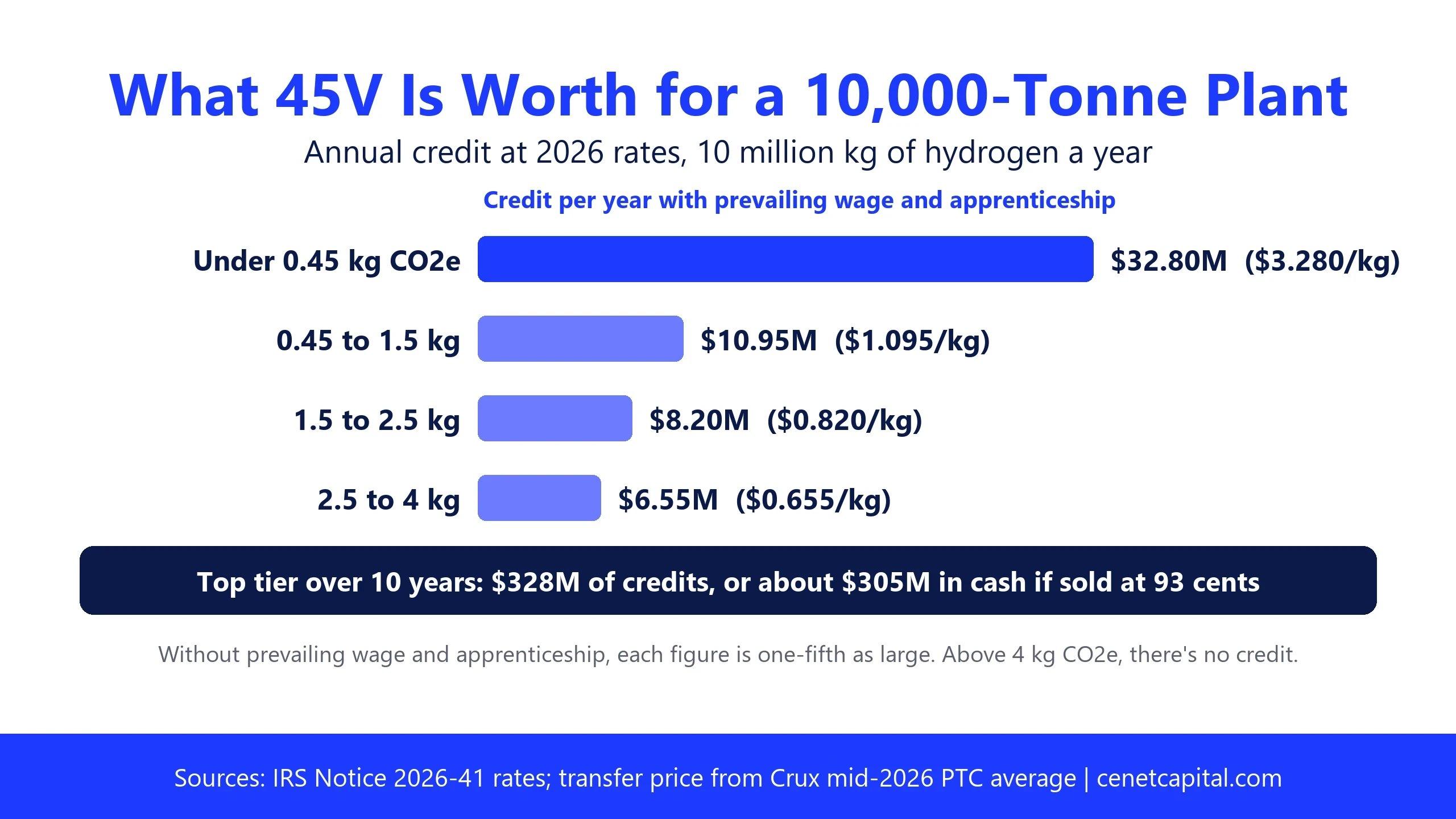
Up to $3.28 per kilogram in 2026. IRS Notice 2026-41 set the inflation factor at 1.0929, making the base $0.656. The emissions tier sets the share you get: 100%, 33.4%, 25% or 20%. With prevailing wage and apprenticeship, that’s $3.28, $1.095, $0.82 or $0.655 per kg.
The tiers are set by well-to-gate emissions in kilograms of CO2e per kilogram of hydrogen: under 0.45 kg for the top tier, 0.45 to 1.5 kg, 1.5 to 2.5 kg, and 2.5 to 4 kg. Above 4 kg, there’s no credit. The rates come from Notice 2026-41.
For a plant making 10,000 tonnes a year, the difference between tiers is large. At the top tier, the credit is about $32.8 million a year, or $328 million over 10 years. At the lowest tier, it’s $6.55 million a year. Without prevailing wage compliance, each figure falls by four-fifths, which is why that rule is the first thing a credit buyer checks.
Who qualifies for the 45V tax credit?
A taxpayer that owns a qualified clean hydrogen production facility in the U.S., produces hydrogen with lifecycle emissions of 4 kg CO2e per kg or less, sells or uses it in a verifiable way, and began construction before January 1, 2028. The facility can’t also claim the 45Q carbon capture credit.
That last rule matters for blue hydrogen. Under section 45V(d)(2), no 45V is allowed at a facility whose carbon capture equipment has earned 45Q in the current or any prior year. Our blue hydrogen guide and 45Q guide compare the two. Some downstream uses also qualify, such as clean ammonia, where the credit is on the hydrogen, not the ammonia.
Projects that began construction before 2025 had another option: under section 48(a)(15), they could elect the 30% investment tax credit (ITC) instead of 45V. That window has closed for new projects, so 45V is now the main federal incentive for clean hydrogen. Our ITC vs. PTC comparison explains the trade-off for projects that still have a choice.
How are emissions measured for 45V?
With the 45VH2-GREET model, a Department of Energy tool that calculates well-to-gate emissions for each production pathway. Producers whose pathway isn’t in the model can ask DOE for a provisional emissions rate. Electrolyzers that claim clean power must also meet the three pillars: incrementality, deliverability and time matching.
The final regulations, issued in January 2025, let electrolyzer operators count clean electricity only if they retire qualifying energy attribute certificates (EACs). The power must come from new capacity, from the same region, and be matched to production. Annual matching is allowed through 2029, and hourly matching starts in 2030. Our guides to 45VH2-GREET and qualifying EACs walk through each step.
Grid power on its own rarely works. A typical U.S. grid mix produces far more than 4 kg of CO2e per kg of hydrogen, which is why green hydrogen doesn’t automatically qualify. Special rules apply to hydrogen made with power from existing nuclear plants. The full regulatory picture is in our 45V rules guide.
What did the One Big Beautiful Bill change for 45V?
It moved the construction deadline. Under the Inflation Reduction Act, facilities had until the end of 2032 to begin construction. The One Big Beautiful Bill Act requires construction to begin before January 1, 2028. The tiers, the 10-year credit period, transferability and direct pay stayed the same.
That five-year cut has forced decisions. Air Products cancelled a Louisiana blue hydrogen project in 2026, and DOE ended funding for two of the seven regional hubs, as our hydrogen hubs update explains. Projects still moving have to prove they began construction in time, using the physical work test or the 5% safe harbor. Our 45V and the Big Beautiful Bill article covers the details. To see what your plant would earn at 2026 rates, use the calculator below.
What is your clean hydrogen worth under 45V?
Illustrative only. Uses 2026 amounts from IRS Notice 2026-41 held flat; the IRS adjusts them for inflation each year. Emissions must be determined with the 45VH2-GREET model (or a provisional emissions rate) and verified annually. Facilities must begin construction before January 1, 2028.
Price your 45V credits →How do you claim or sell the 45V credit?
You claim it on IRS Form 7210 and carry it to Form 3800 with your tax return. If you can’t use the credit yourself, you can sell it to a corporate buyer for cash under section 6418, or elect direct pay for five years under section 6417. Both routes require IRS pre-filing registration first.
Hydrogen is one of three credits, with 45Q and 45X, where a for-profit company can choose direct pay. Under section 6417, the election covers the first year and the next four. Most producers sell instead. Production credits averaged about 93 cents per dollar in Crux’s mid-2026 market data, though 45V buyers expect more diligence on the emissions rate.
Either way, each facility needs an IRS pre-filing registration number every year. Our guides to Form 7210, monetizing 45V and elective pay cover the filing steps, and the hydrogen price per kg article shows what the credit does to your costs.
Sources
Legal Information Institute, 26 U.S. Code 45V, Credit for production of clean hydrogen and 26 U.S. Code 6417
Internal Revenue Service, Internal Revenue Bulletin 2026-29, Notice 2026-41
U.S. Department of Energy, Clean Hydrogen Production Tax Credit (45V) Resources
Congressional Research Service, The Section 45V Clean Hydrogen Production Credit (IF12602)
pv magazine USA, Clean energy capital expenditures on track for $180 billion in 2026, reports Crux
Frequently Asked Questions
What is the 45V tax credit?
Section 45V is the clean hydrogen production tax credit, a production tax credit (PTC) created by the Inflation Reduction Act. It pays a producer for each kilogram of qualified clean hydrogen made at a U.S. facility during its first 10 years in service, at a rate set by the hydrogen's lifecycle emissions.
How much is the 45V credit per kg in 2026?
Who qualifies for the 45V hydrogen tax credit?
Did the One Big Beautiful Bill end the 45V credit?
Can Cenet Capital help me sell my 45V credits?
Turn your 45V credits into cash
Cenet Capital helps hydrogen producers sell 45V credits to corporate tax buyers, or plan a direct-pay election. Tell us your expected output, emissions tier and construction start date.

More Insights