

Project Finance
What an offtake agreement is, how take-or-pay and PPA contracts work, the terms lenders check, and why offtake decides whether a project earns its tax credits.
Author -
Paulestini Francois
Published -
READ TIME
No buyer, no financing, and often no tax credit. Here's what an offtake agreement is, how take-or-pay and take-and-pay contracts differ, which terms lenders read first, and why the Production Tax Credit (PTC) and 45V depend on the offtake contract behind them.
QUICK ANSWER
An offtake agreement is a long-term contract in which a buyer agrees to purchase all or part of a project's future output before it's built. It gives lenders predictable revenue to finance against. Take-or-pay contracts make the buyer pay a minimum even if it takes less; take-and-pay contracts pay only for delivered volume.
KEY FACTS
What is offtake? The sale of a project's output to a committed buyer, the offtaker, under a long-term contract.
What is an offtake contract? Another name for an offtake agreement: a binding promise to buy future output at an agreed price.
What is a take-or-pay contract? A contract where the buyer pays for a minimum volume whether it takes delivery or not.
Offtake agreement vs PPA? A power purchase agreement is an offtake agreement for electricity. A virtual PPA settles financially instead of delivering power.
Does the 45Y PTC need an offtake? The 45Y PTC pays only on electricity sold to an unrelated person (or metered by one), so the sales contract is central.
Does hydrogen offtake matter for 45V? Yes. 45V requires hydrogen produced for sale or use, verified by an unrelated party. Hydrogen with no buyer earns nothing.
What is an offtake agreement?
An offtake agreement is a long-term contract in which a buyer, called the offtaker, agrees to purchase all or part of a project’s future output, such as electricity, hydrogen or fuel, before the project is built. It gives the producer guaranteed revenue that lenders and investors can underwrite, which is why most energy projects can’t be financed without one.
Offtake agreements are standard in power, mining, LNG and, increasingly, clean fuels. Investopedia defines it as a legally binding contract to buy goods yet to be produced, usually negotiated before the facility is built. The producer gets a committed customer, and the buyer locks in supply and price, often for 10 to 20 years.
For clean energy developers there’s a second reason offtake matters. Several federal tax credits are only earned when output is actually sold or used, so the offtake contract is part of how a project proves it earned its credits. This guide covers how offtake contracts work, the main types, the terms that matter and how they connect to tax credits.
How does an offtake agreement work in project finance?
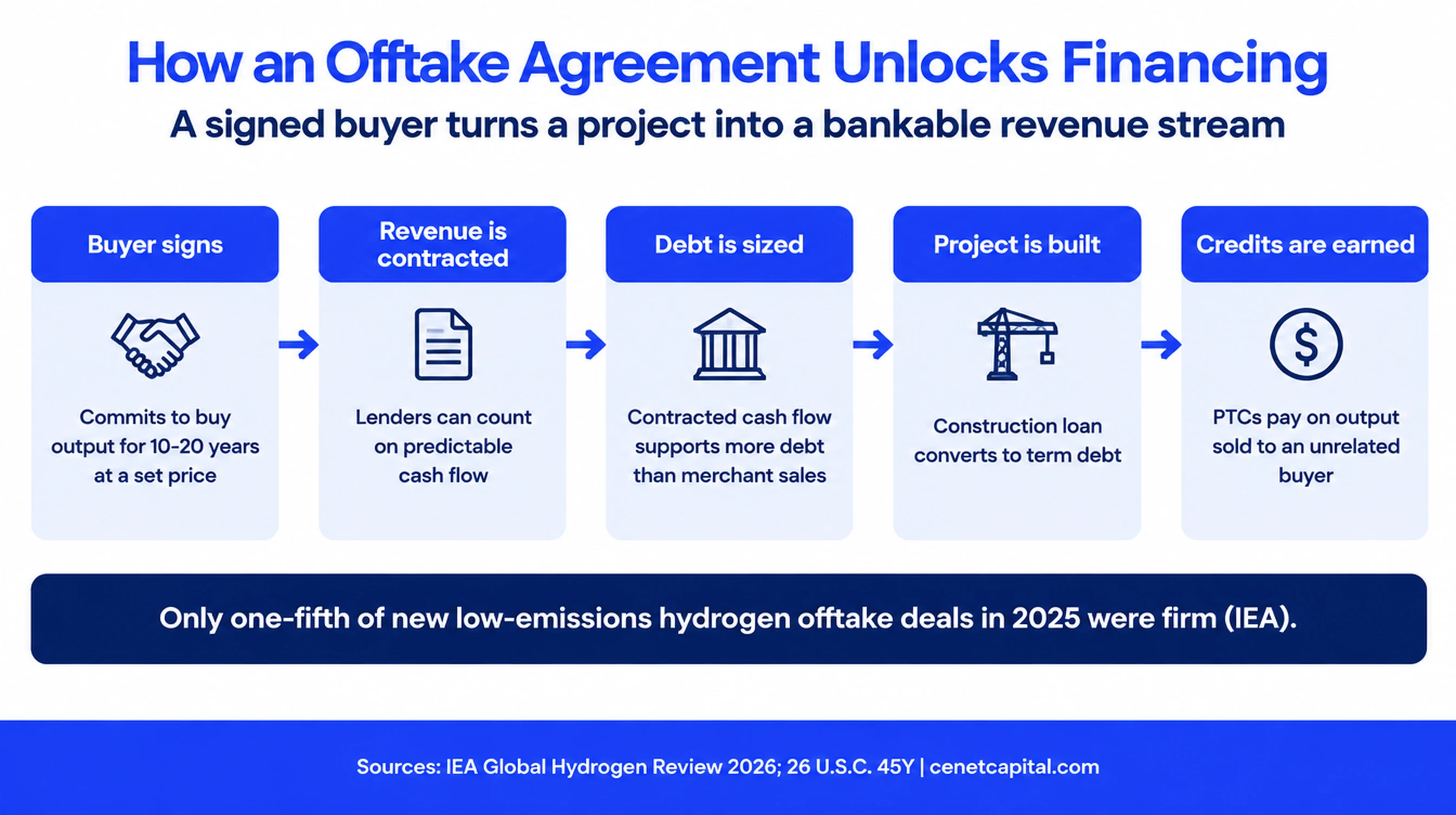
In project finance, the offtake agreement is the revenue foundation of the deal. Lenders size the loan on cash flow available to repay debt, and contracted cash flow from a creditworthy offtaker supports more debt than merchant sales at market prices. A strong offtake contract can be the difference between a financeable project and one that never gets built.
Lenders divide cash flow by a target debt service coverage ratio, and they require more coverage for revenue they can’t predict. That’s why a project that sells 80% of its output under contract usually raises far more debt than the same project selling into the spot market. The buyer’s credit rating matters too: an investment-grade utility or tech company is worth more to a lender than a startup.
Corporate buyers are now the biggest source of these contracts. BloombergNEF counted 55.9 GW of corporate clean power purchase agreements in 2025, down 10% from the 2024 record, with a record 29.5 GW in the U.S. Meta, Amazon, Google and Microsoft signed 49% of the global total. Pricing has stayed firm: LevelTen’s Q2 2026 index put North American PPA offers at an average of $61.40 per MWh for solar and $83.79 for wind.

What are the main types of offtake contracts?
The main types of offtake contracts are take-or-pay, take-and-pay, physical power purchase agreements, virtual power purchase agreements and tolling agreements. They differ in who bears volume risk, whether the product is physically delivered and how the price is set. Lenders generally prefer structures that move more risk onto the buyer.
Take-or-pay: the buyer pays for a minimum volume whether it takes delivery or not.
Take-and-pay: the buyer pays only for what it actually takes, so the seller carries demand risk.
Physical PPA: the buyer takes title to the electricity at a delivery point at a fixed or escalating price.
Virtual PPA: a financial contract for differences. The project sells power into the wholesale market, and the buyer settles the gap between market and strike price and keeps the renewable energy certificates.
Tolling agreement: the buyer supplies the input, such as power or natural gas, and pays a fee to convert it.
Hydrogen offtake contracts usually borrow from the gas world: take-or-pay minimums, price formulas tied to natural gas, and strict purity and pressure specifications.
What is a take-or-pay contract?
A take-or-pay contract requires the buyer to either take a minimum volume or pay for it anyway, usually a large share of the contracted quantity. It shifts demand risk from the seller to the buyer. A take-and-pay contract is the opposite: the buyer pays only for what it takes, so a drop in demand cuts the seller’s revenue.
If a hydrogen buyer’s ammonia plant goes down for six months, a take-or-pay seller still collects its minimum payment, while a take-and-pay seller collects only for hydrogen delivered. A third version, sometimes called hell-or-high-water, makes the buyer pay 100% regardless of events, which lenders love and buyers resist.
Many take-or-pay contracts also include makeup rights, which let the buyer take volumes it already paid for in a later year. Use the chart below to compare what a seller keeps under each structure when the buyer’s demand falls.
Take-or-pay caps the seller's loss: the buyer pays for at least 80% of the contract even when it takes less.
Illustrative contract. Real take-or-pay floors, makeup rights and resale terms are negotiated deal by deal. 45V requires hydrogen produced for sale or use, verified by an unrelated party (26 U.S.C. 45V(c)(2)(B)).
Offtake agreement vs PPA: what is the difference?
A power purchase agreement is one type of offtake agreement, used when the output is electricity. “Offtake agreement” is the broader term and covers any product, from hydrogen and ammonia to lithium, copper or sustainable aviation fuel. In energy finance, people often use the two terms interchangeably when talking about renewable power.
The mechanics are the same: a term, a volume commitment, a price and credit support. PPAs add power-specific terms such as the delivery node, curtailment compensation, availability guarantees and who keeps the renewable energy certificates. Hydrogen offtakes add specifications for purity, pressure and delivery method, plus provisions for emissions documentation that a 45V claim may need.
What terms should an offtake agreement include?
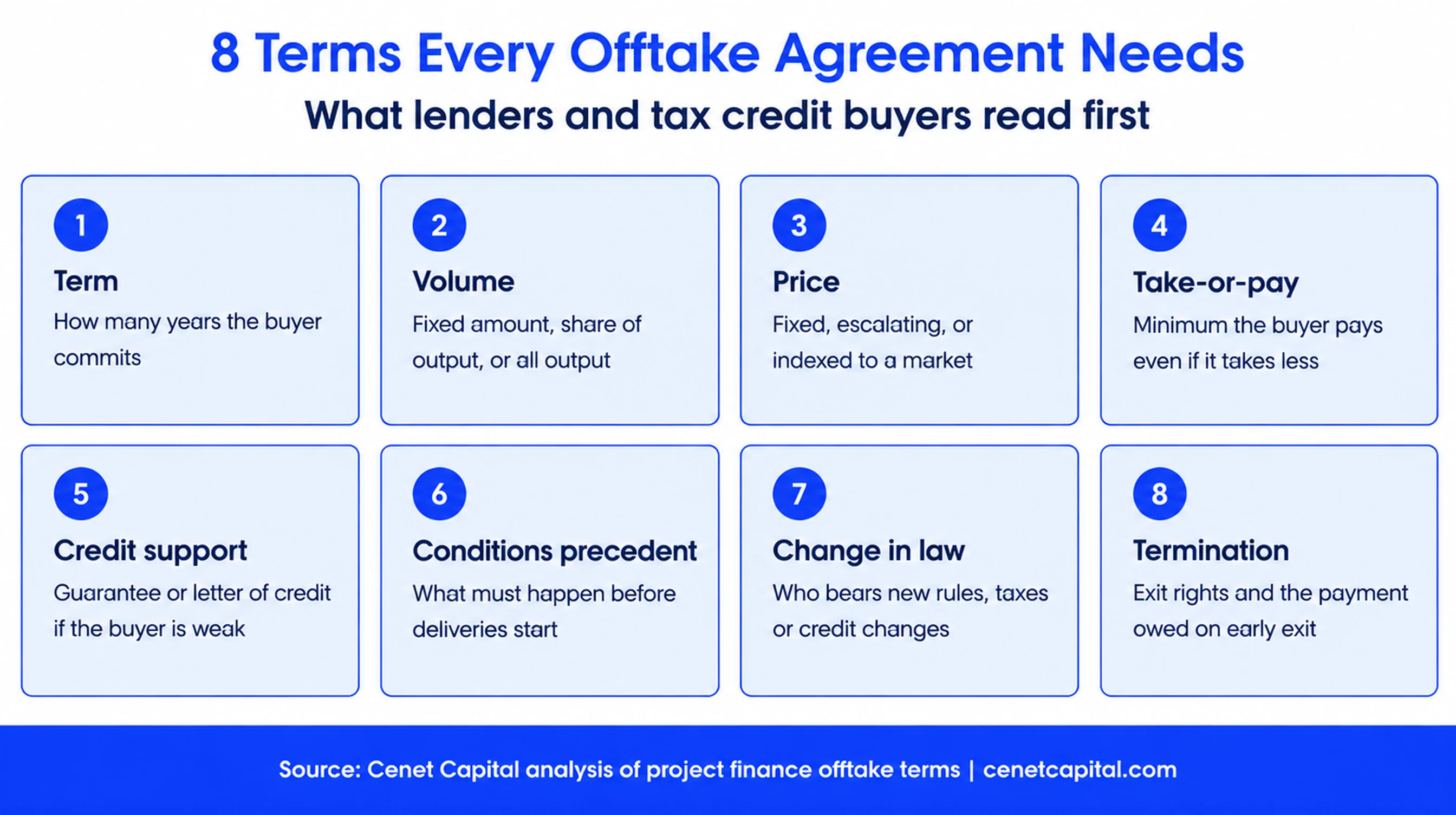
Every offtake agreement should define the term, the volume commitment, the price formula, any take-or-pay minimum, the buyer’s credit support, conditions precedent, change-in-law protection and termination rights. These are the terms lenders, tax equity investors and tax credit buyers read first, because they decide how reliable the project’s revenue really is.
Change in law decides who bears the cost if tax credits change, which mattered when the One Big Beautiful Bill Act cut credit timelines in 2025. Termination payments should be large enough to repay outstanding debt.
Most contracts also carry a force majeure clause that excuses performance after events like floods or fires. Credit support matters most when the buyer isn’t investment grade. A parent guarantee or letter of credit sized to several months of payments can turn a weak offtaker into a financeable one.
How do offtake agreements affect clean energy tax credits?
Production tax credits depend on sales. The Section 45Y clean electricity production tax credit (PTC) pays only on electricity sold to an unrelated person, and the 45V hydrogen credit requires hydrogen produced for sale or use, verified by an unrelated party. The offtake agreement is the evidence that those sales happen.
The statute is explicit. Section 45Y credits kilowatt-hours “sold by the taxpayer to an unrelated person,” with an exception for metered self-use. Section 45V(c)(2)(B) requires that the “production and sale or use” of hydrogen be verified by an unrelated party, so hydrogen that’s vented for lack of a buyer earns nothing. Our 45Y guide and 45V guide cover the rest of each credit.
Investment tax credits (ITC) such as 48E don’t depend on sales, but they still depend on financing, and financing depends on offtake. Offtake also shows up in transfers: buyers of transferable credits review the contract during diligence, as our tax credit purchase checklist explains. A signed contract with a creditworthy buyer makes credits easier to sell for cash.
How much debt can an offtake agreement support?
Debt capacity depends on how much output is contracted, the contract price, the buyer’s credit and how long the contract runs. Contracted cash flow is typically sized at much tighter coverage than merchant cash flow, so raising the contracted share or extending the term usually increases the loan. Losing the buyer early cuts it sharply.
The calculator below estimates debt capacity for a solar or wind project. Toggle the scenarios to see what buyer credit, a take-or-pay clause, an escalator or an early exit does to the loan.
Every $1 of contracted cash flow supports about $0.77 of debt service, versus $0.50 for merchant cash flow.
Illustrative only. Assumes 25% (solar) or 38% (wind) capacity factor, $22 or $43 per kW-year O&M, 7% interest, 18-year sculpted debt, and 1.30x contracted / 2.00x merchant coverage. Real sizing depends on your lender, P-values and term sheet.
Why do hydrogen projects fail without offtake agreements?
Most clean hydrogen projects stall because buyers won’t sign firm, long-term contracts at prices that cover production costs. Without bankable offtake, lenders won’t commit and projects never reach a final investment decision. The IEA found that only one-fifth of new low-emissions hydrogen offtake agreements signed in 2025 were firm.
The IEA’s Global Hydrogen Review 2026 counted 1.7 million tonnes per year of new offtake agreements in 2025, the same as 2024, and noted that investment in some sectors lags because firm offtake remains scarce.
Air Products’ Louisiana Clean Energy Complex shows the stakes. The company had said it wouldn’t make a final investment decision without firm offtake agreements for its hydrogen and nitrogen. In June 2026 it exited the project, along with an Arizona green hydrogen facility, and expected a pre-tax charge of up to $2.9 billion. For hydrogen developers, the lesson is to sign the buyer first and treat the 45V credit as support for the contract, not a substitute for it.
Sources
Investopedia, What Is an Offtake Agreement in Project Financing? (April 2026)
Legal Information Institute, 26 U.S. Code 45Y and 26 U.S. Code 45V
International Energy Agency, Global Hydrogen Review 2026: Demand
Air Products and Chemicals, Form 8-K, Item 2.06 Material Impairments (2026)
Utility Dive, Corporate clean energy procurement, citing BloombergNEF’s 1H 2026 Corporate Energy Market Outlook
pv magazine USA, Solar PPA prices dip in Q2 while wind climbs, reporting LevelTen Energy’s Q2 2026 PPA Price Index
Frequently Asked Questions
What is an offtake agreement in simple terms?
It's a promise from a buyer to purchase what a project will produce, signed before the project is built. The producer gets guaranteed revenue it can borrow against, and the buyer locks in supply and price, often for 10 to 20 years.
What is the difference between take-or-pay and take-and-pay?
Who is the offtaker?
Can a project get financing without an offtake agreement?
Can Cenet Capital help monetize credits from a contracted project?
Contracted output? Turn your credits into cash
Cenet Capital helps developers with signed offtake agreements value their 45Y, 48E and 45V credits and sell them to corporate tax buyers. Tell us about your project, buyer and timeline.

More Insights


