

Credit Guides
What a hydrogen fueling station costs to build, why hydrogen is $36 per kg at the pump, how many California stations are open, and whether 30C still applies.
Author -
Paulestini Francois
Published -
READ TIME
A hydrogen station costs millions to build and still sells fuel at about $36 per kg. Here's what drives hydrogen fueling station cost, why California's pump price doubled, and which incentives remain, including the 30C Investment Tax Credit (ITC) and the 45V Production Tax Credit (PTC).
QUICK ANSWER
A light-duty hydrogen fueling station costs about $1.4 million to $4.2 million in equipment; DOE puts the average new California station at $1.9 million for 1,240 kg of daily capacity. Heavy-duty truck stations run an estimated $9 million to $13 million. Low utilization keeps pump prices near $36 per kg.
KEY FACTS
What is the hydrogen refueling station cost per kg of capacity? About $1,200 to $3,000 per kg of daily capacity in equipment, per DOE Record 21002.
What is the cost to build a hydrogen fueling station for trucks? An estimated $9 million to $13 million per heavy-duty hydrogen station, per the CEC's freight assessment.
What is the hydrogen price per kg at the pump? $35.47 per kg on average in California in Q2 2025, up from $14.95 in Q2 2022.
How many hydrogen stations in California are open? 50 open retail stations as of September 2025, plus 11 temporarily offline.
Does the 30C tax credit cover hydrogen? Yes. The 30C ITC paid 30% up to $100,000 per dispenser or storage item, for property placed in service by June 30, 2026.
Can a station claim the 45V PTC? Only if it produces its own clean hydrogen on site and begins construction before January 1, 2028.
How much does a hydrogen fueling station cost?
A light-duty hydrogen fueling station costs about $1.4 million to $4.2 million in equipment, and the average new California station is about $1.9 million for roughly 1,240 kg of daily capacity, according to the Department of Energy. Heavy-duty truck stations cost far more, an estimated $9 million to $13 million each.
The DOE figures come from Hydrogen Program Record 21002, which reviewed 111 stations funded by the California Energy Commission. Equipment costs ranged from about $1,200 to $3,000 per kg of daily fueling capacity, in 2016 dollars. Smaller stations supplied by gaseous tube trailers came in around $1.4 million for 770 kg per day, while larger liquid-supplied stations of 1,400 to 1,620 kg per day ran $1.9 million to $4.2 million.
Those are grant-application estimates for equipment, so land, permitting and site work can add more. The good news is that costs have fallen fast: per unit of capacity per dispenser, they dropped 77% to 88% between 2012 and 2020 as stations grew larger. This guide covers what drives the cost, why pump prices stay high, and which incentives, including the 30C tax credit, still apply.
What equipment drives hydrogen station costs?
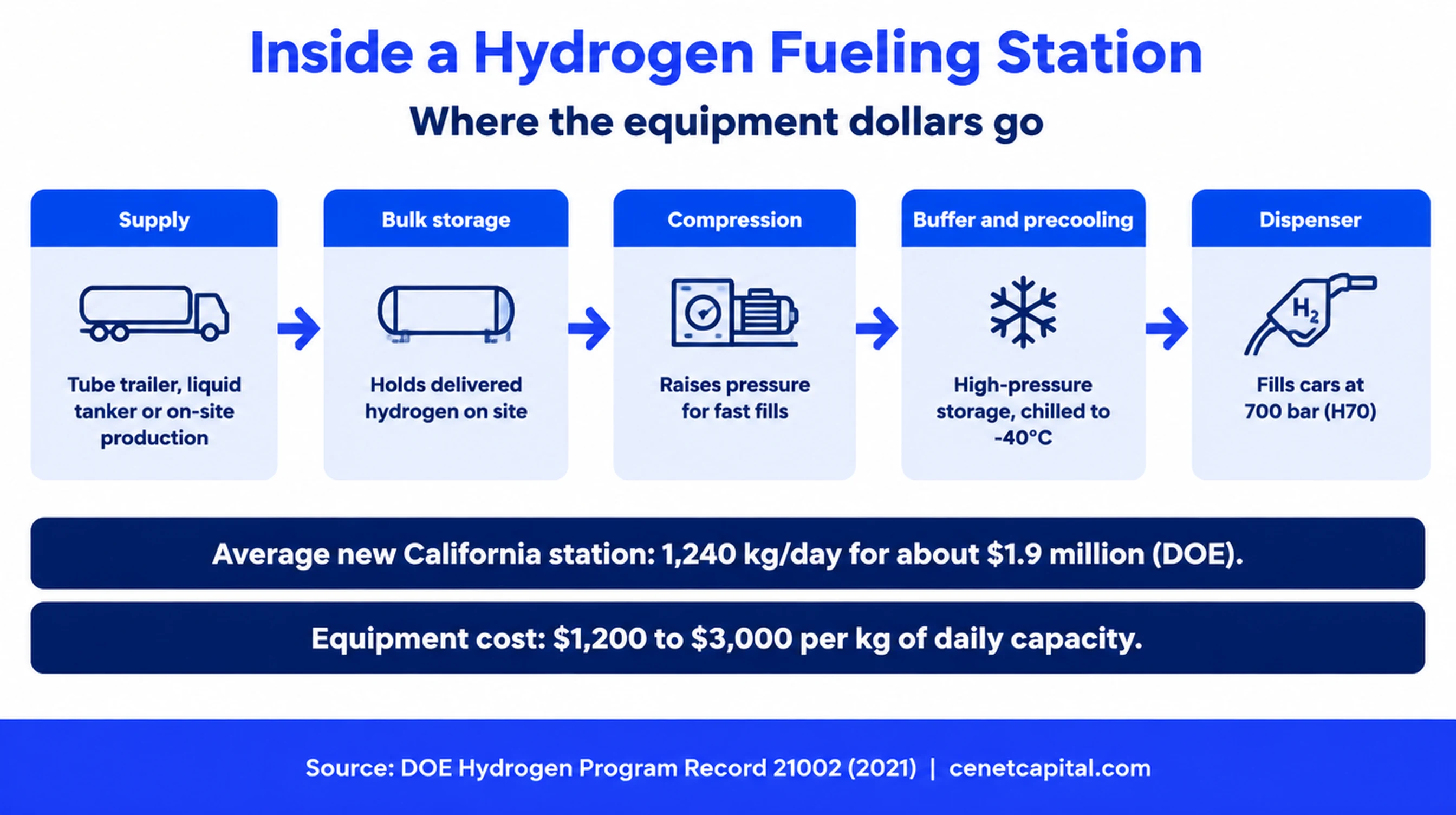
Hydrogen station costs come from five systems: hydrogen supply, bulk storage, compression, high-pressure buffer storage with precooling, and the dispensers. How hydrogen arrives matters most. Liquid-supplied stations cost more up front but deliver more capacity, while tube-trailer stations are cheaper and smaller.
Supply mode is the biggest swing factor in hydrogen fuel station cost. Light-duty stations fill cars at 700 bar under the SAE J2601 protocol, which means compressing hydrogen to very high pressure and chilling it to about -40°C so the tank doesn’t overheat during a fast fill. In DOE’s dataset, the larger liquid-supplied stations had four fueling positions and the tube-trailer stations had two.
A few stations make hydrogen on site with an electrolyzer, which adds equipment cost but removes delivery costs. On-site production is also the only way a station operator can claim the clean hydrogen production credit, covered in our hydrogen electrolyzer guide.
How much does a heavy-duty hydrogen station cost?
A heavy-duty hydrogen fueling station for trucks costs an estimated $9 million to $13 million to build, about five times a light-duty station. Truck stations need much more storage and compression because a single fuel cell truck can hold several times the hydrogen of a car, and fleets fill on tight schedules.
The estimate comes from the California Energy Commission’s freight corridor assessment under SB 671, as summarized in an Assembly committee analysis. It projects that California needs 800 to 850 public heavy-duty hydrogen stations by 2035, for a combined $10 billion to $15 billion in public and private investment. Utility coordination is a gating item, because compressors draw significant power.
For heavy-duty stations, a fleet supply contract with a creditworthy trucking company or port operator usually comes before construction. That’s the same logic as any offtake agreement: lenders want contracted demand before they fund the build.
Why does hydrogen cost $36 per kg at the pump?
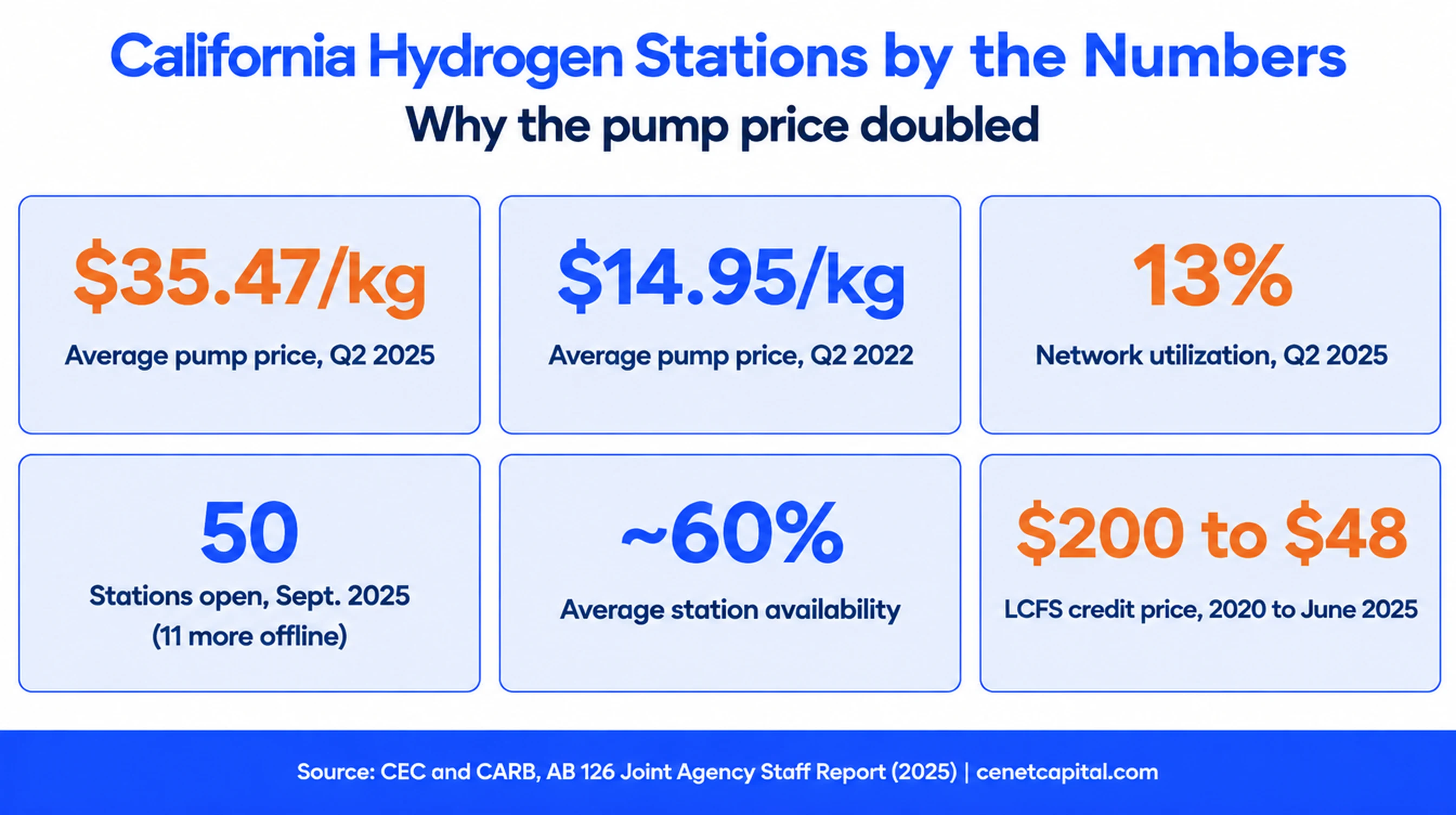
Hydrogen averaged $35.47 per kg at California stations in the second quarter of 2025, more than double the $14.95 of 2022. Station developers blame higher natural gas and delivery costs, inflation, and a collapse in Low Carbon Fuel Standard (LCFS) credit prices, which used to subsidize operations. Low utilization spreads fixed costs over few kilograms.
The California Energy Commission’s 2025 AB 126 report says $36 per kg is roughly like paying $14.40 for a gallon of gasoline, after accounting for fuel cell efficiency, and up to $180 to fill an empty tank. LCFS credits that sold for about $200 when stations were funded fell to around $48 by June 2025.
Utilization is the hidden driver. Stations dispensed just 13% of nameplate capacity in the second quarter of 2025, and about 18% on average since 2015. The chart below shows how much capital cost each kilogram carries at different utilization levels for DOE’s two station types.
At 13% utilization, capital alone adds $4.48 to every kg. That's before delivered hydrogen, power and maintenance, which make up most of today's $35+ pump price.
Capital recovery only, at 8% over 15 years. Station costs from DOE Hydrogen Program Record 21002 (2016 dollars); utilization from the CEC's 2025 AB 126 report (13% in Q2 2025, about 18% average since 2015). Click a bar to pin it.
How many hydrogen stations are open in California?
California had 50 open retail hydrogen stations as of September 2, 2025, plus 11 more that had been offline for at least 30 days. Average network availability was only about 60%. The state’s 14,128 registered fuel cell cars could all be served on paper, but outages and closures left some regions short.
The network has shrunk from its plans. Shell cancelled all 50 of its planned stations in 2024 and closed seven open ones, and Iwatani cancelled 11. Average daily dispensing fell 30% in a year, to 4,224 kg per day in the second quarter of 2025, down from a peak of 7,651 kg per day in late 2022. Supply has been fragile too: in June 2026, Air Products exited a planned Arizona green hydrogen facility.
Station developers still forecast 112 stations by 2030, and the CEC has invested $174 million in light-duty hydrogen infrastructure. Our report on hydrogen hubs in 2026 covers the supply side.
Can a hydrogen station still claim the 30C tax credit?
Only if it was placed in service by June 30, 2026. The 30C alternative fuel refueling property credit pays 30% of cost, up to $100,000 per item, for hydrogen dispensers and storage in eligible census tracts. The One Big Beautiful Bill Act ended it after that date, but earlier stations can still claim or sell it.
30C is an investment tax credit (ITC) for refueling equipment. Businesses get 30% with prevailing wage and apprenticeship, or 6% without. The Department of Energy’s Alternative Fuels Data Center explains that each fuel dispenser and each hydrogen storage unit counts as a separate item, so a station with several dispensers can earn well over $100,000. The site must be in a low-income or non-urban census tract.
The credit is claimed on Form 8911 for the year the property was placed in service. Owners without enough tax liability can sell it for cash, as our 30C tax credit guide explains. Use the calculator below to estimate a station’s credit item by item.
The $100,000 per-item cap binds: each item costs about $466,667, so 30% would be $140,000. More separately counted items raise the total.
Illustrative only. Splits cost evenly across items; your cost segregation decides the real per-item basis. Presets use DOE Hydrogen Program Record 21002 and the CEC SB 671 heavy-duty range. Claimed on Form 8911. Confirm with your tax advisor.
What other incentives help pay for a hydrogen station?
Beyond 30C, hydrogen stations rely on state grants, California’s LCFS program and, for stations that make their own hydrogen, the 45V clean hydrogen production credit. LCFS pays infrastructure credits based on a station’s capacity and uptime, on top of credits for the fuel it dispenses.
CARB’s hydrogen refueling infrastructure program had approved 79 light- and medium-duty stations and 8 heavy-duty stations for infrastructure crediting as of August 17, 2026. The CEC has also allocated nearly $120 million for medium- and heavy-duty stations.
A station with an on-site electrolyzer can claim the 45V production tax credit (PTC) if construction begins before January 1, 2028, worth up to $3.28 per kg in 2026 for the cleanest hydrogen. Our 45V guide explains the tiers, and hydrogen price per kg covers production costs.
Is a hydrogen fueling station a good investment in 2026?
For light-duty retail stations, it’s hard to make the numbers work in 2026. Utilization is low, LCFS prices are weak and the 30C credit is gone for new projects. Heavy-duty and fleet stations with contracted demand are the stronger case, especially when paired with on-site production that can earn 45V.
The math in the chart above shows why. A $1.4 million tube-trailer station at 13% utilization carries roughly $4.48 of capital cost in every kilogram, but at 80% that falls below $1. Stations built around a guaranteed fleet customer, such as transit buses, port drayage trucks or forklifts, can run near capacity from the start.
If you already own a station placed in service by June 30, 2026, the 30C credit is still worth claiming. Owners who can’t use it can sell it to a corporate tax buyer for cash.
Sources
U.S. Department of Energy, Hydrogen Program Record 21002: Hydrogen Fueling Stations Cost (2021)
California Energy Commission and California Air Resources Board, Joint Agency Staff Report on Assembly Bill 126: 2025 Annual Assessment of the Hydrogen Refueling Network
California Assembly Utilities and Energy Committee, AB 2505 (Carrillo) bill analysis (2026)
U.S. Department of Energy, Alternative Fuels Data Center, Alternative Fuel Infrastructure Tax Credit
Internal Revenue Service, About Form 8911
California Air Resources Board, LCFS ZEV Infrastructure Crediting
Air Products and Chemicals, Form 8-K, Item 2.06 Material Impairments (2026)
Frequently Asked Questions
How much does it cost to build a hydrogen fueling station?
About $1.4 million for a 770 kg per day tube-trailer station and $1.9 million to $4.2 million for larger liquid-supplied stations, in DOE's review of 111 California projects. The average was $1.9 million for 1,240 kg per day. Heavy-duty truck stations are estimated at $9 million to $13 million.
Why is hydrogen fuel so expensive in California?
How long does it take to fill a hydrogen car?
Can I still get the 30C tax credit for a hydrogen station?
Can Cenet Capital help sell a hydrogen station's tax credits?
Own a hydrogen station? Claim or sell your 30C
Cenet Capital helps hydrogen station owners confirm 30C eligibility for property placed in service by June 30, 2026 and sell the credit to corporate tax buyers for cash. Tell us about your station.

More Insights