

Buying & Selling Credits
A CFO's tax credit purchase checklist: when buying clean energy credits pays, how to size and time it, diligence, recapture, the agreement and ASC 740.
Author -
Paulestini Francois
Published -
READ TIME
Buying clean energy tax credits can cut a company's federal tax bill by 7 to 9 cents on every dollar, but only if the deal is sized, timed and checked properly. The decision belongs to the CFO, and it isn't only a tax question. Here's a checklist for a tax credit purchase: when it makes sense, how much to buy and when to pay, the diligence to require, who carries recapture risk, what the agreement needs, and how to book it.
QUICK ANSWER
A tax credit purchase makes sense when your company will owe federal income tax this year, can pay cash before filing, and can verify the credit. Credits traded at about 91 to 93 cents per dollar in mid-2026. Size the purchase to the section 38 limit, check the credit amount and recapture terms, and get indemnity.
KEY FACTS
What is section 6418? The provision that allows a one-time transfer of tax credits from eligible project owners to unrelated buyers for cash.
Is the discount on purchasing tax credits taxable? No. A buyer who pays $9 for $10 of credit has no gross income on the $1 difference, and the $9 isn't deductible.
How much tax can purchased credits offset? The first $25,000 of tax plus 75% of the rest under section 38(c), after other credits.
Who bears tax credit recapture? The buyer, for transferred 48, 48E, 48C and 45Q credits, pro rata if the seller kept part.
What is the penalty for an overstated credit? You repay the excess plus 20%, unless you show reasonable cause.
How does accounting for transferable tax credits work? Under Deloitte's reading of ASC 740, a deferred tax asset for the credit and a deferred credit for the discount.
Should your company make a tax credit purchase?
Usually yes, if three things are true: you’ll owe real federal income tax this year, you have cash to pay before you file, and someone on your team can run the diligence. Clean energy credits traded at about 91 to 93 cents per dollar in mid-2026, so every dollar of credit cuts a dollar of tax for less.
Under section 6418, a project owner can sell all or part of an eligible credit to an unrelated buyer for cash. The buyer is then treated as the taxpayer for that credit. The price you pay isn’t deductible, and under 26 CFR 1.6418-2 the discount isn’t taxable income either.
Crux’s mid-year 2026 report put average pricing at $0.913 for investment tax credits and $0.930 for production tax credits, with $21 billion of transfers in the first half and $47.5 billion to $49 billion expected for the year, as pv magazine reported. Our corporate buyer’s guide covers the mechanics. This checklist covers the decisions a CFO has to own.
One group should usually pass. The IRS transferability FAQs say individuals, estates, trusts, closely held C corporations and personal service corporations are subject to the passive activity rules for purchased credits. That generally means the credits only offset tax on passive income, which most of those buyers don’t have.
How much tax credit purchase capacity does your company have?
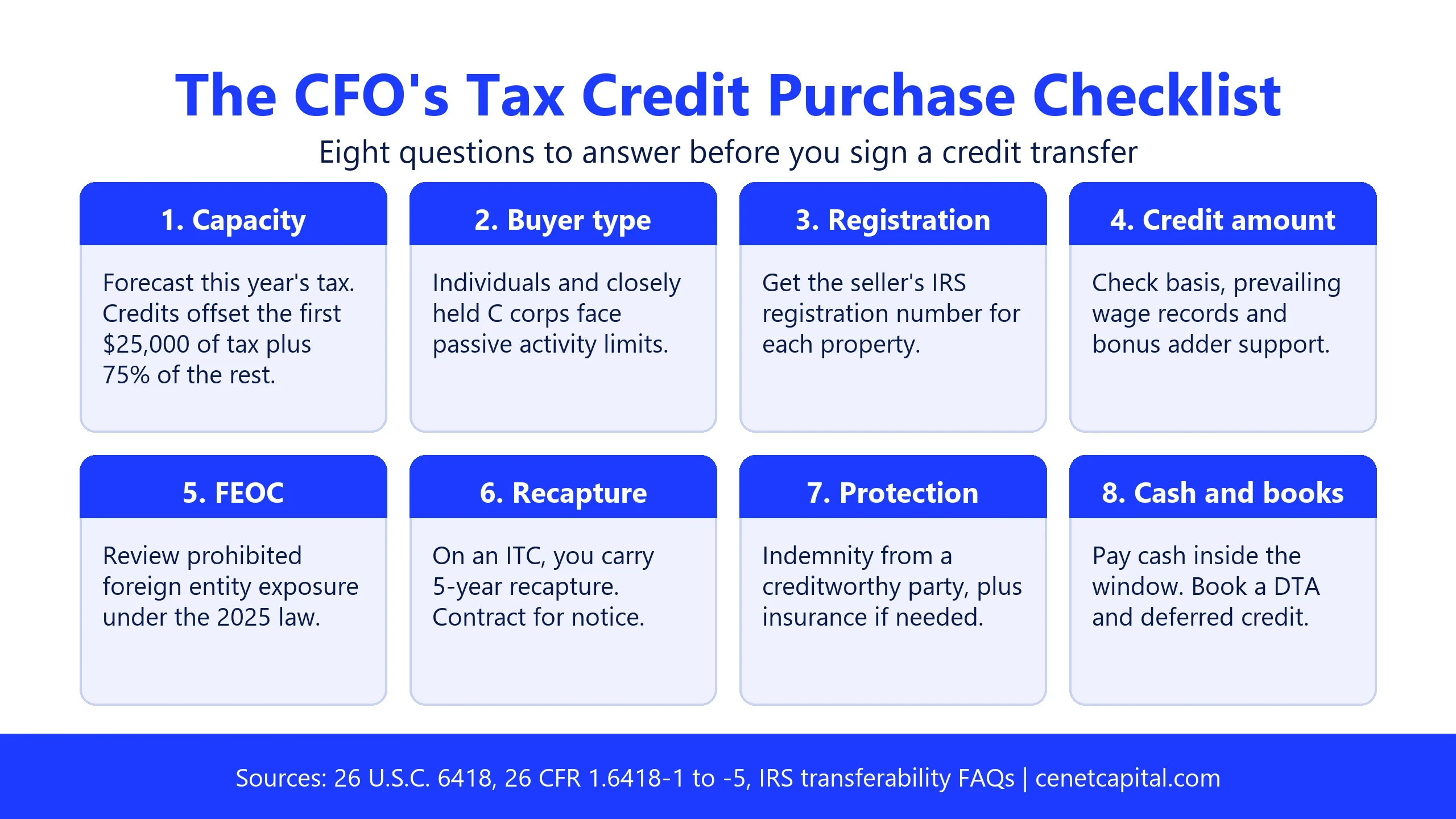
Start with this year’s forecast federal income tax, not last year’s return. Under section 38(c), energy credits can offset the first $25,000 of tax plus 75% of the rest, after any other credits you already claim. A company expecting $8 million of tax can use about $6 million of purchased credits this year.
The limit comes from 26 U.S.C. 38(c). Clean energy credits are “specified credits,” so tentative minimum tax is treated as zero when you apply it. Our guide to Form 3800 instructions shows where the math lands on the return.
Timing matters as much as size. Section 6418(d) says a purchased credit is taken into account in your first tax year ending with or after the seller’s tax year in which the credit was determined. If you overbuy, the excess generally carries back three years and forward 22 under section 39(a)(4), which the final rules extend to buyers in 26 CFR 1.6418-5(h). A carryforward ties up cash, so most CFOs size the purchase to a forecast they would defend in a board meeting, then top up later in the year. Our buyer math guide works through the savings.
When should you pay for the credits?
Cash has to change hands between the first day of the seller’s tax year that generates the credit and the due date of the transfer election statement. You can sign a forward commitment earlier, as long as every payment falls inside that window. You can also lower your quarterly estimated payments once you’ve bought, or plan to buy, the credit.
The payment window is in the definition of cash in 26 CFR 1.6418-1(f), which also requires payment by check, wire, ACH or another transfer of immediately available funds. Anything other than cash kills the election.
Question 12 of the IRS FAQs says a buyer may count a purchased or intended credit when calculating estimated payments, no earlier than the seller could. You stay liable for underpayment penalties under section 6655 if the deal slips, so build that risk into the forecast.
What due diligence should a CFO require before a tax credit purchase?
Treat it like buying an asset the IRS can audit for years. Confirm the registration number, unrelated-party status and credit amount, then test what drives that amount: cost basis for investment credits, prevailing wage records, bonus adders and foreign entity exposure. If the credit turns out overstated, you repay the excess plus a 20% penalty.
Registration number: every transferred credit needs one from IRS pre-filing registration, and you report it on Form 3800, per the IRS elective pay and transferability page.
Unrelated parties: section 6418(a) bars transfers between related parties under sections 267(b) and 707(b)(1). Get a written attestation that covers consolidated group members.
Credit amount: for an investment credit, review the cost basis and an independent appraisal. For any credit, check the prevailing wage and apprenticeship records, because missing them can cut the credit to one-fifth. Check the support for bonus adders such as domestic content too.
Foreign entity risk: the 2025 law added FEOC rules. Crux reports that tax credit insurance generally excludes this risk until Treasury guidance arrives, so you may be carrying it yourself.

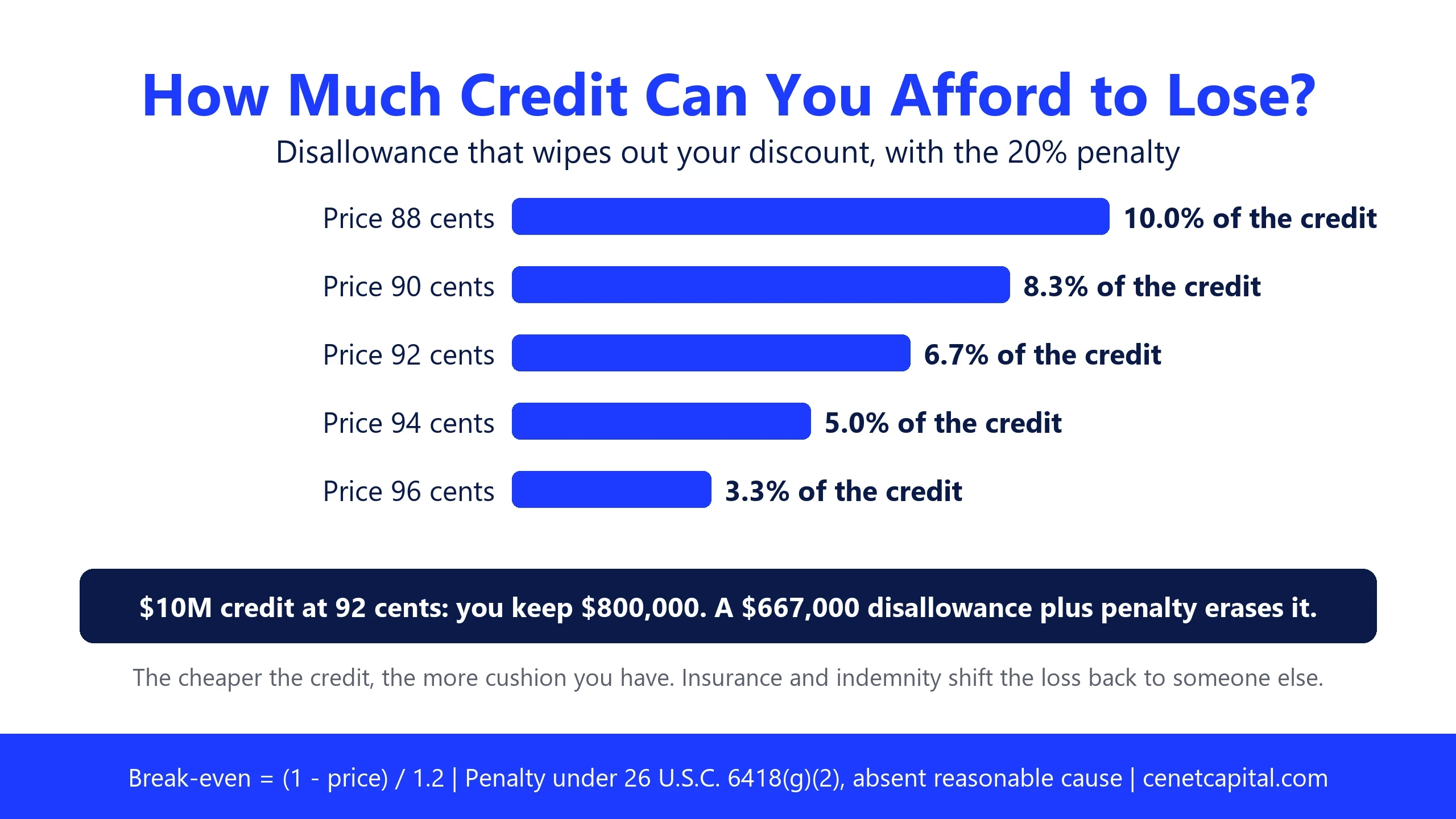
The penalty is what makes diligence worth paying for. Under section 6418(g)(2), an “excessive credit transfer” is any amount you claim above what the seller could have claimed. It increases your tax by that amount plus 20%, unless you show reasonable cause. At 92 cents, losing more than 6.7% of the credit erases your entire discount.
Who carries tax credit recapture risk after the transfer?
You do. If investment credit property is sold or stops qualifying within five years of being placed in service, the recapture tax falls on the buyer, not the seller. Recapture starts at 100% of the credit in year one and drops 20 points each year. Buyers of 45Q carbon capture credits carry that credit’s recapture risk too.
The final rules in 26 CFR 1.6418-5(d)(3) make the buyer responsible for recapture of section 48, 48E and 48C credits, split pro rata if the seller kept part of the credit. IRS FAQ Question 13 applies the same rule to transferred 45Q credits. The recapture schedule of 100%, 80%, 60%, 40% and 20% comes from 26 U.S.C. 50(a). A recapture event isn’t an excessive credit transfer, so the 20% penalty doesn’t apply, but you still pay back the credit.
Production tax credits work differently. They’re earned on power already generated and sold, so there’s no five-year clawback. For investment credits, the protection is contractual: the seller must notify you of a recapture event, and you want covenants, an indemnity and often tax credit insurance behind that notice.
Is this credit deal ready to sign?
Tick what you've already received from the seller. Tap any item to see why it matters.A general guide, not tax or legal advice. Break-even assumes any disallowed credit is repaid with the 20% excessive credit transfer penalty and no insurance recovery. Review every deal with your tax advisor.
Get a diligenced deal →What goes into a tax credit purchase agreement?
The tax credit purchase agreement sets the price and payment dates. It also carries the protections that make the deal safe to sign: seller representations on eligibility and credit amount, an indemnity backed by a creditworthy party, recapture notice and operating covenants, insurance terms, and the information you need to file.

Price and schedule: cents per dollar, closing dates and any forward-commitment terms, all inside the cash window.
Representations and indemnity: who pays if the credit is reduced, and who stands behind the seller if it’s a project company with no other assets.
Filing deliverables: the transfer election statement, attached to both parties’ returns, lists the credit, the amount, the cash paid and the dates paid, and the registration number under 26 CFR 1.6418-2(b)(5).
OPAL Fuels filed the September 2024 tax credit purchase agreement between its subsidiary OPAL Paragon LLC and Apollo Management Holdings with the SEC. Its sections on representations, covenants, the transfer election and seller indemnification are a useful map before your counsel drafts one.
How do you account for transferable tax credits?
Under Deloitte’s reading of ASC 740, a buyer records a deferred tax asset for the full credit and a deferred credit for the discount. The deferred credit turns into an income tax benefit as the credits are used on the return. Your savings show up in the tax line, not as pretax income.
Deloitte’s Accounting Spotlight explains that the deferred credit isn’t a deferred tax liability. The asset is tested for realizability like any other deferred tax asset. There’s no standard written specifically for accounting for transferable tax credits, so agree the treatment with your auditors before closing. Also assess whether any part of the credit is an uncertain tax position, since you’re now the taxpayer on the return.
Do you need a full-time CFO to buy tax credits?
No. The work comes down to a tax forecast, a diligence review and a contract, all on a deadline. Large companies run it through their tax department. Mid-sized companies without a full-time CFO often bring in a fractional CFO to build the forecast, set the maximum price and coordinate the tax advisor and counsel.
If you’re weighing that route, Victor Parrish’s guide to what a fractional CFO actually does explains when part-time finance leadership makes sense. Whoever owns the decision should also own the follow-through. That means putting the Form 3800 filing, the registration number and every recapture notice date on the calendar, then checking the deal against the current pricing ranges.
Sources
Legal Information Institute, 26 U.S. Code 6418, Transfer of certain credits
Legal Information Institute, 26 CFR 1.6418-1, Definitions
Legal Information Institute, 26 CFR 1.6418-2, Rules for making transfer elections
Legal Information Institute, 26 CFR 1.6418-5, Special rules
Legal Information Institute, 26 U.S. Code 38, General business credit, 26 U.S. Code 39 and 26 U.S. Code 50
Internal Revenue Service, Elective pay and transferability frequently asked questions: Transferability
pv magazine USA, Clean energy capital expenditures on track for $180 billion in 2026, reports Crux
Deloitte, Accounting for Transferable Tax Credits
U.S. Securities and Exchange Commission, OPAL Fuels tax credit purchase agreement, September 13, 2024
Frequently Asked Questions
Should my company make a tax credit purchase?
It usually makes sense if you'll owe meaningful federal income tax this year, can pay cash before you file and can verify the credit. Credits traded at about 91 to 93 cents per dollar in mid-2026. Individuals and closely held C corporations face passive activity limits that often rule purchases out.
How much in tax credits can a company buy?
What should a tax credit purchase agreement include?
Who pays if a purchased tax credit is recaptured?
Does Cenet Capital sell tax credits to corporate buyers?
Buying credits this year? Start with a clean file.
Cenet Capital sells fully diligenced, insurable clean energy credits to corporate buyers, with registration numbers, basis support and indemnity terms ready before you sign. Tell us your tax year and target amount.

More Insights