
Credit Guides
How steam methane reforming turns natural gas into hydrogen, what grey and blue SMR hydrogen cost, how SMR compares with ATR, and when it can earn 45V or 45Q.
Author -
Paulestini Francois
Published -
READ TIME
Almost all the hydrogen the U.S. uses today comes out of one kind of machine: the steam methane reformer. Here's how steam methane reforming works, what it costs, how it compares with autothermal reforming, and what it takes for SMR hydrogen to earn the 45V or 45Q tax credit.
QUICK ANSWER
Steam methane reforming (SMR) makes hydrogen by reacting natural gas with 700°C to 1,000°C steam over a nickel catalyst, then shifting the carbon monoxide into more hydrogen and CO2. It's the cheapest route, about $1.06 per kg in NETL's study, but emits roughly 12 kg of CO2e per kg unless the CO2 is captured.
KEY FACTS
What is SMR hydrogen? Hydrogen made by steam methane reforming of natural gas, the source of most U.S. hydrogen.
What is the steam methane reforming process? Desulfurize the gas, reform methane with steam, run the water-gas shift, then purify the hydrogen with pressure-swing adsorption.
What is a steam methane reformer? A furnace full of catalyst-filled tubes where methane and steam react, heated by burning more natural gas.
What is grey hydrogen? Hydrogen from natural gas with the CO2 vented. The IEA puts it at 10 to 14 kg CO2e per kg.
What is autothermal reforming? A reformer that burns part of the methane with oxygen inside the reactor, concentrating CO2 for easier capture.
Can SMR earn the 45V PTC or the 45Q tax credit? It can earn one or the other. 45V needs lifecycle emissions under 4 kg, and a plant claiming 45Q can't claim 45V.
What is steam methane reforming?
Steam methane reforming (SMR) is the most common way to make hydrogen. It reacts natural gas with high-temperature steam over a nickel catalyst to produce hydrogen and carbon monoxide, then converts the carbon monoxide into more hydrogen and CO2. Most hydrogen made in the U.S. today comes from steam methane reformers.
The Department of Energy calls SMR a mature production process, and it’s the backbone of hydrogen supply for oil refineries and ammonia plants. The U.S. makes about 10 million metric tons of hydrogen a year, and roughly 95% of it comes from natural gas reforming.
That scale is also SMR’s problem. Without carbon capture, every kilogram of hydrogen comes with roughly 9 to 10 kg of CO2 from the plant, plus methane leaked upstream. This guide explains how a steam methane reformer works, what it costs, how it compares with autothermal reforming, and when SMR hydrogen can earn federal tax credits.
How does steam methane reforming work?
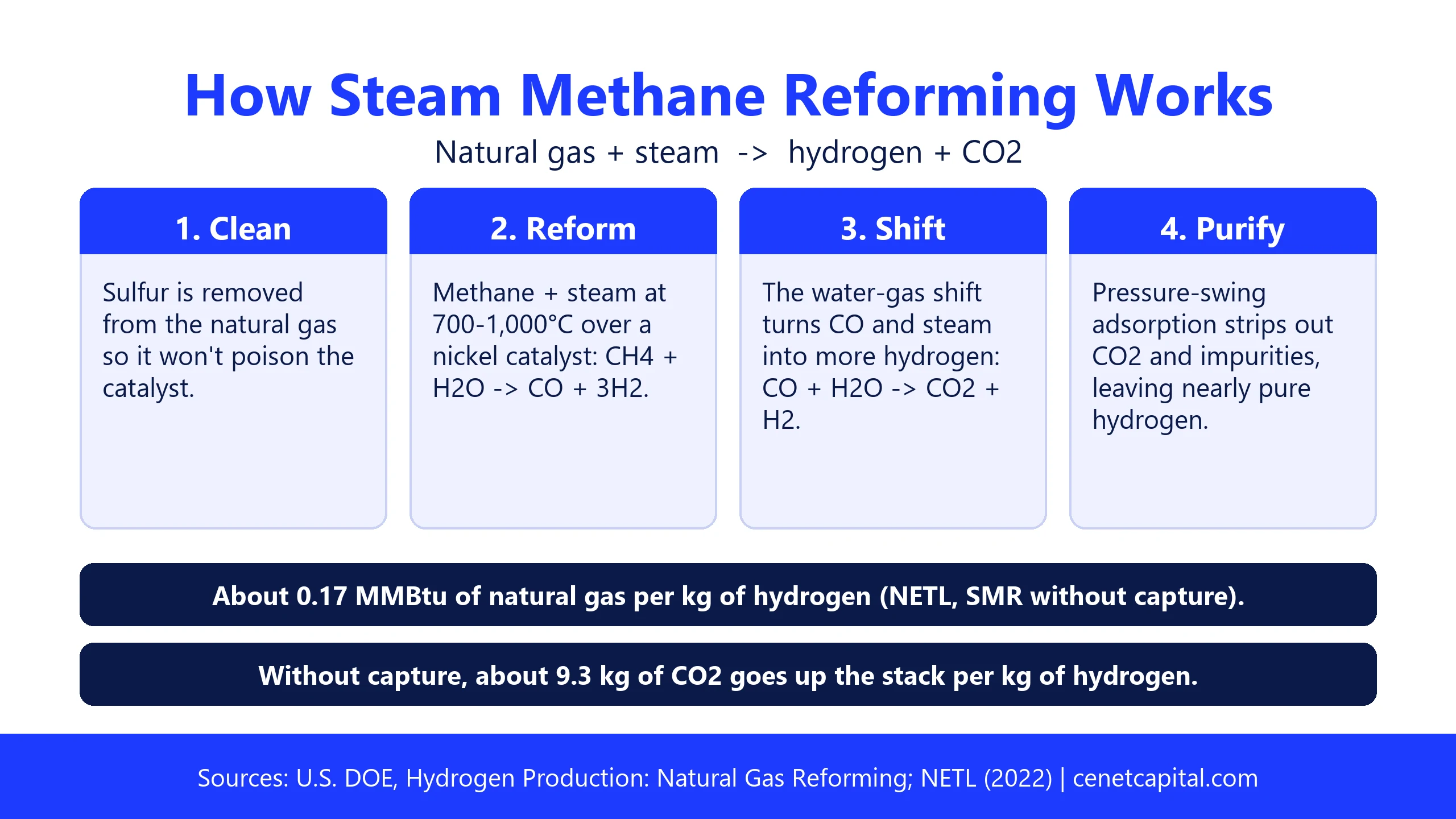
A steam methane reformer works in four steps. Sulfur is removed from the natural gas. Methane and steam react at 700°C to 1,000°C over a catalyst to make hydrogen and carbon monoxide. A water-gas shift reaction turns the carbon monoxide into more hydrogen and CO2. Pressure-swing adsorption then purifies the hydrogen.
The core steam methane reforming reaction is CH4 + H2O → CO + 3H2. It’s endothermic, so the reformer tubes sit inside a furnace that burns extra natural gas to supply the heat. The water-gas shift reaction, CO + H2O → CO2 + H2, adds hydrogen and gives off a little heat. Overall, one molecule of methane and two of water yield four molecules of hydrogen and one of CO2.
That design creates two CO2 streams. One is concentrated process CO2 from the shift reaction, which is relatively easy to capture. The other is dilute flue gas from the furnace, which is harder and costlier to capture. In the National Energy Technology Laboratory’s 2022 study, an SMR without capture used about 0.17 MMBtu of natural gas per kg of hydrogen.
What is grey hydrogen?
Grey hydrogen is hydrogen made from natural gas, usually by steam methane reforming, with the CO2 released to the air. It’s the cheapest and most common hydrogen in the world. Including upstream methane leaks, the IEA puts grey hydrogen at 10 to 14 kg of CO2-equivalent per kg of hydrogen.
That range comes from the IEA’s hydrogen emissions intensity report. When the CO2 is captured and stored, the same process makes blue hydrogen. Our guide to the colors of hydrogen explains the full spectrum, and our blue hydrogen tax credit guide covers capture economics in depth.
NETL’s lifecycle analysis found similar numbers for hydrogen from natural gas. Its SMR without capture came to 12 kg of CO2e per kg, with about 9.3 kg from the plant stack and most of the rest from producing and transporting the gas. If the plant can use its excess steam elsewhere, that falls to about 10 kg.
How much does steam methane reforming cost?
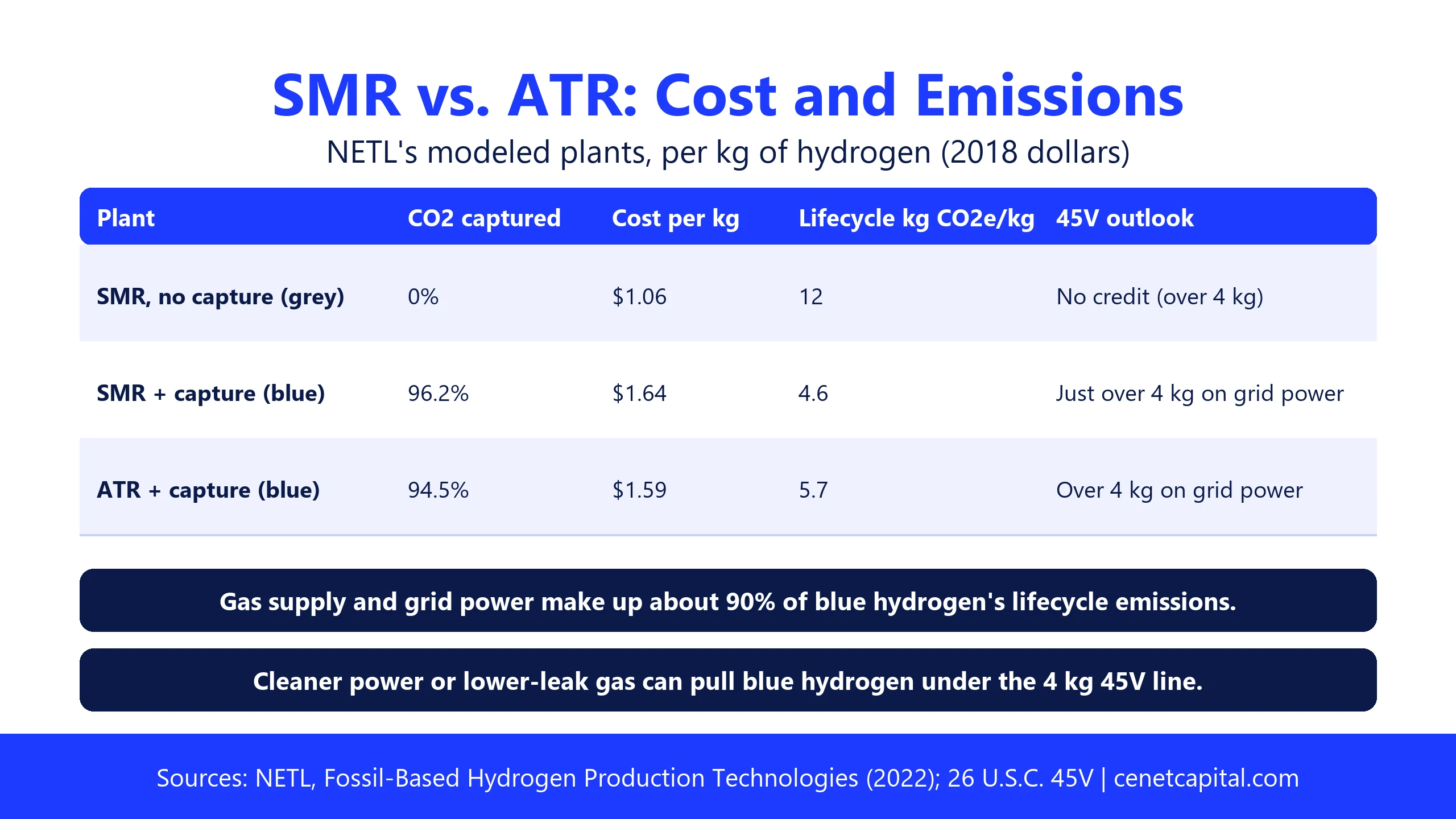
Grey hydrogen from steam methane reforming costs about $1 to $1.50 per kg, depending mostly on the natural gas price. NETL’s 2022 study put a new SMR without capture at $1.06 per kg in 2018 dollars. Adding 96% carbon capture raised it to $1.64, and an autothermal reformer with capture came in at $1.59.
Fuel dominates the bill. In the NETL comparison, natural gas made up 49% to 73% of the levelized cost of the reforming plants, so every $1 per MMBtu change in the gas price moves hydrogen cost by roughly 17 to 19 cents per kg. Capture adds capital, power demand and CO2 transport and storage costs.
Federal credits can close much of that gap. The 45Q credit pays up to $85 per tonne of CO2 stored with prevailing wage met, or about 75 to 82 cents per kg of blue hydrogen. Compare that with the cost of electrolytic hydrogen per kg. Use the calculator below to price SMR hydrogen at your own gas price.
What does SMR hydrogen cost at your gas price?
Built on NETL's modeled plants. Pick a design, set your natural gas price, and see the cost per kg before and after the 45Q carbon capture credit.At $3.50 gas, 45Q brings blue hydrogen to $0.66 per kg, at or below grey hydrogen's $0.90. A plant that takes 45Q can't also claim 45V.
Illustrative only. NETL non-fuel costs are in 2018 dollars and assume a 90% capacity factor. 45Q at $85 per tonne for geologic storage with prevailing wage met.
Price my 45Q credits →Steam methane reforming vs. autothermal reforming: what’s the difference?
Autothermal reforming (ATR) heats the reaction from inside, by feeding oxygen that burns part of the methane in the reactor, instead of using an external furnace. That puts nearly all the CO2 into one concentrated stream, which makes capture easier. SMR needs separate capture on its furnace flue gas to reach high capture rates.
NETL modeled 96.2% capture for SMR and 94.5% for ATR, but real plants have done far worse so far. An IEEFA analysis found that no commercial-scale hydrogen plant with capture had captured even 80% of its CO2, and Shell’s Quest project in Alberta had reached 68%.
ATR needs an air separation unit for oxygen and more electricity, which is why its lifecycle emissions in NETL’s study were higher on grid power: 5.7 kg of CO2e per kg versus 4.6 for SMR with capture. ATR tends to win for very large new plants, while SMR dominates the existing fleet that could be retrofitted.
Can steam methane reforming qualify for the 45V tax credit?
Yes, but only with low lifecycle emissions. Unabated SMR is far above the 4 kg CO2e per kg ceiling for the 45V clean hydrogen production tax credit (PTC). With carbon capture, clean power and low-leak gas, SMR can reach the lower tiers, worth $0.656 to $1.095 per kg in 2026. The plant can’t also claim 45Q.
45V is calculated with the 45VH2-GREET model, which includes SMR with optional carbon capture, fed by fossil gas or renewable natural gas. Under section 45V(d)(2), no 45V credit is allowed at a facility whose capture equipment earned 45Q. The facility must also begin construction before January 1, 2028.
NETL’s numbers show why the inputs matter. Gas supply and grid electricity made up about 90% of the lifecycle emissions of its capture cases. Swap in clean power backed by qualifying energy attribute certificates, and SMR with capture drops from 4.6 to about 3.4 kg, inside the 20% tier. Try it in the chart below.
Where grey and blue hydrogen land against the 45V tiers
NETL's lifecycle emissions per kg of hydrogen, split by source. Switch to clean power or change upstream gas emissions to see what moves a plant under the 4 kg line.As modeled by NETL, both blue designs sit just above the 4 kg ceiling. Clean power or lower-leak gas is what moves them under it.
Source: NETL, Comparison of Commercial, State-of-the-Art, Fossil-Based Hydrogen Production Technologies (2022). Your 45V rate comes from 45VH2-GREET, which uses different assumptions.
Can renewable natural gas make SMR hydrogen cleaner?
Yes. Under the final 45V rules, a steam methane reformer can use renewable natural gas (RNG) from landfills, wastewater or animal manure, or coal mine methane, and get credit for the emissions it avoids. Treasury dropped a proposed “first productive use” test. Book-and-claim RNG certificates can’t be used until after 2026.
Instead of first productive use, the final regulations assign an “alternative fate” to each methane source, as Baker Botts explains. Landfill gas, wastewater gas and coal mine methane are assumed to be flared otherwise. Manure-based RNG is benchmarked against the national average of manure management practices, which can give it a larger emissions benefit.
Until a qualifying gas certificate registry is recognized, producers must show physical delivery, such as a direct pipeline from the RNG supplier. After that, RNG bought through the pipeline system can count. RNG can also earn the 45Z clean fuel credit if it’s sold as transportation fuel, so hydrogen producers compete with fuel buyers for supply.
What’s next for steam methane reformers?
Existing SMRs will keep supplying refineries and ammonia plants, but new blue hydrogen projects are struggling. Air Products cancelled its Louisiana blue hydrogen and ammonia complex in June 2026, expecting up to $2.9 billion in charges. Projects that can begin construction before 2028 can still lock in 45V or 45Q.
Air Products said the project’s expected returns no longer met its investment criteria. For owners of existing reformers, the more practical path is retrofitting capture on the concentrated process CO2 stream and claiming 45Q, which pays for 12 years from when the capture equipment is placed in service.
Either way, the credits are valuable and transferable. Producers can sell 45V credits or 45Q credits to corporate tax buyers for cash, and our 45Q tax credit guide covers the capture side in detail.
Sources
U.S. Department of Energy, Hydrogen Production: Natural Gas Reforming
National Energy Technology Laboratory, Comparison of Commercial, State-of-the-Art, Fossil-Based Hydrogen Production Technologies (2022)
IEEFA (Schlissel and Juhn), Blue Hydrogen: Not Clean, Not Low Carbon, Not a Solution
Legal Information Institute, 26 U.S. Code 45V
Baker Botts, Final Section 45V Clean Hydrogen Production Tax Credit Regulations: A Closer Look (February 2025)
Chemical Processing, Air Products Cancels $4.5B Louisiana Clean Energy Project
International Energy Agency, Towards hydrogen definitions based on their emissions intensity (2023)
Frequently Asked Questions
What is steam methane reforming used for?
Steam methane reforming makes most of the hydrogen used by oil refineries, ammonia and fertilizer plants, and methanol producers. It also makes syngas, the hydrogen and carbon monoxide mixture used to build other chemicals.
Why is steam methane reforming bad for the environment?
What is the difference between steam reforming and autothermal reforming?
How much does steam methane reforming cost per kg?
Can Cenet Capital help sell 45V or 45Q credits from a reformer?
Running a reformer? Turn capture into cash
Cenet Capital helps hydrogen producers compare 45V and 45Q for reformers with carbon capture and sell the credits to corporate tax buyers. Tell us your plant, capture plan and timeline.

More Insights