The domestic content bonus adds 10 points to the ITC or 10% to the PTC. See the two tests, 2026 thresholds, how to calculate U.S. content, elective pay and a checker.
Author -
Paulestini Francois
Published -
READ TIME
The domestic content bonus is one of the most valuable adders in clean energy tax credits, and one of the hardest to prove. It can lift a 30% investment credit to 40%, and for cities, schools and nonprofits using elective pay it can decide whether a larger project gets paid at all. Here's what the bonus requires, the threshold for your construction start year, how to calculate U.S. content with the IRS safe harbor tables, what the bonus is worth, and a checker to test your own component mix.
QUICK ANSWER
The domestic content bonus adds 10 percentage points to a clean energy investment tax credit (30% becomes 40%) or 10% to a production tax credit. To qualify, 100% of structural steel and iron must be U.S.-made and at least 50% of manufactured product costs must be U.S.-made for projects beginning construction in 2026.
KEY FACTS
Two tests: All structural steel and iron must be produced in the U.S., and an adjusted percentage of manufactured product costs must be U.S.-made.
Thresholds: 40% for construction beginning by June 15, 2025, 45% for the rest of 2025, 50% in 2026 and 55% after 2026 (offshore wind 20%, 27.5% and 35%).
How to calculate: Divide the cost of U.S.-made manufactured products by total manufactured product cost, using actual costs or the Notice 2025-08 elective safe harbor table.
What it's worth: About $200,000 on a $2 million solar project using the ITC, or roughly $9.5 million over 10 years for a 100 MW wind farm on the PTC.
Elective pay: For tax-exempt owners of 1 MW+ facilities starting construction after 2025, missing domestic content eliminates the direct payment unless an exception applies.
What is the domestic content bonus credit?
The domestic content bonus is an add-on to the clean energy investment and production tax credits for projects built with U.S.-made steel, iron and manufactured products. It adds 10 percentage points to the investment tax credit (turning 30% into 40%) or increases the production tax credit by 10%. Projects that don’t meet prevailing wage and apprenticeship rules get a smaller 2-point ITC bonus. To qualify, all structural steel and iron must be made in the U.S., and a minimum share of the cost of manufactured products, 50% for projects beginning construction in 2026, must come from U.S. manufacturing.
The bonus applies under Sections 48 and 48E (investment credits) and 45 and 45Y (production credits). It also matters a great deal for nonprofits and government entities taking elective pay, because larger projects that don’t meet domestic content can see their direct payment cut or eliminated. The IRS’s main guidance is Notice 2023-38, with the simpler “elective safe harbor” in Notice 2024-41, updated by Notice 2025-08 in February 2025.
What are the domestic content requirements?
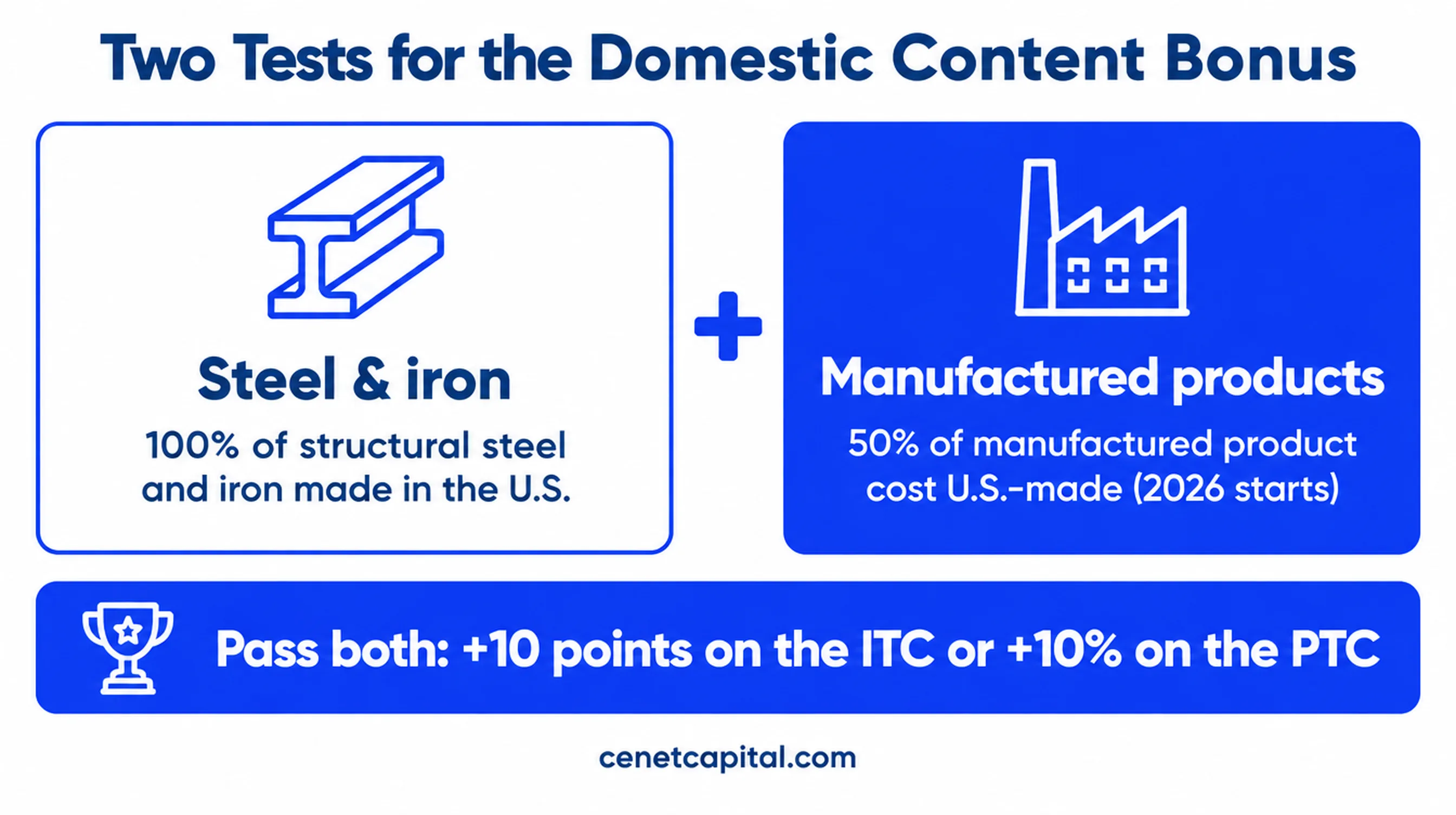
There are two tests, and a project must pass both.
Test | Requirement | Covers |
|---|---|---|
Steel and iron | 100% of structural steel and iron must be produced in the U.S. (all manufacturing processes, except metallurgical processes involving refining additives) | Foundations, piles, structural racking and other steel or iron that performs a structural function |
Manufactured products | The “adjusted percentage” of total manufactured product costs must be U.S.-made | Modules, trackers, inverters, batteries and other components |
A manufactured product counts as U.S.-made if it’s manufactured in the U.S. and enough of its own component cost is U.S.-sourced. Components such as solar cells, wafers and tracker parts each carry an assigned share of a product’s cost in the IRS safe harbor tables, so sourcing a domestic module with domestic cells can do much of the work.
What percentage of U.S. content is required?
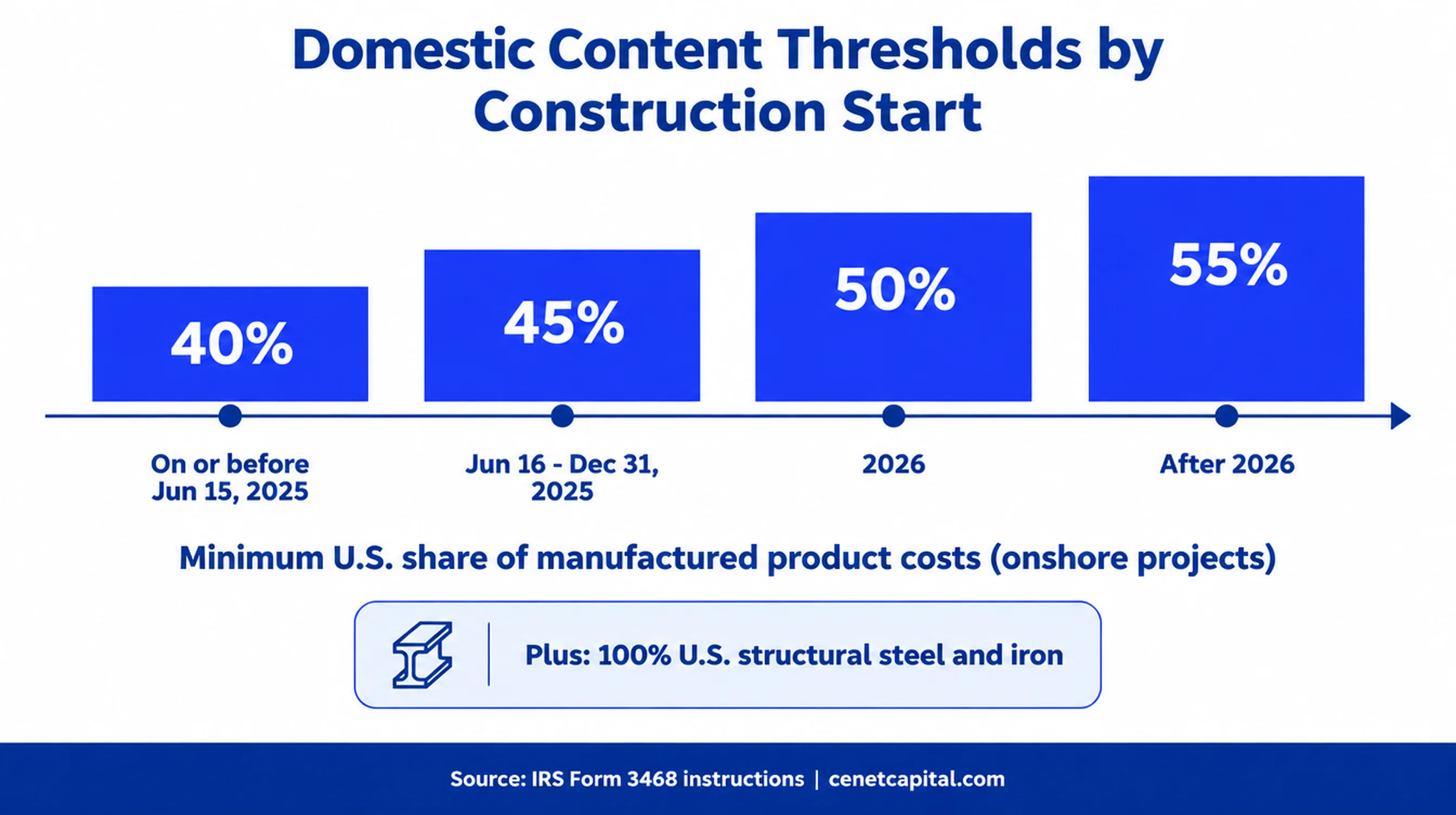
For projects beginning construction in 2026, at least 50% of manufactured product costs must be U.S.-made (35% for offshore wind), per the IRS’s 2025 Form 3468 instructions. The threshold depends on when construction began:
Construction begins | Onshore projects | Offshore wind |
|---|---|---|
On or before June 15, 2025 | 40% | 20% |
June 16 – December 31, 2025 | 45% | 27.5% |
2026 | 50% | 35% |
After 2026 (48E/45Y) | 55% | Rising further |
Because the bar keeps rising, a component mix that qualified a 2025 project may not qualify one that starts in 2027. Use the calculator below to test a project’s mix against the threshold for its start year.
Does your project qualify for the domestic content bonus?
Screening tool only. Default cost shares are illustrative; use the IRS elective safe harbor table (Notice 2025-08) or actual costs. Thresholds per the 2025 Form 3468 instructions; 55% applies to 48E/45Y construction after 2026.
Price my bonus credit →How do you calculate domestic content?
Divide the cost of U.S.-made manufactured products and components by the total cost of all manufactured products in the project. Under the elective safe harbor, you don’t need supplier cost data: you use the IRS’s assigned cost percentages for each category of component instead.
List every manufactured product in the project (modules, inverters, racking, trackers, batteries, transformers where applicable).
Assign a cost share using the Notice 2025-08 elective safe harbor table for your project type, or actual direct costs.
Mark which are U.S.-made using supplier certifications.
Add up the U.S. share and compare it with the threshold for your construction start year.
Confirm the steel and iron test separately; it’s pass/fail.
Example: a 2026 solar project where U.S.-made modules with U.S. cells account for 38% of manufactured product cost under the safe harbor table, and a U.S.-made tracker accounts for another 15%, reaches 53% and clears the 50% threshold, provided its structural steel is also U.S.-made.
How much is the domestic content bonus worth?
For an investment tax credit, 10 percentage points of eligible cost. For a production tax credit, 10% more credit every year for 10 years.
Project | Without bonus | With domestic content | Added value |
|---|---|---|---|
$2M commercial solar (ITC) | $600K | $800K | $200K |
$40M battery storage (ITC) | $12M | $16M | $4M |
100 MW wind (PTC, ~306,600 MWh/yr) | $9.5M/yr | $10.5M/yr | ~$9.5M over 10 years |
The bonus stacks with the energy community bonus. A solar or storage project with prevailing wage, an energy community location and domestic content earns a 50% ITC. Our investment tax credit guide shows how the adders combine, and the energy community guide covers the location bonus.
Why does domestic content matter for elective pay?
Tax-exempt and government entities taking the credit as a direct payment face a penalty if larger projects don’t meet domestic content. For facilities of 1 MW or more, the payment was reduced to 90% for construction starting in 2024 and 85% in 2025, and is eliminated entirely for construction starting after 2025, unless the project meets domestic content or qualifies for an exception. Exceptions apply if using U.S. products would increase total construction costs by more than 25%, or if the products aren’t available in sufficient quantity or quality. For a school district or city building solar in 2026, domestic content has effectively become a requirement, not a bonus.
Which components matter most for solar and storage?
For solar, modules (and the cells inside them) carry the largest share of manufactured product cost, followed by trackers or racking and inverters. For battery storage, the battery cells and modules dominate. That’s why the domestic content strategy for most projects starts with the biggest-ticket items.
Solar: a U.S.-assembled module with U.S. cells counts for much more than a U.S.-assembled module with imported cells. Domestic trackers, now widely available, add a meaningful share and also help with the steel test.
Storage: U.S. cell and module production has grown quickly, helped by the 45X manufacturing credit, but supply is still tight; plan procurement early.
Wind: towers, nacelles and blades all have U.S. supply, though foundations and steel requirements make the steel and iron test more demanding than for solar.
There’s a useful overlap with the foreign-entity rules: U.S.-made components often also help a project meet the material assistance test that applies to construction starting after 2025. See our FEOC rules guide and the 45X guide for how domestic manufacturing is incentivized.
What are the most common domestic content mistakes?
Using the wrong year’s threshold. The percentage is set by the beginning-of-construction year, which has to be documented.
Assuming “assembled in USA” means U.S.-made. A product’s own components also have to clear the test.
Forgetting the steel test. One imported structural component can fail the whole bonus.
Weak certifications. Generic supplier letters often don’t cover what the IRS requires.
Late procurement. Domestic components can have long lead times; locking them in after construction starts is often too late.
How do you document the domestic content bonus?
Supplier certifications for each manufactured product and for steel and iron, signed under penalties of perjury.
Calculation workpapers showing the safe harbor table or cost data used and the resulting percentage.
Domestic content certification statement attached to Form 3468 (line 9) for an ITC, or the production credit form for a PTC.
Construction start evidence, because it sets the threshold.
Credit buyers and insurers review this package closely, because a bonus that fails becomes an excessive credit transfer. Strong documentation protects your sale price. See our Form 3468 instructions for where the bonus is reported.
Sources
IRS, 2025 Instructions for Form 3468 (domestic content threshold table)
RSM, Treasury issues Notice 2025-08 for domestic content bonus credit rules
Congressional Research Service, Domestic content requirements for electricity tax credits
Frequently Asked Questions
How much is the domestic content bonus?
10 percentage points of eligible cost for the investment tax credit (for example, 30% to 40%) or a 10% increase in the production tax credit. Projects that don't meet prevailing wage and apprenticeship rules get a 2-point ITC bonus instead.
What is the domestic content threshold for 2026?
What is the domestic content elective safe harbor?
Does the domestic content bonus apply to elective pay?
Can Cenet Capital buy credits with the domestic content bonus?
Made in America? Get paid for it.
Cenet Capital prices domestic content bonus credits and reviews your supplier certifications before closing, so the adder holds up in diligence. Send us your project details.

More Insights