

Credit Guides
Form 3800 instructions for 2025: who files, Parts I to VI, the general business credit limit, transfers, elective pay, carryovers and a credit limit calculator.
Author -
Paulestini Francois
Published -
READ TIME
Every business credit, from the research credit to the clean energy ITC, ends up on one IRS form: Form 3800. It's where credits are totaled, capped by your tax liability and tracked from year to year, and the 2025 version changed more than most. This guide walks through the Form 3800 instructions: who files it, what each part does, how the credit limit works, where transfers and elective payments go, what's new for 2025, and a calculator to see how much credit you can use this year.
QUICK ANSWER
Form 3800 is the IRS form businesses use to claim the general business credit, including clean energy credits such as 48E, 45Y and 45Z. It totals each credit from its source form, limits the credit to net income tax minus the greater of tentative minimum tax or 25% of net regular tax over $25,000, and tracks carryovers.
KEY FACTS
What is IRS Form 3800? The form that totals general business credits from their source forms, applies the annual limit and tracks carryovers.
What is the general business credit limit? Net income tax minus the greater of tentative minimum tax or 25% of net regular tax over $25,000. Corporations subtract 25% of net income tax over $25,000.
Where do clean energy credits go on Form 3800 Part III? For 2025, 48E goes on line 1v, 45Z on line 1q and 45Y on line 1gg.
How long is the general business credit carryforward? 20 years. Most credits carry back 1 year; clean energy credits listed in section 6417(b) carry back 3.
Do transfers and elective payments need a registration number? Yes. It goes in Part III, column (b), and IRS pre-filing registration must be finished before the return is filed.
What is Form 3800?
Form 3800, General Business Credit, is the IRS form that collects every business tax credit a taxpayer claims, from the research credit to the clean energy investment and production credits. It applies the annual tax-liability limit and tracks unused credits that carry back or forward to other years. Each credit is first figured on its own source form, such as Form 3468 for the investment credit or Form 7211 for the 45Y clean electricity production credit, and the result then flows to Form 3800.
The IRS is direct about it: “You must file Form 3800 and the credit source form(s) to claim any of the general business credits,” according to the Instructions for Form 3800 (2025). The general business credit itself is defined in 26 U.S.C. 38, and 2025 is the first year the form has separate lines for the 45Y, 45Z and 48E clean energy credits.
Who has to file Form 3800?
Any business or individual claiming a general business credit files Form 3800 with its return, including corporations, partnerships, S corporations, sole proprietors, estates and trusts. Partnerships and S corporations that make an elective payment or transfer election, or receive a transferred credit, also complete it and attach it to Form 1065 or 1120-S.
Most owners whose only credit comes from a partnership or S corporation can report it directly on Form 3800 without the source form. The IRS lists exceptions, including transferred clean energy credits, the investment credit on Form 3468, estates and trusts, and cooperatives. Credit buyers file too: a corporation that purchases a transferred credit reports it on the credit’s source form and on Form 3800. Our guide to buying clean energy tax credits covers the buyer side.
What are the parts of Form 3800?
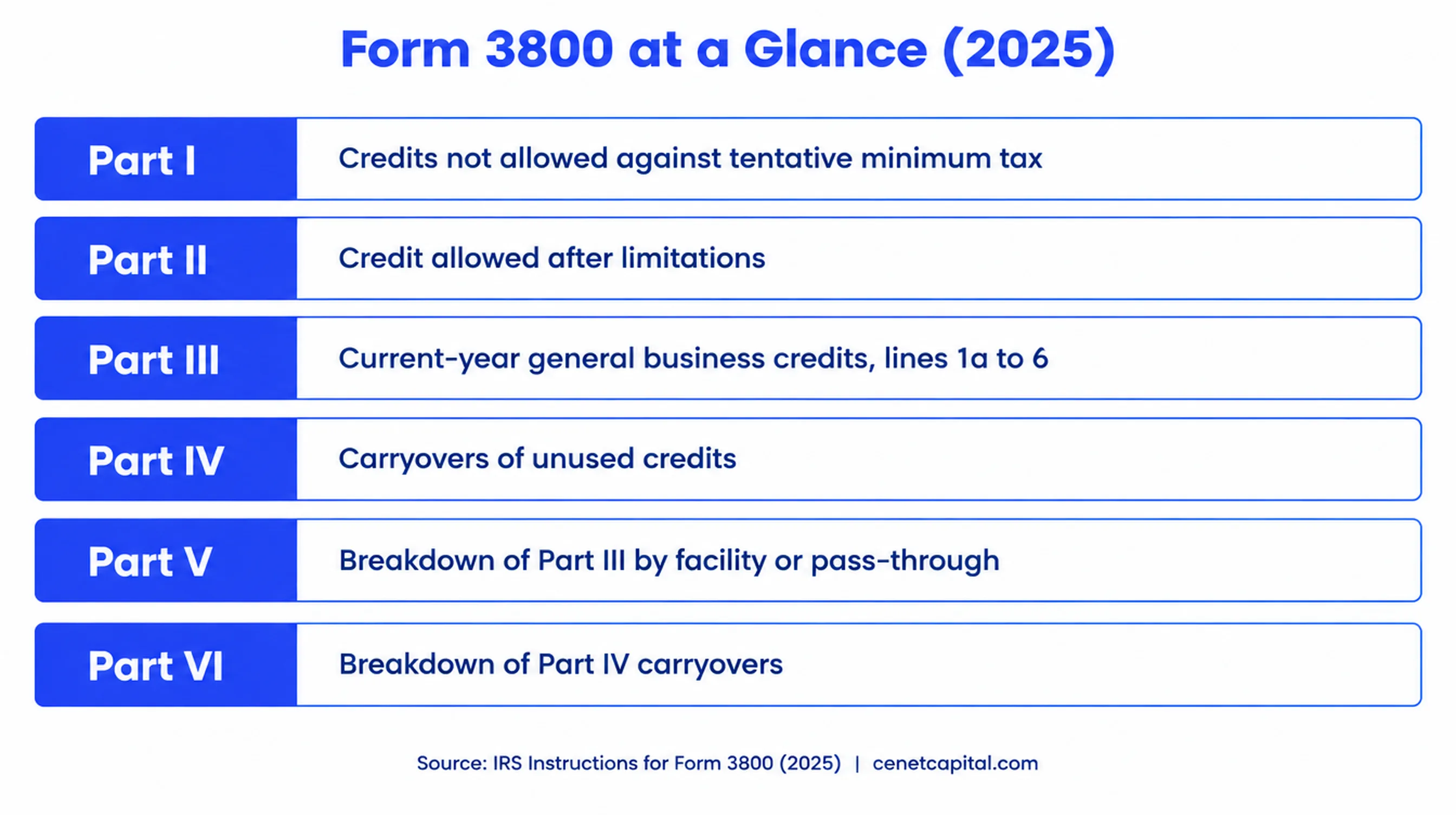
The 2025 Form 3800 has six parts. Part III lists this year’s credits line by line and Part IV lists carryovers. Parts I and II apply the tax-liability limit, and Parts V and VI break the totals down by facility, pass-through entity or credit. Most preparers fill in Parts III and IV first, then work back through Parts I and II.
Part | What it does | 2025 detail |
|---|---|---|
Part I | Credits not allowed against tentative minimum tax | Lines 4 and 5 now hold only non-passive carryforwards and carrybacks |
Part II | Figuring credit allowed after limitations | Renamed for 2025 and split into Sections A to D |
Part III | General business credits or eligible small business credits | Lines 1a to 6, one line per credit, columns (a) to (j) |
Part IV | Carryovers of general business credits | Eligible small business column removed; those amounts go on line 4y |
Part V | Breakdown of Part III amounts | Facility-by-facility and pass-through detail |
Part VI | Breakdown of Part IV carryovers | Detail behind each carryover |
Above Part I, Item A asks whether the filer is subject to the corporate alternative minimum tax or the base erosion tax, and the new Item B asks about transfer elections and how many transfer election statements are attached.
How is the general business credit limit calculated?
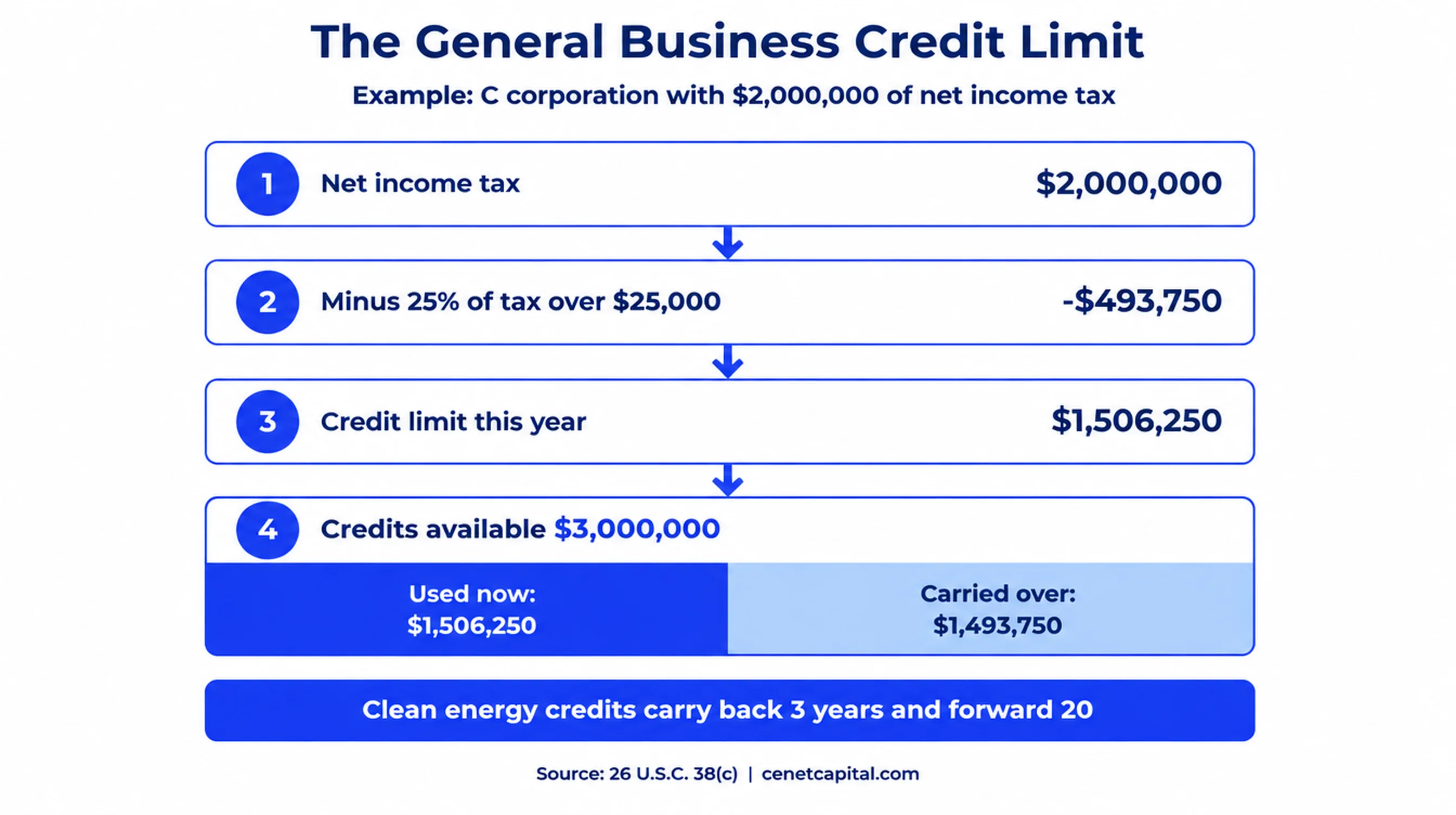
The credit can’t exceed net income tax minus the greater of tentative minimum tax or 25% of net regular tax liability above $25,000. Corporations use a simpler test: net income tax minus 25% of net income tax above $25,000. Any credit above the limit becomes unused credit that carries to other years.
The formula comes from section 38(c)(1), which defines net income tax as regular tax plus alternative minimum tax, reduced by certain nonrefundable personal credits. Here’s how it works for a C corporation:
Net income tax: $2,000,000
25% of the amount over $25,000: $493,750
Credit limit for the year: $1,506,250
Credits available: $3,000,000, so $1,506,250 is used now and $1,493,750 carries over
That’s why profitable companies still end up with unused credits, and why a market for clean energy credits exists at all: a developer that can’t use its credit sells it to a company that can. Our guide to transferable tax credits explains how those sales work.
How much general business credit can you use this year?
Illustrative only. Uses the section 38(c)(1) limit and ignores specified credits allowed against TMT, empowerment zone credits, the corporate AMT and passive activity limits. Most other general business credits carry back 1 year and forward 20.
Sell my unused credits →How do you fill out Form 3800 Part III?
Part III has one line per credit, such as line 1v for the 48E clean electricity investment credit, line 1q for the 45Z clean fuel credit and line 1gg for the 45Y clean electricity production credit. Ten columns separate passive and non-passive credits, transfers and elective payments.
Column | What goes in it |
|---|---|
(a) | Number of items, such as facilities or pass-through entities |
(b) | Elective payment or transfer registration number |
(c) | EIN of the pass-through or transfer counterparty |
(d) and (e) | Passive and non-passive credits |
(f) | Transfer election amount: negative for the seller, positive for the buyer |
(g) | Non-passive credits combined with transfers in or out |
(h) | Gross elective payment election amount |
(i) | Amount of column (g) applied against tax in Part II |
(j) | Net elective payment: the smaller of (h) or (g) minus (i) |
The 2025 instructions say “new columns were added and several columns were repositioned or renamed,” so a worksheet built for the 2024 form can put amounts in the wrong column.
Where do transferred and elective pay credits go on Form 3800?
A seller reports a transferred credit as a negative amount in Part III, column (f), and the buyer reports it as a positive amount, each with the IRS registration number in column (b). Elective payment amounts go in columns (h) and (j), and the net amount from line 6, column (j), flows to the return’s payment line.
Form 1120: Schedule J, line 22a
Form 1065: line 29
Form 1120-S: line 24d
Form 1040: Schedule 3, line 13c
The registration number comes from the IRS pre-filing registration portal, and the instructions are clear that “you must complete pre-filing registration before you file your tax return.” A registration number is valid only for the tax year it was issued for. For 2025, the new Schedule A (Form 3800) can serve as the transfer election statement. Our elective pay guide explains who can take credits as cash from the IRS.

What’s new on the 2025 Form 3800?
For 2025, Form 3800 added Item B and Schedule A for transfer elections, new Part III lines for the 45Y, 45Z and 48E credits, and a restored line for the small agri-biodiesel producer credit. Part II was renamed and split into Sections A to D, and the eligible small business credit column was removed from Part IV.
45Y clean electricity production credit: line 1gg, from Form 7211
45Z clean fuel production credit: line 1q, from Form 7218
48E clean electricity investment credit: line 1v, from Form 3468, Part V
Small agri-biodiesel producer credit: line 1l, restored by the One Big Beautiful Bill Act
Eligible small business carryforwards: now reported on Part IV, line 4y
For a credit-by-credit view of what the 2025 law changed, see our One Big Beautiful Bill clean energy guide.
What happens to unused general business credits?
Unused general business credits generally carry back 1 year and forward 20 years. Clean energy credits listed in section 6417(b), the ones eligible for elective pay, carry back 3 years and forward 20. Carryovers are tracked in Part IV and used in the order the rules set.
The IRS instructions state that “unused credits listed in section 6417(b) may be carried back 3 years and carried forward 20 years,” following 26 U.S.C. 39. A carryforward still has value, but a dollar of credit used in five years is worth much less than cash today. That’s why many developers sell credits they can’t use instead of carrying them forward, as our comparison of refundable, transferable and direct-pay credits shows.
What are the most common Form 3800 mistakes?
The most common mistakes are a missing registration number, using 2024 column positions on the 2025 form, buyer and seller amounts that don’t match, leaving out the source form, and applying the individual limit formula to a corporation. Each can delay processing or trigger an IRS notice.
No registration number in column (b) for a transfer or elective payment.
Column (f) amounts that don’t match the transfer election statement.
Claiming a credit in Part III without attaching its source form, such as Form 3468 or Form 7211.
Treating passive credits from a partnership as non-passive, or skipping Form 8582-CR.
Not carrying the net elective payment from line 6, column (j), to the payment line of the return.
Sources
Legal Information Institute, 26 U.S. Code 38, General business credit
Legal Information Institute, 26 U.S. Code 39, Carryback and carryforward of unused credits
Frequently Asked Questions
What is Form 3800 used for?
Form 3800 is used to claim the general business credit. It totals business credits such as the research credit and clean energy credits from their source forms, applies the annual tax-liability limit, and tracks unused credits carried back or forward.
Do I need to file Form 3800 if I only have one credit?
How do you calculate the general business credit limit?
How long can unused general business credits be carried forward?
Can Cenet Capital buy credits I can't use on Form 3800?
Credits stuck on Form 3800? Sell them for cash.
If the general business credit limit leaves clean energy credits unused, Cenet Capital buys transferable credits directly, so you get cash this year instead of a 20-year carryforward. Send us your credit amount for a price.

More Insights