

Credit Guides
What the general business credit includes, how the Section 38(c) limit works, carryback and carryforward rules, and how much in tax credits a business can use.
Author -
Paulestini Francois
Published -
READ TIME
Every business tax credit, from research to the clean energy Investment Tax Credit (ITC) and Production Tax Credit (PTC), flows into one combined general business credit with one annual cap. Here's what it includes, how the limit is calculated, and what happens to credits that don't fit.
QUICK ANSWER
The general business credit combines more than 40 federal business credits, including the ITC, PTC and research credit, under Section 38. A C corporation can use them up to its net income tax minus 25% of the amount above $25,000. Unused credits carry back one year and forward 20.
KEY FACTS
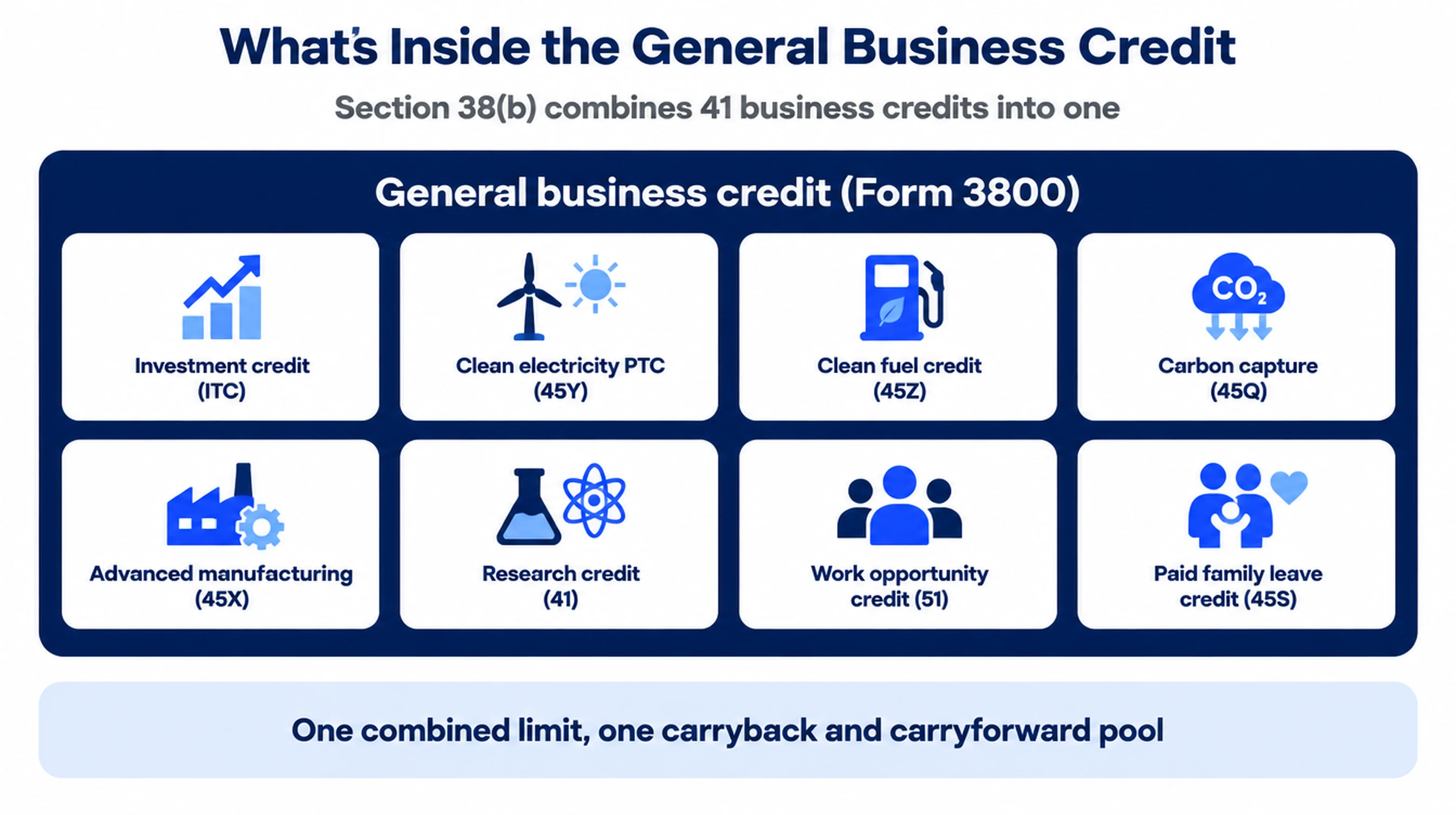
What is the general business credit? The combined total of 41 business credits listed in Section 38(b), claimed on Form 3800.
What is the general business credit limit? For a C corporation, net income tax minus 25% of net income tax above $25,000; $756,250 on $1 million of tax.
How long is the general business credit carryforward? 20 years, after a 1-year carryback; elective-pay-eligible clean energy credits get a 3-year carryback.
What are specified credits? Credits in Section 38(c)(4)(B), such as the Section 48 energy credit and WOTC, that individuals can use against the AMT.
Which general business credits are used first? Carryforwards first, then current-year credits, then carrybacks, under Section 38(a).
Do purchased tax credits count toward the limit? Yes. Transferred credits are general business credits and share the same Section 38(c) cap.
What is the general business credit?
The general business credit is the combined total of more than 40 federal business tax credits, from the research credit to clean energy credits like the Investment Tax Credit (ITC) and Production Tax Credit (PTC). Section 38 adds them together, applies one annual limit, and carries unused amounts back one year and forward 20.
You don’t claim the general business credit directly. You figure each component credit on its own form, then total them on Form 3800, where the limit and carryovers are applied.
That shared limit is why the general business credit matters so much to companies that buy clean energy credits: it caps how much of any credit, bought or earned, can reduce tax in a single year.
Which credits are part of the general business credit?
Section 38(b) lists 41 component credits. They include the investment credit (which carries the Section 48 and 48E ITCs), the research credit, the work opportunity credit, the paid family leave credit, and clean energy credits such as 45Q carbon capture, 45X manufacturing, 45Y clean electricity and 45Z clean fuel.
The full list in 26 U.S.C. 38(b) runs from the investment credit in paragraph (1) to the military spouse retirement plan credit in paragraph (41). Most businesses touch only a few of them in any year.
Personal credits such as the child tax credit or the earned income credit are not part of it. They follow their own rules.
How is the general business credit limit calculated?
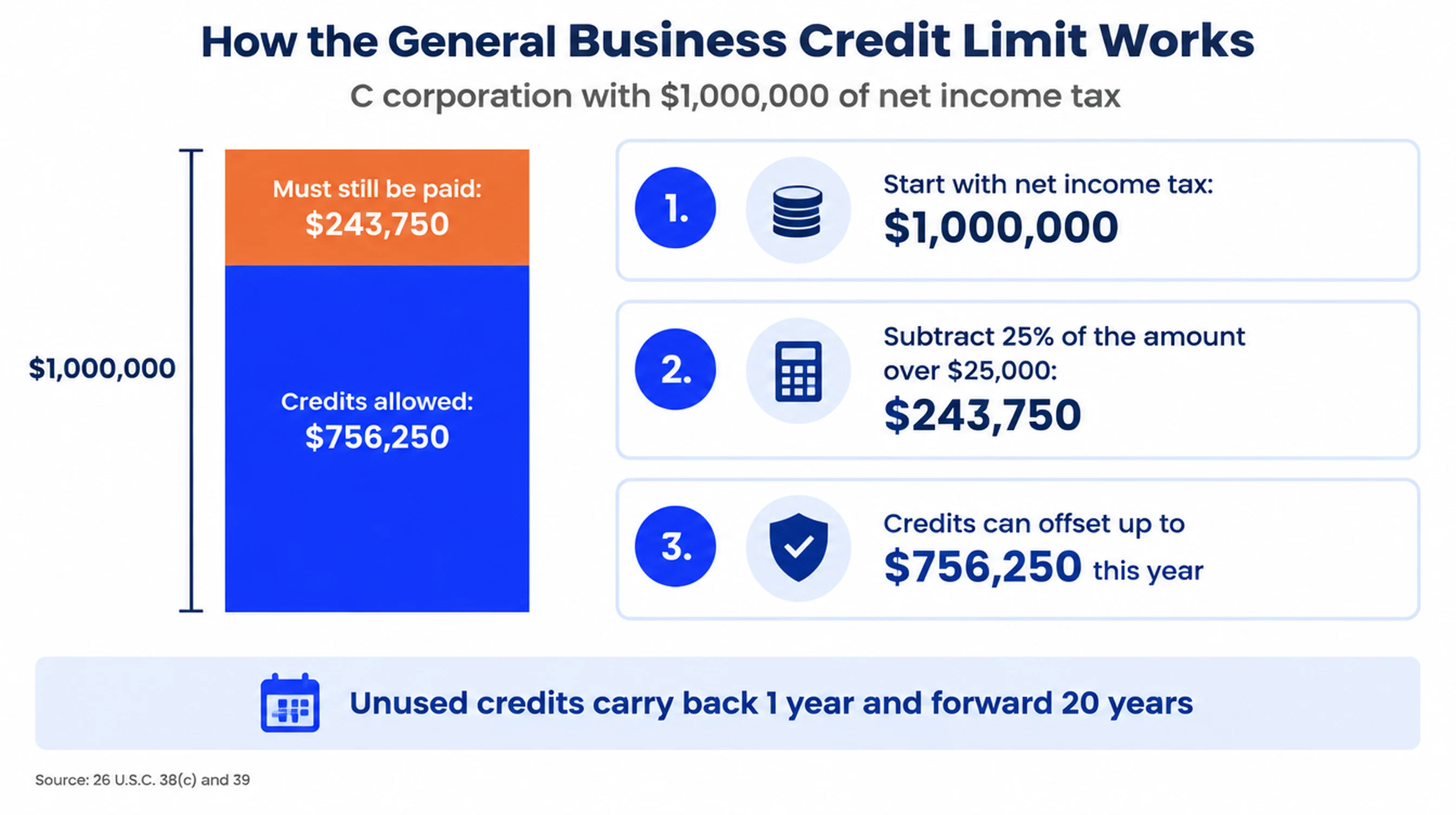
For a C corporation, general business credits can’t exceed net income tax minus 25% of net income tax above $25,000. A company with $1 million of net income tax can use up to $756,250. Individuals subtract the greater of their tentative minimum tax or 25% of net regular tax above $25,000.
Section 38(c)(1) sets the general formula, and Section 38(c)(6)(E) swaps in the simpler 25% test for corporations. Net income tax is regular tax plus any alternative minimum tax under Section 55, minus certain nonbusiness credits.
An individual works the same math with one extra test. Say an owner has $200,000 of net income tax, of which $180,000 is net regular tax, and a $60,000 tentative minimum tax. Twenty-five percent of regular tax above $25,000 is $38,750, which is smaller than the tentative minimum tax, so the limit is $200,000 minus $60,000, or $140,000.
The limit is a cap, not a cliff. Whatever doesn’t fit this year becomes a carryback or carryforward instead of disappearing.
What are specified credits?
Specified credits are a short list in Section 38(c)(4)(B) that individuals can use against the alternative minimum tax, because the tentative minimum tax is treated as zero for them. They include the Section 48 energy credit, the work opportunity credit, the paid family leave credit and the research credit of an eligible small business.
Specified credits matter mainly to individuals and pass-through owners who would otherwise be stuck at their tentative minimum tax. Newer clean energy credits such as 45Y, 48E, 45X and 45Z are not on the list.
For corporations, the distinction rarely matters, since the corporate limit already ignores tentative minimum tax.
You have $56,250 of unused credit capacity. A business could buy that much in transferable clean energy credits at a discount and use it all this year.
Illustrative only. Ignores the passive activity and at-risk rules, empowerment zone and other special credit limits, and the corporate alternative minimum tax interaction. Confirm with your tax advisor.
In what order are general business credits used?
Section 38(a) uses carryforwards from earlier years first, then the current year’s credits, then any carrybacks. Within each group, Section 38(d) applies credits in the order they appear in Section 38(b). Using old carryforwards first helps keep credits from expiring at the end of their 20-year window.
The ordering decides which credits survive when you hit the limit. A company with big carryforwards may find that a current-year credit purchase just pushes its own older credits forward again.
Run your own numbers in the calculator below before you plan a credit purchase.
What happens to unused general business credits?
Unused general business credits carry back one year and then forward 20 years under Section 39. Clean energy credits that qualify for elective pay under Section 6417 get a three-year carryback instead. Some older credits that expire unused become a deduction under Section 196 in the year after the carryforward ends.
Section 39(a)(4) gives those “applicable credits” a three-year carryback and a 22-year carryforward. Section 196 covers credits such as the investment and research credits, but not newer clean energy credits like 45Y or 45Z.
The chart below shows how quickly a large credit year gets absorbed when credits outrun the limit.
At these numbers the carryforward is fully used by 2032, well inside the 20-year window.
C corporation limit under 26 U.S.C. 38(c)(6)(E); carryforwards used before current-year credits under 38(a). Ignores carrybacks, CAMT and passive activity limits. Illustrative.
How do passive activity rules limit individuals?
Individuals, trusts and closely held corporations can generally use credits from passive activities only against tax on passive income under Section 469. The final transferability rules apply the same limit to purchased clean energy credits, so most individual buyers need passive income to use them.
That’s why individual buyers of transferable credits are less common than corporations. Our guide on whether buying tax credits reduces your taxes explains who can benefit.

How does the general business credit limit affect buying tax credits?
A buyer should purchase only as many transferable credits as its remaining general business credit capacity can absorb this year. Credits beyond the limit carry forward, which delays the savings and lowers the deal’s return. Buyers typically model their limit, existing credits and estimated tax before signing.
Buyers paid about $0.913 per dollar for ITCs and $0.930 for PTCs in 2026, according to Crux. That discount only pays off when the credit is used on time.
Our guides to buying clean energy tax credits and the purchase checklist cover sizing and diligence.
How do you claim the general business credit?
Figure each credit on its own form, such as Form 3468 for the ITC or Form 6765 for research, then report them on Form 3800. Form 3800 applies the Section 38(c) limit, tracks carryforwards and carrybacks, and lists transferred and elective pay credits. Attach it to your income tax return.
Partnerships and S corporations don’t apply the limit themselves. They pass each partner’s or shareholder’s share of the credits through on Schedule K-1, and the owner applies the Section 38(c) limit on their own Form 3800. Keep a schedule of each credit’s year and source, since carryforwards are tracked by year.
The IRS publishes current Form 3800 instructions. For a line-by-line walkthrough, see our Form 3800 guide, and for the bigger picture on credits versus deductions, our tax credit vs. deduction guide.
Sources
26 U.S.C. 38 (general business credit), 39 (carrybacks and carryforwards), 196 (deduction for unused credits) and 469 (passive activity limits)
pv magazine USA, Clean energy capital expenditures on track for $180 billion in 2026, reports Crux
Frequently Asked Questions
What is included in the general business credit?
It includes 41 component credits listed in Section 38(b), such as the investment credit, research credit, work opportunity credit, paid family leave credit and clean energy credits like 45Q, 45X, 45Y and 45Z. Each is figured on its own form and totaled on Form 3800.
How much general business credit can I use in a year?
What happens if I can't use all my general business credits?
Is the general business credit refundable?
Can Cenet Capital help me use my general business credit capacity?
Have credit capacity to spare? Put it to work
Cenet Capital helps corporations size their unused general business credit capacity and fill it with discounted transferable clean energy credits. Tell us your expected tax liability and existing credits.

More Insights