Project Finance
Compare commercial solar financing in 2026: cash, solar loans, C-PACE, leases and PPAs, who keeps the 30% ITC, the 2027 deadline and selling credits for cash.
Author -
Paulestini Francois
Published -
READ TIME
How you pay for a commercial solar system decides who keeps the 30% Investment Tax Credit (ITC) and how fast it pays back. Here's how cash, loans, C-PACE, leases and PPAs compare in 2026, and why the end-2027 placed-in-service deadline now shapes every financing decision.
QUICK ANSWER
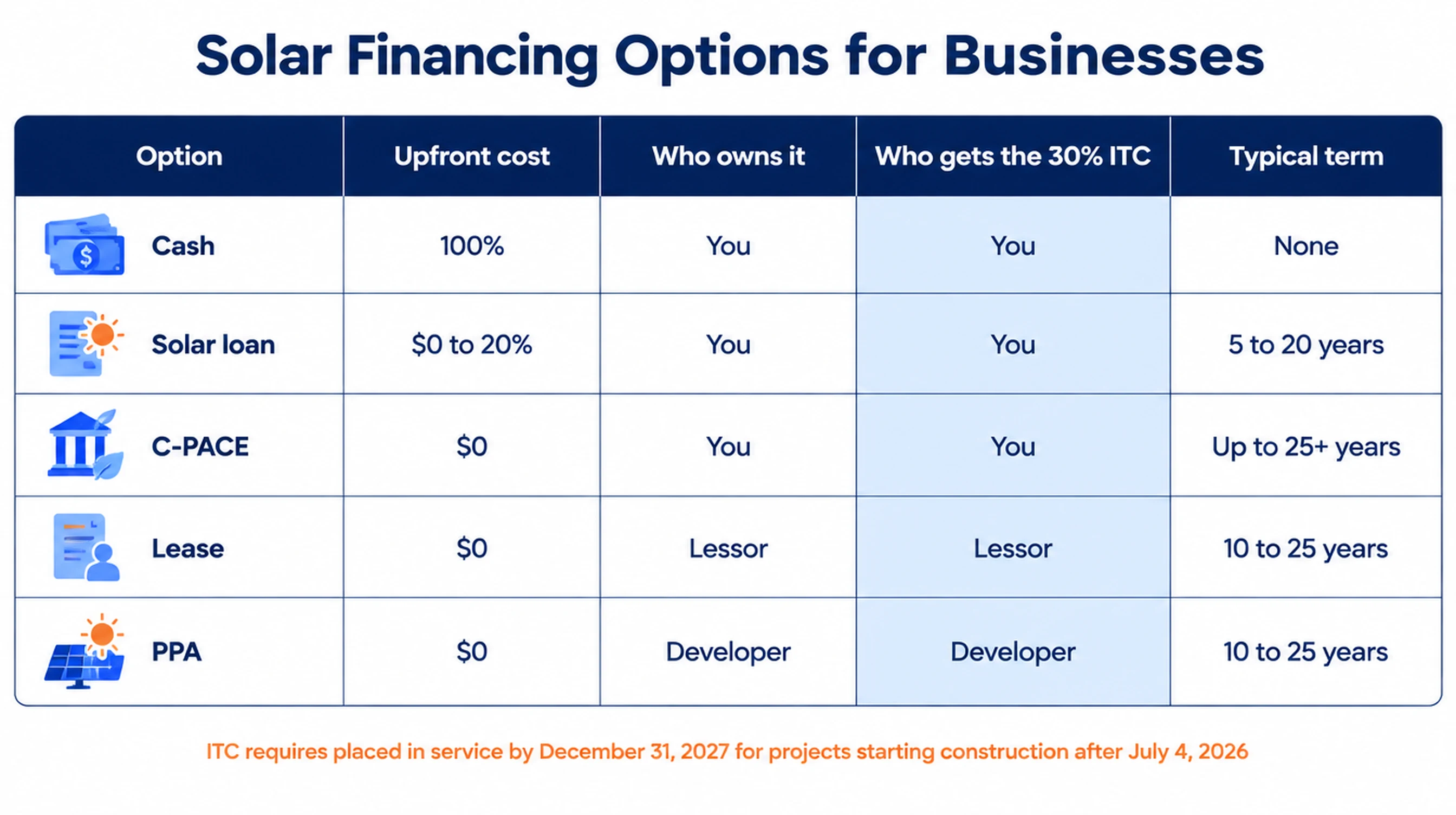
Businesses finance commercial solar with cash, a commercial solar loan, C-PACE, a lease or a power purchase agreement (PPA). Owners using cash, loans or C-PACE keep the 30% Section 48E ITC and depreciation; lease and PPA customers pay little upfront but give the credit to the system owner.
KEY FACTS
What is the cheapest way to finance commercial solar? Cash earns the most over 25 years; a loan or C-PACE near your cost of capital is close in present value.
What are commercial solar loan rates? Typically 4.5% to 9% in 2026, depending on credit, project size and lender, per Lunex Power.
What is C-PACE? Long-term property-assessed financing repaid on the property tax bill; 37 states have active commercial PACE programs.
Who gets the tax credit in a commercial solar PPA? The developer that owns the system; the customer gets cheaper power instead.
Can you sell the commercial solar tax credit? Yes, under Section 6418; ITCs averaged about 91 cents per dollar in 2026, per Crux.
What is the 48E deadline for solar? Projects starting construction after July 4, 2026 must be placed in service by December 31, 2027.
What are the main ways to finance commercial solar?
Businesses finance commercial solar five main ways: cash, a commercial solar loan, C-PACE, a lease, or a power purchase agreement (PPA). With cash, loans and C-PACE, the business owns the system and claims the 30% Investment Tax Credit (ITC). With a lease or PPA, a third party owns it and keeps the credit.
Financing commercial solar comes down to three things: whether you can use or sell the tax credit, how much cash you want to tie up, and whether you’d rather own the panels or just buy cheaper power.
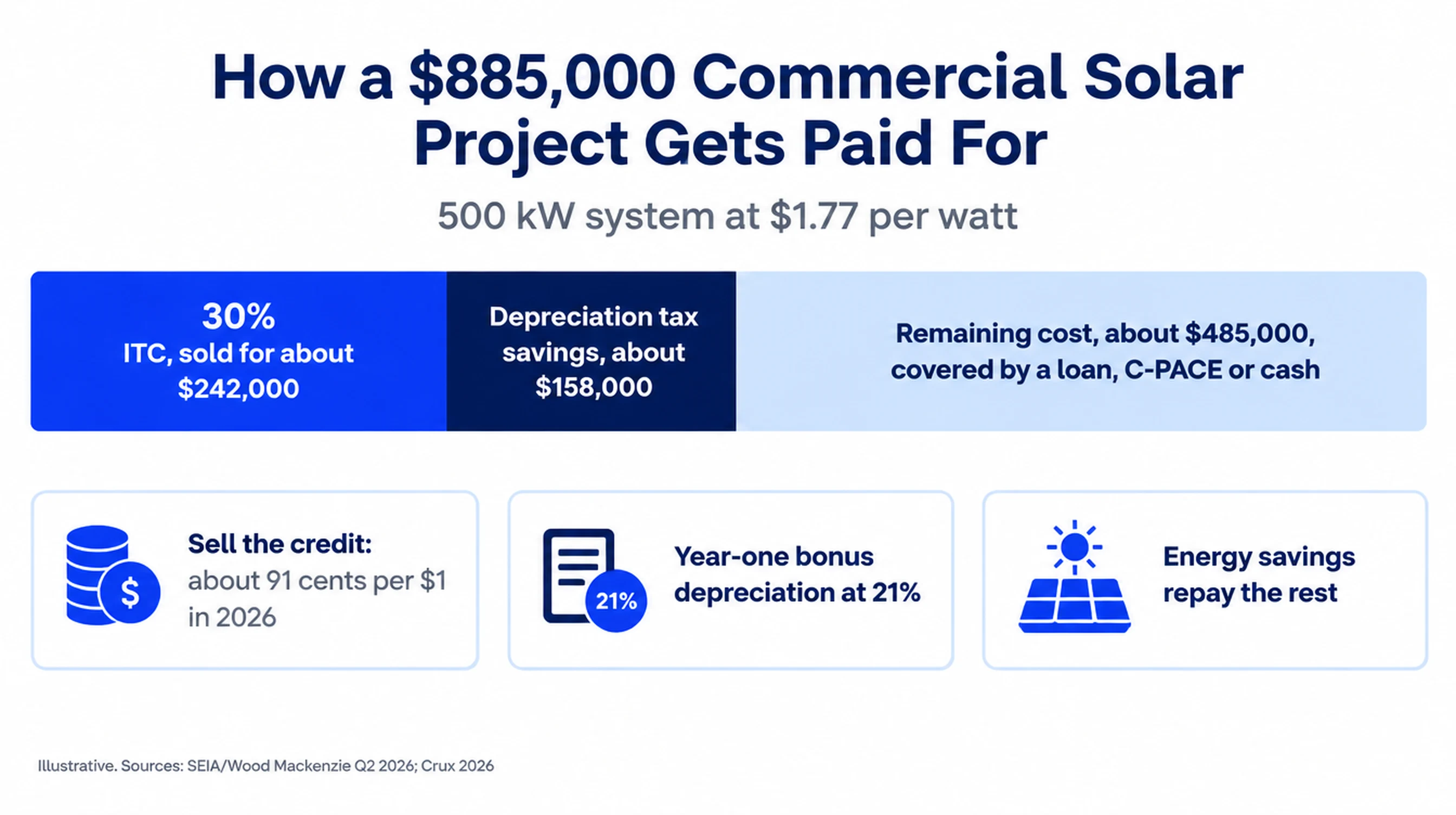
Cost sets the stakes. Commercial systems averaged $1.77 per watt installed in the second quarter of 2026, so a 500 kW rooftop runs about $885,000 before incentives.
How do commercial solar loans work?
A commercial solar loan lets a business borrow most or all of the system cost and repay it over 5 to 20 years while owning the panels. The owner keeps the ITC and depreciation. Lunex Power puts typical commercial solar loan rates at 4.5% to 9%, depending on credit, size and lender.
Specialty solar lenders, green banks and credit unions now offer fixed-rate loans that can cover the full project. Lunex Power reports rates in the 4.5% to 9% range across the market, with the best pricing going to strong credit and larger systems.
Many borrowers use the year-one ITC to pay down principal. Some lenders build that into the loan with a larger first payment, so energy savings cover the rest.
What is C-PACE financing for solar?
Commercial Property Assessed Clean Energy (C-PACE) is long-term financing repaid through a special assessment on the property tax bill. It can cover up to 100% of a solar project, often over 20 years or more, and the obligation can stay with the building if it’s sold. The owner still claims the ITC.
C-PACE requires state enabling law and a local program. PACENation counts 37 states with active commercial PACE programs, according to Rutgers’ Policy Lab. The Department of Energy’s C-PACE toolkit explains how programs are set up.
Because the assessment sits senior to the mortgage, existing lenders usually must consent. Long terms keep payments low, which often makes C-PACE cash-flow positive from year one.
How does a commercial solar PPA or lease work?
In a power purchase agreement, a developer installs and owns the system on your property and sells you the power at a set rate, usually below your utility rate. In a lease, you pay a fixed monthly amount to use the system. Either way you pay little or nothing upfront, but the owner keeps the tax credit.
A solar lease or PPA suits businesses with no tax appetite or no appetite for owning equipment. The developer claims the ITC, often sells it, and passes part of the value through in a lower price.
The tradeoff is lifetime savings. You give up the 30% credit, depreciation and most of the long-term upside in exchange for no capital outlay and no maintenance.
Which commercial solar financing option saves the most?
Over 25 years, paying cash usually produces the most total savings, because there’s no interest and the owner keeps the ITC and depreciation. Loans and C-PACE come close on a present-value basis when their rate is near your cost of capital. PPAs save the least but require no money upfront.
On a present-value basis, borrowing at your own cost of capital is roughly neutral, so a loan at 8% and cash discounted at 8% look similar. Cheaper long-term money, such as C-PACE, can edge ahead.
Most commercial solar finance decisions turn on two numbers: your tax position and your utility rate. The utility rate drives everything: the higher it is and the faster it rises, the faster any owned system pays back.
How does the 30% ITC help pay for commercial solar?
The Section 48E ITC returns 30% of eligible cost in the year the system is placed in service. On an $885,000 system that’s $265,500, or about $242,000 in cash if sold at 91 cents. Depreciation on the remaining basis adds roughly $158,000 of tax savings for a corporation at 21%.
The solar ITC also trims depreciation. Under Section 50(c)(3), depreciable basis drops by half the credit, so the depreciation is figured on 85% of cost. Bonuses for energy communities and domestic content can lift the credit to 40% or 50%.
Together, the credit and depreciation can cover about 45% of the cost in year one, leaving financing to carry the rest. Compare all four options in the calculator below.
Solar loan finances 100% of the cost; the ITC sale and depreciation in year one more than cover the first year of payments.
Illustrative only. Assumes 1,300 kWh per kW per year, a 21% federal rate, depreciation taken in year one, C-PACE at 7.5% over 20 years, and a PPA escalating 2% a year. Ignores state incentives, taxes on energy savings, financing fees and inverter replacement. Confirm with your tax advisor and lender.
What is the deadline to get the solar tax credit?
Commercial solar projects that began construction by July 4, 2026 keep the full credit if placed in service within the four-year continuity window. Projects that started later must be placed in service by December 31, 2027. After that, wind and solar get no 48E or 45Y credit under Public Law 119-21.
Section 45Y(d)(4) ends the credit for wind and solar placed in service after December 31, 2027, unless construction began within 12 months of enactment. For new projects, financing has to close fast enough to energize by the end of 2027.
The stricter start-of-construction rules in Notice 2025-42 were vacated by a federal court in June 2026. Our commercial solar tax credit guide covers the timeline.
Can you sell the solar tax credit to fund the project?
Yes. Under Section 6418, a business that owns the system can sell its ITC for cash to a corporate buyer, typically for 88 to 93 cents per dollar in 2026. A bridge loan can advance that cash during construction, so the credit helps fund the build instead of arriving a year later on a tax return.
Crux put average 2026 ITC pricing at $0.913. Smaller deals usually price lower, so owners who sell solar tax credits from a single rooftop often aggregate with other projects. Our guides to selling commercial solar tax credits and bridge loans explain the steps. The chart below shows how each option’s cash builds over time.
Cash starts deepest in the hole and finishes highest. The year-one credit sale and depreciation recover a big share of the cost at once.
Illustrative only, before taxes on energy savings. Assumes $1.77/W, 1,300 kWh/kW a year, a 21% federal rate, the ITC sold at 91¢ and depreciation in year one. Sources: SEIA/Wood Mackenzie Solar Market Insight Q2 2026; Crux 2026 pricing; 26 U.S.C. 48E, 50(c)(3).
How do tax-exempt organizations finance solar?
Nonprofits, schools, local governments and tribes can own solar and take the ITC as a direct payment from the IRS through elective pay, instead of selling it. They often pair it with a loan, C-PACE, or a bond, or they sign a PPA if they prefer not to own the system.
Elective pay requires IRS pre-filing registration and a timely filed return. See our elective pay guide for eligibility.
Sources
Lunex Power, How to Finance Commercial Solar (2026)
Rutgers Policy Lab, Garden State C-PACE program launches; U.S. DOE, C-PACE Toolkit Overview
pv magazine USA, Clean energy capital expenditures on track for $180 billion in 2026, reports Crux
SEIA and Wood Mackenzie, Solar Market Insight Q2 2026 (commercial system pricing, via our commercial solar cost guide)
Frequently Asked Questions
How do businesses pay for commercial solar?
Most use one of five structures: cash, a commercial solar loan, C-PACE financing, an equipment lease, or a power purchase agreement. Ownership options keep the tax credit and depreciation; lease and PPA options trade those benefits for little or no upfront cost.
Is a commercial solar loan or PPA better?
Can you finance 100% of a commercial solar project?
Does commercial solar still get a tax credit after the Big Beautiful Bill?
Can Cenet Capital help finance commercial solar?
Financing commercial solar? Monetize your ITC
Cenet Capital helps businesses and developers sell their commercial solar ITC to corporate buyers, and line up bridge financing so the credit funds construction. Tell us your system size, cost and in-service date.

More Insights