

Credit Guides
Tax credit vs deduction: a deduction cuts taxable income, a credit cuts the tax itself. See 2026 examples, bracket math and how businesses buy tax credits.
Author -
Paulestini Francois
Published -
READ TIME
A tax credit and a tax deduction can carry the same dollar figure and be worth wildly different amounts. Here's how each one works, what the same $10,000 saves in every 2026 bracket, and how businesses use clean energy credits, like the Investment Tax Credit (ITC) and Production Tax Credit (PTC), to cut their tax bills.
QUICK ANSWER
A tax deduction reduces the income you pay tax on, so it saves your tax rate times the deduction. A tax credit reduces the tax itself, dollar for dollar. That makes a $10,000 credit worth $10,000, while a $10,000 deduction saves $2,100 for a corporation and $1,000 to $3,700 for individuals.
KEY FACTS
Tax credit vs deduction: which is better? A credit of the same size, always: it cuts tax dollar for dollar, while a deduction saves only your marginal rate.
What is the 2026 standard deduction? $16,100 for single filers, $32,200 for married couples filing jointly and $24,150 for heads of household, per the IRS.
What is a refundable tax credit? A credit that pays out any amount above your tax bill as a refund; a nonrefundable tax credit stops at zero tax.
What are transferable tax credits? Clean energy credits that an owner can sell once for cash to an unrelated taxpayer under Section 6418.
How much can a business use in credits each year? The general business credit is capped at net income tax minus 25% of net regular tax above $25,000; the rest carries forward 20 years.
Can I buy tax credits? Yes. Buyers paid about $0.913 per $1 of investment tax credit (ITC) and $0.930 per $1 of production tax credit (PTC) on average in 2026, per Crux.
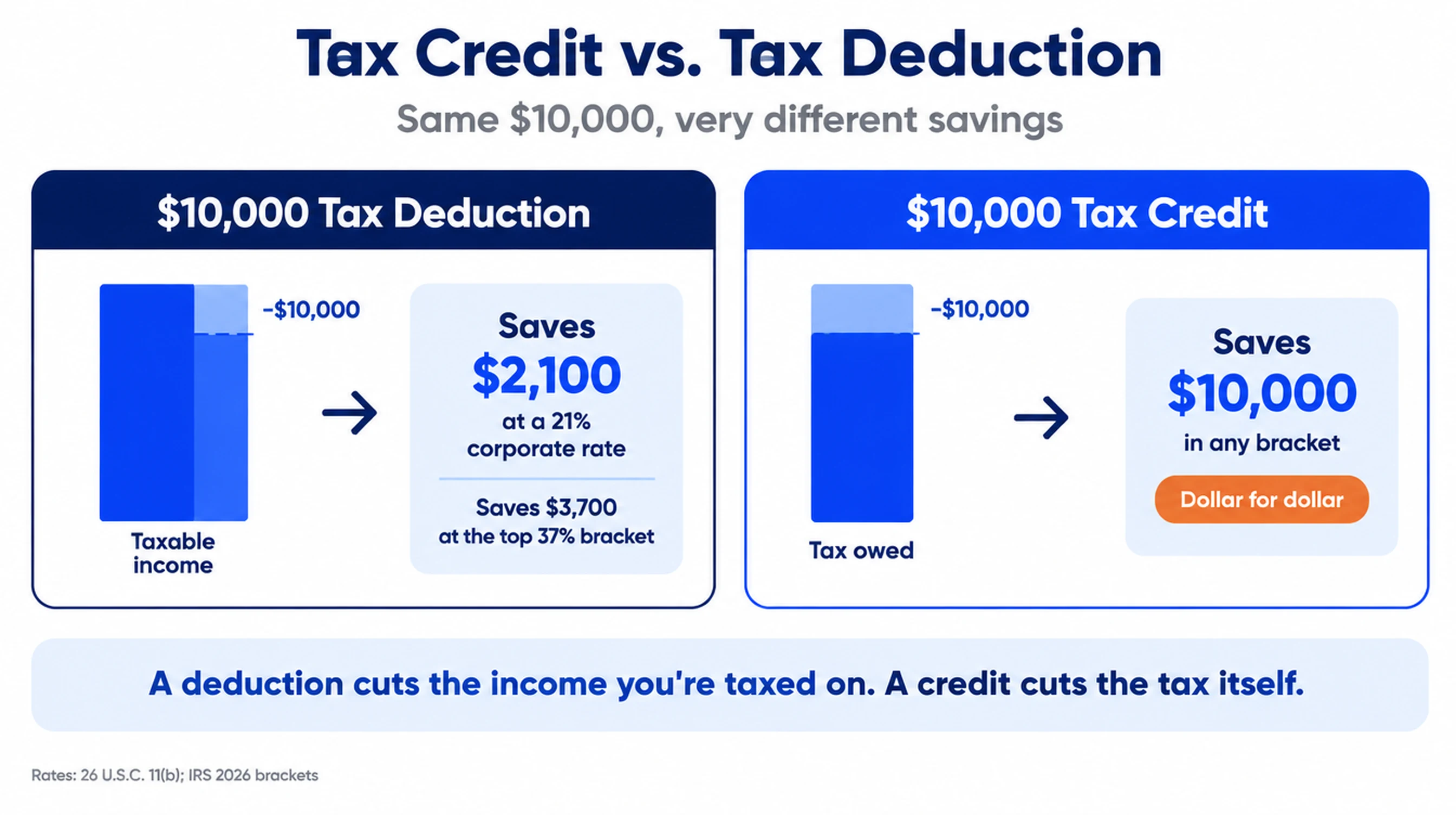
What is the difference between a tax credit and a tax deduction?
A tax deduction lowers the income you’re taxed on, so it saves you your tax rate times the deduction. A tax credit lowers the tax itself, dollar for dollar. A $10,000 deduction saves a corporation $2,100 at the 21% rate; a $10,000 credit saves $10,000 in any bracket.
The Tax Policy Center puts it simply: credits are subtracted from tax liability, while deductions are subtracted from income before tax is figured. That order of operations is the whole difference, whether you frame it as tax credit vs deduction or tax deduction vs tax credit.
It’s also why businesses with large tax bills pay close attention to credits, including clean energy credits they can buy from project developers.
How does a tax deduction work?
A deduction is subtracted from gross income to get taxable income. Its value equals the deduction times your marginal tax rate, the rate on your last dollar of income. In 2026, the same $1,000 deduction saves an individual between $100 and $370 depending on the bracket, and a C corporation $210.
Individuals pick the larger of the standard deduction or itemized deductions. For 2026, the IRS set the standard deduction at $16,100 for single filers and $32,200 for married couples filing jointly, with seven brackets from 10% to 37%.
Businesses deduct ordinary expenses such as wages, rent and depreciation. A C corporation pays a flat 21% under 26 U.S.C. 11(b), so each deducted dollar is worth 21 cents.
How does a tax credit work?
A credit is subtracted from the tax you owe after your tax is calculated. A $50,000 credit cuts a $200,000 tax bill to $150,000, whatever your bracket. Some credits stop at zero tax, some pay out the excess as a refund, and some business credits can be sold to another taxpayer for cash.
Business credits, including the Investment Tax Credit (ITC) and Production Tax Credit (PTC) for clean energy, are combined into the general business credit on Form 3800. Section 38(c) limits how much a business can use in one year, and unused amounts carry back one year and forward 20 under Section 39.
Which is worth more, a tax credit or a deduction?
A credit is worth more than a deduction of the same size for every taxpayer, because no marginal rate reaches 100%. At the top 37% bracket a deduction returns 37 cents per dollar; a credit returns the full dollar. A corporation needs a $4.76 deduction to match each $1 of credit.
The math is a simple division: the deduction needed to equal a credit is the credit divided by your tax rate. At 21%, a $100,000 credit equals a $476,190 deduction. At 24%, it equals $416,667.
A few costs let you pick a tax credit or deduction. Foreign income taxes are the classic case: you can claim them as a foreign tax credit or as an itemized deduction, and the credit usually wins.
A deduction can still be worth more in dollars when it’s much bigger than the credit. A $1 million deduction saves a corporation $210,000, more than a $100,000 credit. Compare the two by bracket in the chart below.
Every bar stays under the dashed line: even at the top 37% rate, a deduction returns 37 cents per dollar, while a credit returns the full dollar.
Federal income tax only, at the marginal rate shown. Sources: IRS IR-2025-103 and Rev. Proc. 2025-32 (2026 brackets); 26 U.S.C. 11(b) (21% corporate rate).
What are refundable, nonrefundable and transferable tax credits?
A nonrefundable credit can cut your tax to zero but not below. A refundable credit pays out any excess as a refund. A transferable credit can be sold for cash to an unrelated taxpayer, which lets developers without big tax bills monetize clean energy credits and lets buyers cut their own taxes.
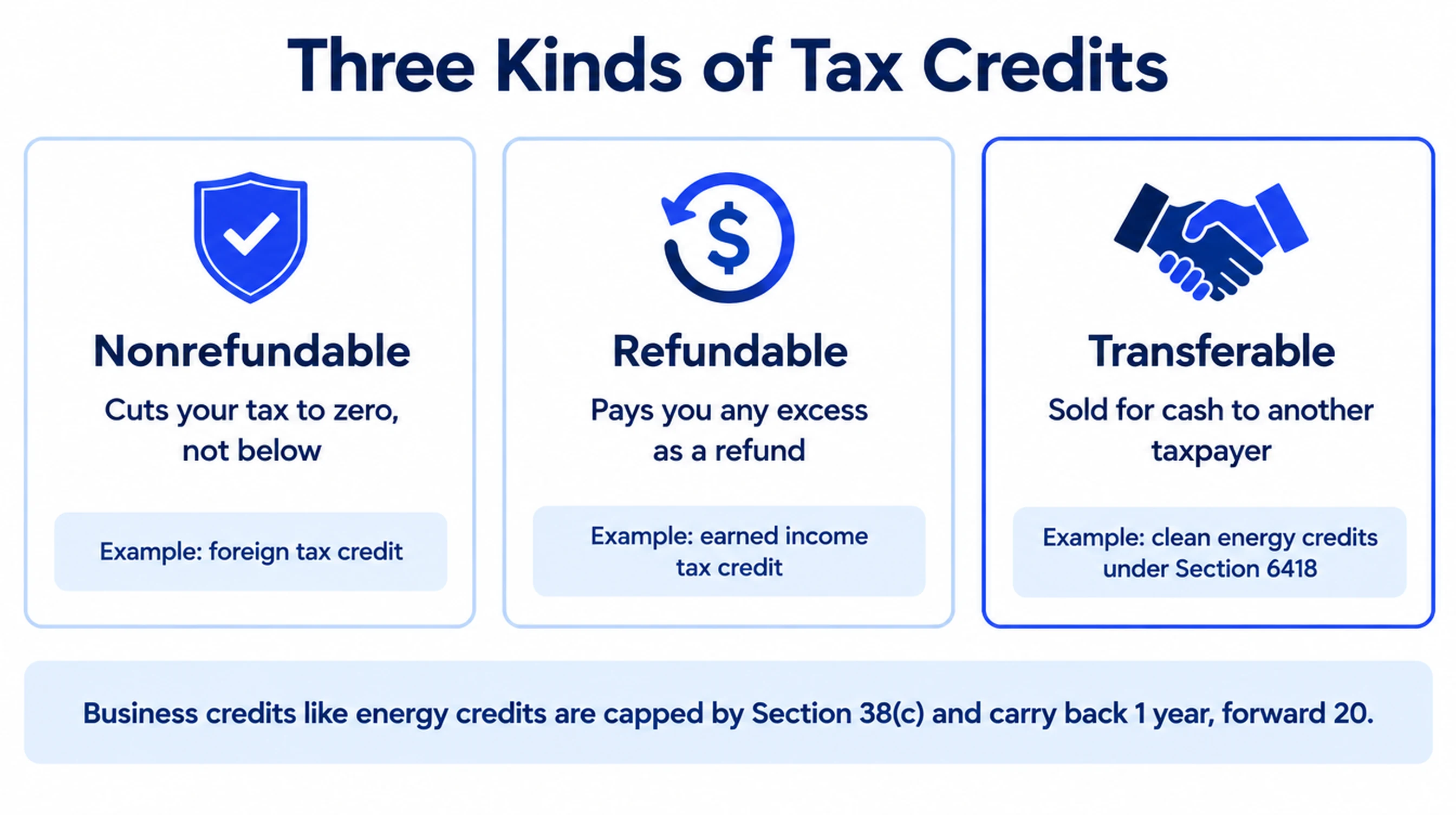
The earned income tax credit is the best-known refundable credit. Most business credits are nonrefundable but carry forward. Since 2023, Section 6418 has let owners sell eligible clean energy credits once, for cash, to unrelated buyers. Tax-exempt groups can instead take some credits as a payment through elective pay. Our guide to refundable vs. transferable tax credits covers each in detail.
How do business tax credits and deductions differ?
For a C corporation, every deduction is worth 21 cents per dollar, while business credits are worth a full dollar up to the Section 38(c) limit. That cap allows credits up to net income tax minus 25% of net regular tax above $25,000, so a company with a $1 million tax bill can use about $756,250.
Credits and deductions also interact. Claiming the ITC reduces a project’s depreciable basis by half the credit under Section 50(c)(3), so a 30% credit trims depreciation deductions on 15% of the cost. The PTC has no basis reduction.
That’s why developers model both together. Our investment tax credit guide walks through a full example.

What are examples of tax credits and deductions in 2026?
Common 2026 deductions include the standard deduction, business expenses, depreciation and mortgage interest. Common credits include the child tax credit, the research credit, and clean energy credits such as the ITC, PTC, 45X manufacturing credit and 45Z clean fuel credit. Several energy incentives changed or ended under the One Big Beautiful Bill Act.
One business energy deduction is closing. The Section 179D deduction for energy-efficient commercial buildings no longer applies to property whose construction begins after June 30, 2026. On the credit side, wind and solar projects face new deadlines, while geothermal, storage and nuclear keep credits into the 2030s. See our list of energy tax credits still available in 2026.
Can you buy tax credits to lower your tax bill?
Yes. Corporations and some individuals can buy transferable clean energy credits from project owners for less than face value, then use them dollar for dollar against federal income tax. Crux reported average 2026 prices of about $0.913 per dollar for ITCs and $0.930 for PTCs, a 7% to 9% saving.
The buyer pays cash, files a transfer election with the seller, and claims the credit on its return. Crux, which tracks the market, put first-half 2026 transfer volume at $21 billion, with average pricing of $0.913 for ITCs and $0.930 for PTCs.
Buyers should only purchase what their liability can absorb under the 38(c) limit, and should check recapture and prevailing wage risk first. Our guide to buying clean energy tax credits and purchase checklist cover diligence. Try your own numbers below.
Buying $100,000 of transferable credits for $91,000 wipes out $100,000 of federal tax, a $9,000 saving with no project to build.
Illustrative only. Uses your top marginal rate for the whole deduction and treats state tax as a flat rate; ignores AMT, phase-outs and state conformity. The 38(c) cap ignores tentative minimum tax. Credit purchases are subject to the passive activity rules for individuals. Confirm with your tax advisor.
Can you claim both a credit and a deduction for the same cost?
Often yes, but the tax code usually trims one to avoid a double benefit. The ITC reduces depreciable basis by half the credit. The research credit can reduce the research expense deduction under Section 280C. Buyers of transferable credits can’t deduct what they paid, and sellers don’t report the cash as income.
Under Section 6418, the payment for a transferred credit isn’t deductible to the buyer or included in the seller’s gross income. The buyer’s saving is the gap between the credit’s face value and its price.
Because the rules overlap, model credits and deductions together before you file or sign a purchase agreement.
Sources
IRS, IRS releases tax inflation adjustments for tax year 2026 (IR-2025-103)
Tax Policy Center, What are tax credits and how do they differ from tax deductions?
U.S. DOE, 179D Commercial Buildings Energy-Efficiency Tax Deduction
PV Tech, US clean energy tax credit transfers up to US$21 billion in H1 2026; pv magazine USA, Clean energy capital expenditures on track for $180 billion in 2026
Frequently Asked Questions
Is a tax credit the same as a tax deduction?
No. A deduction lowers your taxable income, so its value depends on your tax rate. A credit lowers the tax you owe directly, so it's worth its full face value whatever your bracket.
How much is a $1,000 tax deduction worth?
Which is worth more, a $200 deduction or a $200 credit?
Do tax credits reduce taxable income?
Can Cenet Capital help my business buy tax credits?
Have a big tax bill? Buy credits at a discount
Cenet Capital helps corporations and high-income taxpayers buy transferable clean energy tax credits for less than face value, with diligence on recapture and compliance. Tell us your expected federal tax liability.

More Insights