

Policy & Compliance
IRS Notice 2025-42 cut the 5% safe harbor for wind and solar ITC and PTC projects. A court vacated it in June 2026. Here's what that means for you now.
Author -
Paulestini Francois
Published -
READ TIME
IRS Notice 2025-42 changed how wind and solar developers prove a project began construction, right before the deadline that decides whether they keep their tax credits. Then a federal court threw it out. Here's what the notice did, why it was vacated, whether the five percent safe harbor is back, and what to do with a project that's already underway.
QUICK ANSWER
IRS Notice 2025-42, released August 15, 2025, removed the 5% safe harbor for proving that wind and most solar projects began construction for the 45Y PTC and 48E ITC. On June 6, 2026, a federal court vacated it, restoring the 5% safe harbor. The government had not appealed as of September 2026.
KEY FACTS
What is IRS Notice 2025-42? Treasury guidance that made the Physical Work Test the only way for wind and most solar projects to prove they began construction for 45Y and 48E.
Was Notice 2025-42 vacated? Yes. The D.C. federal court vacated it in full on June 6, 2026, in Oregon Environmental Council v. IRS.
Is the five percent safe harbor back? Yes. Paying or incurring at least 5% of total cost again proves construction began, unless new guidance or an appeal changes that.
What is the physical work test? Physical work of a significant nature, such as excavating a turbine foundation, installing solar racks, or making custom components under a binding contract.
What is the continuity safe harbor? Place the facility in service by the end of the fourth calendar year after construction began, such as December 31, 2030 for a 2026 start.
Does the beginning of construction safe harbor matter for the 48E ITC and 45Y PTC? Yes. Wind and solar projects that began construction by July 4, 2026 keep the 48E ITC or 45Y PTC even if they finish after 2027.
What is IRS Notice 2025-42?
IRS Notice 2025-42 is Treasury guidance, released August 15, 2025, on when a wind or solar project has begun construction for the clean electricity production tax credit (PTC) under section 45Y and the investment tax credit (ITC) under section 48E. It removed the 5% safe harbor for most of these projects.
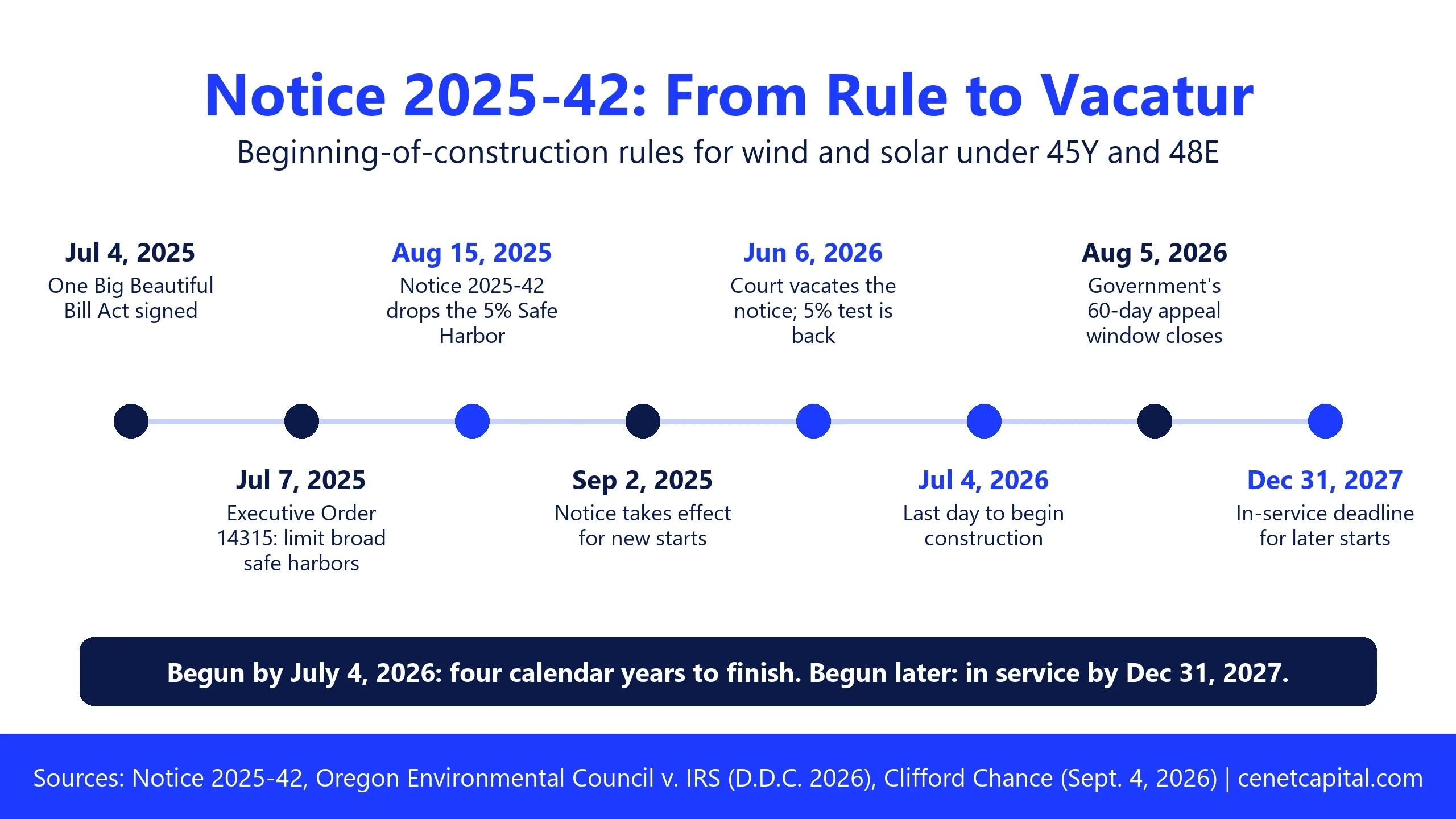
The date mattered because of the One Big Beautiful Bill Act, signed on July 4, 2025. It ends the 45Y and 48E credits for wind and solar facilities placed in service after December 31, 2027, unless construction began by July 4, 2026. Projects that began construction by that date keep the credit even if they finish later. So the rules for proving that construction “began” decided which projects kept their credits.
Three days after the law passed, Executive Order 14315 told Treasury to make sure the deadline wasn’t circumvented and to limit broad safe harbors “unless a substantial portion” of a facility had been built. Notice 2025-42 was the response, published in Internal Revenue Bulletin 2025-36 on September 2, 2025. It applied to wind and solar facilities that hadn’t begun construction before that date.
What did Notice 2025-42 change about the 5% safe harbor?
Before the notice, developers could prove construction began in two ways: the Physical Work Test, or the Five Percent Safe Harbor for paying or incurring at least 5% of a facility’s total cost. Notice 2025-42 made the Physical Work Test the only method for wind and solar, except solar facilities of 1.5 MW AC or less.
The two tests date back to Notice 2013-29, and Notice 2022-61 applied them to 45Y and 48E. For a decade, the 5% test was the industry’s main tool: a developer could buy transformers or modules worth 5% of a project’s cost and lock in its credit year. The notice called that kind of spending a way to circumvent the deadline.
The change hit wind projects and large solar projects claiming the solar ITC hardest. The notice also kept the four-year Continuity Safe Harbor, so a facility that began construction in time still had to be placed in service within four calendar years. It left energy storage, hydrogen and every other technology untouched. Our guide to the One Big Beautiful Bill’s credit changes covers the rest of the law.
Why did a court vacate Notice 2025-42?
On June 6, 2026, the U.S. District Court for the District of Columbia vacated Notice 2025-42 in Oregon Environmental Council v. IRS. The court held it arbitrary and capricious under the Administrative Procedure Act, set it aside for all taxpayers, and sent it back to the IRS.
According to Clifford Chance’s summary of the ruling, the court found that Treasury and the IRS failed to explain why they departed from a framework in place since 2013. They didn’t consider the reliance interests of developers who had planned around the 5% test, and they treated wind and solar differently from other technologies without adequate justification.
Holland & Knight notes that the vacatur applies to all taxpayers, not just the plaintiffs. The court also found that most plaintiffs had standing and that the Anti-Injunction Act didn’t bar the case.
Is the five percent safe harbor available again?
Yes, for now. With Notice 2025-42 vacated, the earlier guidance governs again, so wind and solar projects can use the 5% safe harbor or the Physical Work Test. The government had 60 days to appeal, until August 5, 2026, and had not filed a notice of appeal as of September 4, 2026.
Clifford Chance’s September 4 briefing explains that the government could still ask for an extension under appellate Rule 4(a)(5), but only until that day and only by showing excusable neglect or good cause. We haven’t found any public report of an appeal or extension since. The vacatur doesn’t stop Treasury from issuing new guidance, but any replacement would have to fix the problems the court identified, including reliance.
The ruling came less than a month before the July 4, 2026 deadline, and Troutman Pepper Locke warned that the risk of reversal might make developers wary of relying on it. Projects that paid 5% of costs between September 2, 2025 and July 4, 2026 are the ones that benefit most, and their records now carry real weight.
What counts as physical work of a significant nature?
The Physical Work Test looks at the nature of the work, not its cost. On site, it includes excavating a wind turbine foundation, setting anchor bolts, pouring concrete pads, or installing solar racks. Off site, it includes manufacturing custom components such as transformers or racking under a binding written contract signed before the work starts.
Preliminary work doesn’t count, even when its cost goes into the project’s tax basis. Notice 2025-42 lists planning and design, securing financing, permits, resource studies, surveys, clearing a site, test drilling and removing old foundations. Components that are already in a manufacturer’s inventory, or are normally held in inventory, don’t count either.
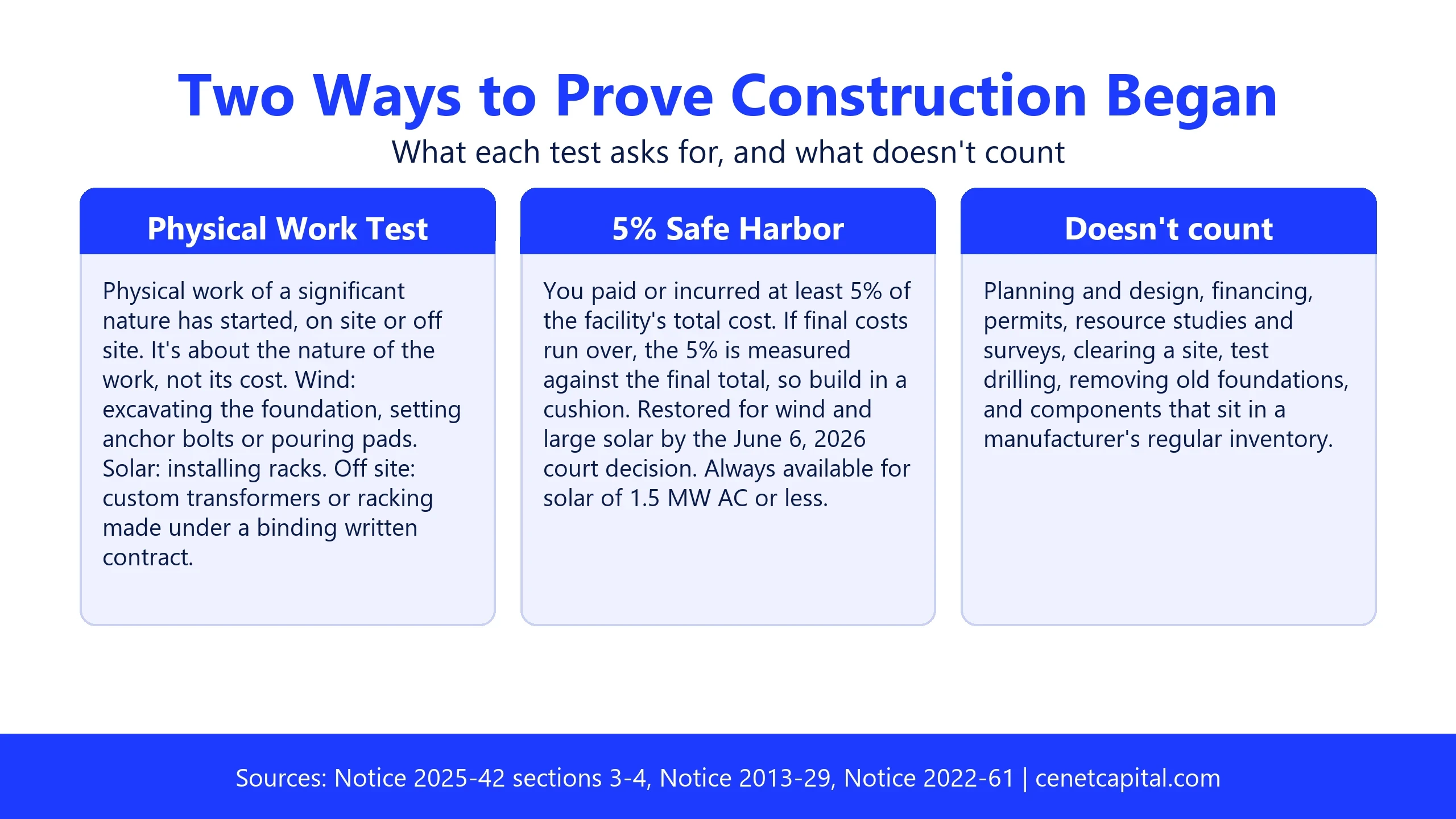
The 5% test has its own traps. It’s measured against the facility’s final total cost, so a project that runs over budget can fall below 5% after the fact. Costs count when they’re paid or incurred under tax accounting rules, so delivery dates and contract terms matter. Many developers documented both tests to be safe.
What is the continuity safe harbor?
Beginning construction isn’t enough on its own. A project must also show a continuous program of construction. Under the Continuity Safe Harbor, that requirement is met if the facility is placed in service by the end of the fourth calendar year after construction began. A project that began in 2026 has until December 31, 2030.
A project that misses that date isn’t automatically disqualified, but it has to prove continuous work on the facts. Notice 2025-42 lists disruptions that don’t break continuity, including severe weather, natural disasters, permitting and interconnection delays, endangered species, financing delays and supply shortages. Those excuses help only in a facts-and-circumstances review. They don’t extend the four-year safe harbor. Check your project’s dates in the checker below.
Did your project begin construction in time?
Updated for the June 6, 2026 court decision that vacated Notice 2025-42.You're relying on the 5% Safe Harbor that Notice 2025-42 took away. A federal court vacated the notice on June 6, 2026, and the government had not appealed as of September 4, 2026, so the safe harbor is available again. Keep proof of the costs paid or incurred, and watch for new IRS guidance.
Your placed-in-service date is inside the four-year Continuity Safe Harbor.
Construction starting after 2025 also brings the foreign-entity (material assistance) rules into play.
A general guide, not tax advice. Whether construction began depends on the facts, your documentation and any new IRS guidance.
Check my project's credits →What should developers do now that the July 4, 2026 deadline has passed?
Lock down the record. For wind and solar projects that began construction by July 4, 2026, document the test you rely on, keep invoices, contracts and site photos, and track the four-year continuity date. Projects that hadn’t begun by then must be placed in service by December 31, 2027 to earn any 45Y or 48E credit.
That documentation is what tax credit buyers check first. A buyer of your 48E investment tax credit or 45Y production tax credit will ask how construction began, and many insist on tax credit insurance when a project relied on the 5% test. Projects that began construction after 2025 also face the foreign entity of concern rules, which Notice 2025-42 didn’t address. Our ITC vs. PTC comparison helps you choose between the two credits.
Other technologies were never affected. Energy storage, geothermal, nuclear and other zero-emission facilities keep both tests, and hydrogen projects use them to meet the 45V construction deadline of January 1, 2028. Before you sell credits, you’ll also need an IRS pre-filing registration for each facility.
Sources
Internal Revenue Service, Internal Revenue Bulletin 2025-36, Notice 2025-42 and Notice 2025-42 (PDF)
Internal Revenue Service, Notice 2013-29 and Notice 2022-61
Clifford Chance, Wind and solar projects in the US: The vacatur of Notice 2025-42 (September 4, 2026)
Holland & Knight, Court Vacates IRS Notice 2025-42: “5% Safe Harbor” for Wind and Solar Facilities Reinstated
Troutman Pepper Locke, District Court Vacates IRS Notice 2025-42, Restoring Five Percent Safe Harbor Option
Legal Information Institute, 26 U.S. Code 45Y and 26 U.S. Code 48E
Frequently Asked Questions
What did Notice 2025-42 do?
It eliminated the five percent safe harbor for wind and solar facilities claiming the 45Y production tax credit or 48E investment tax credit, leaving the Physical Work Test as the only way to prove construction began. Solar facilities of 1.5 MW AC or less kept the safe harbor. It applied to projects that hadn't begun construction before September 2, 2025.
Why was Notice 2025-42 vacated?
Did the government appeal the Notice 2025-42 ruling?
What happens to wind and solar projects that missed July 4, 2026?
Can Cenet Capital help sell credits from a project that used the 5% safe harbor?
Make sure your construction start holds up
Cenet Capital helps wind and solar owners sell 48E ITCs and 45Y PTCs to corporate buyers, including projects that relied on the 5% safe harbor. Tell us when construction began and how you documented it.

More Insights