

Policy & Compliance
IRS pre-filing registration is required to sell or direct-pay an ITC or PTC. Who registers, when (120 days before filing), what you need, and 2026 dates.
Author -
Paulestini Francois
Published -
READ TIME
Before you can sell a clean energy tax credit or take it as a direct payment, the IRS needs to know about the facility. That's what IRS pre filing registration does, and a missing registration number can sink a credit sale that's otherwise ready to close. Here's who has to register, when, what the IRS asks for, and the dates that apply to 2026 credits.
QUICK ANSWER
IRS pre-filing registration is required before you transfer a clean energy credit under section 6418 or take direct pay under section 6417. You register each facility in the IRS Energy Credits Online tool after it's placed in service, ideally 120 days before your return is due, and get a registration number for that tax year.
KEY FACTS
What is IRS pre filing registration? The mandatory IRS step that gives each facility a registration number before its credit can be sold or paid out.
Where do you register? In IRS Energy Credits Online, part of the IRS business tax account, using the entity's own EIN.
When should you register? After the facility is placed in service and at least 120 days before the return is due, per IRS Publication 5884.
How long is a registration number valid? One tax year. Production credits such as the 45Y PTC must be renewed every year they're sold or paid out.
Do you need separate numbers for elective pay registration and transfers? Yes. An elective pay registration number can't be used for a transfer election, or the other way around.
Where does the registration number go? On Form 3800 with your return and on the transfer election statement, for both an ITC and a PTC.
What is IRS pre-filing registration?
IRS pre-filing registration is the mandatory step before you sell a clean energy tax credit under section 6418 or take it as direct pay under section 6417. Through the IRS Energy Credits Online tool, you register each facility and get a registration number that has to appear on your tax return. Without it, the election is invalid.
The requirement covers both investment tax credits (ITCs), such as the 48E clean electricity ITC, and production tax credits (PTCs), such as 45Y, 45Q and 45V. A company that simply claims its own credit against its own tax doesn’t register. Registration is only for monetizing a credit.
Don’t confuse it with the clean vehicle dealer registration, which was a separate IRS program. The IRS stopped accepting new dealer registrations on October 1, 2025. The energy credit tool covers the 6417, 6418 and 48D(d) elections, and the current user guide is Publication 5884 (Rev. 7-2026).
Who needs to register, and for which credits?
Any entity that wants to transfer a credit or receive it as a direct payment. That includes developers selling an ITC or PTC to a corporate buyer, and tax-exempt groups, governments, tribes and rural co-ops taking direct pay. For-profit companies can take direct pay only for the 45Q, 45V and 45X credits, for five years.
Each entity registers under its own EIN. The IRS says never to use another entity’s EIN, “even if it is closely related.” An elective pay registration number can’t be used for a transfer, or the other way around, so choose the election before you register. If you’ll revoke an earlier direct pay election to sell instead, explain that in your submission.
Sellers usually register at the level of the entity that owns the facility, often a project partnership. The IRS transferability FAQs say separate registration numbers are generally needed for each property, unless the credit’s own rules allow properties to be grouped. Our transferable tax credits guide and elective pay guide explain the two elections.
When should you register?
After the facility is placed in service, and at least 120 days before your tax return is due, including extensions. The IRS opens each tax year for registration early in that year’s second quarter. You can’t register a facility that isn’t in service yet, or before the tax year in which you earn the credit.
For a calendar-year C corporation earning credits in 2026, the return is due April 15, 2027, so the 120-day mark is December 16, 2026. With an extension to October 15, 2027, it’s June 17, 2027. Partnerships and S corporations file a month earlier, so their dates come sooner. The IRS registration page asks you to contact it if your extended due date is 60 days away and you still don’t have a number.
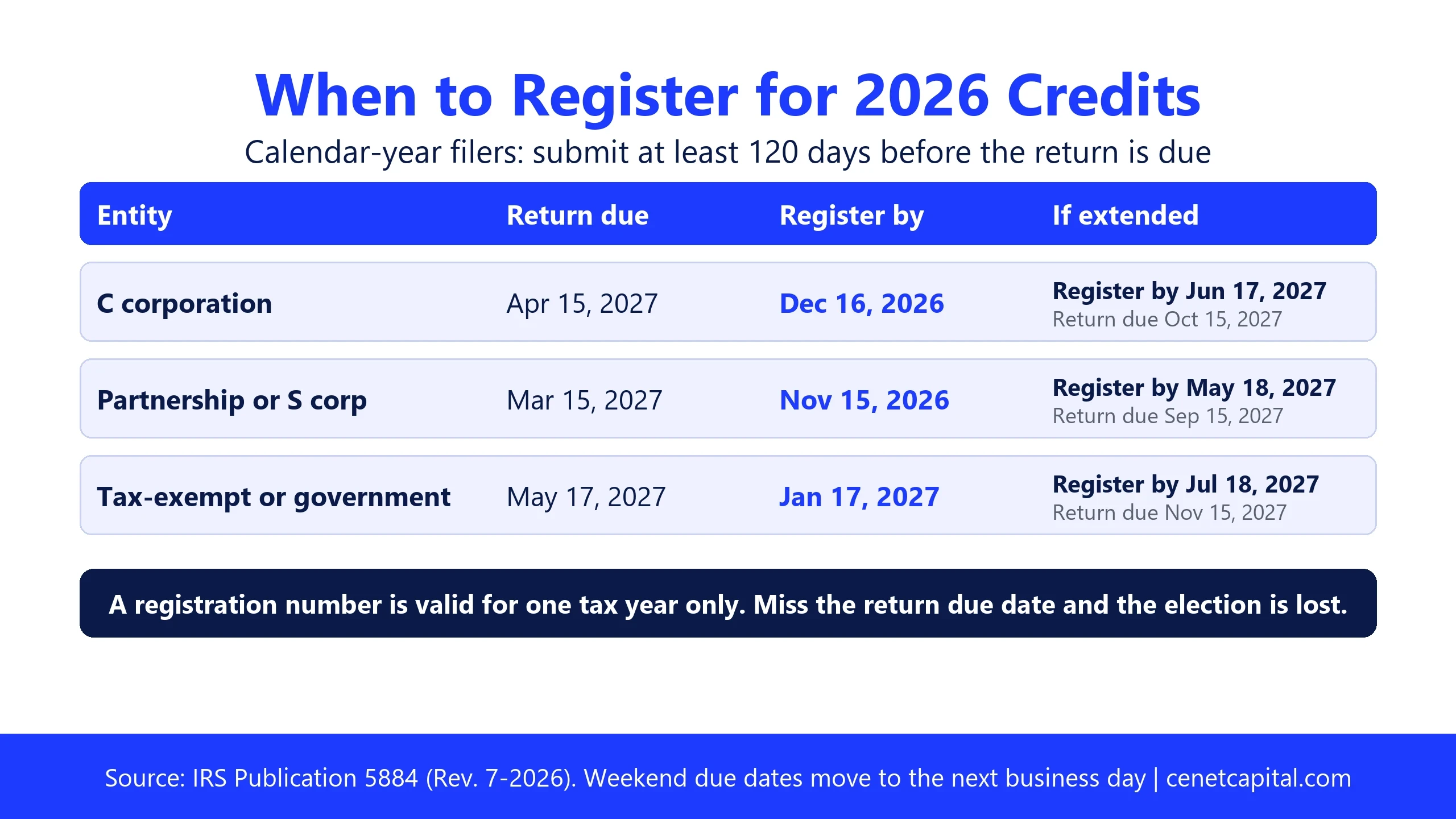
The deadline at the end is strict. The election must be made on a timely filed original return, including extensions, and there’s no late election. Missing it means the credit can’t be sold or paid out for that year.
What information and documents do you need?
Entity details, then facts about each facility: the credit, the election, the date construction began where it matters, the placed-in-service date, and the location by state, county, latitude and longitude. You also upload documents proving the facility exists, is yours and was placed in service on the date you claim.
Publication 5884 asks for coordinates in decimal form with six digits after the decimal point. Typical documents include operating permits, commissioning reports, interconnection agreements and purchase invoices. For a 45V hydrogen facility, the tool also asks for the name and address of the unrelated party that will verify production and sale or use, if known. Documents attached to a submitted registration can’t be removed later, so check them first.
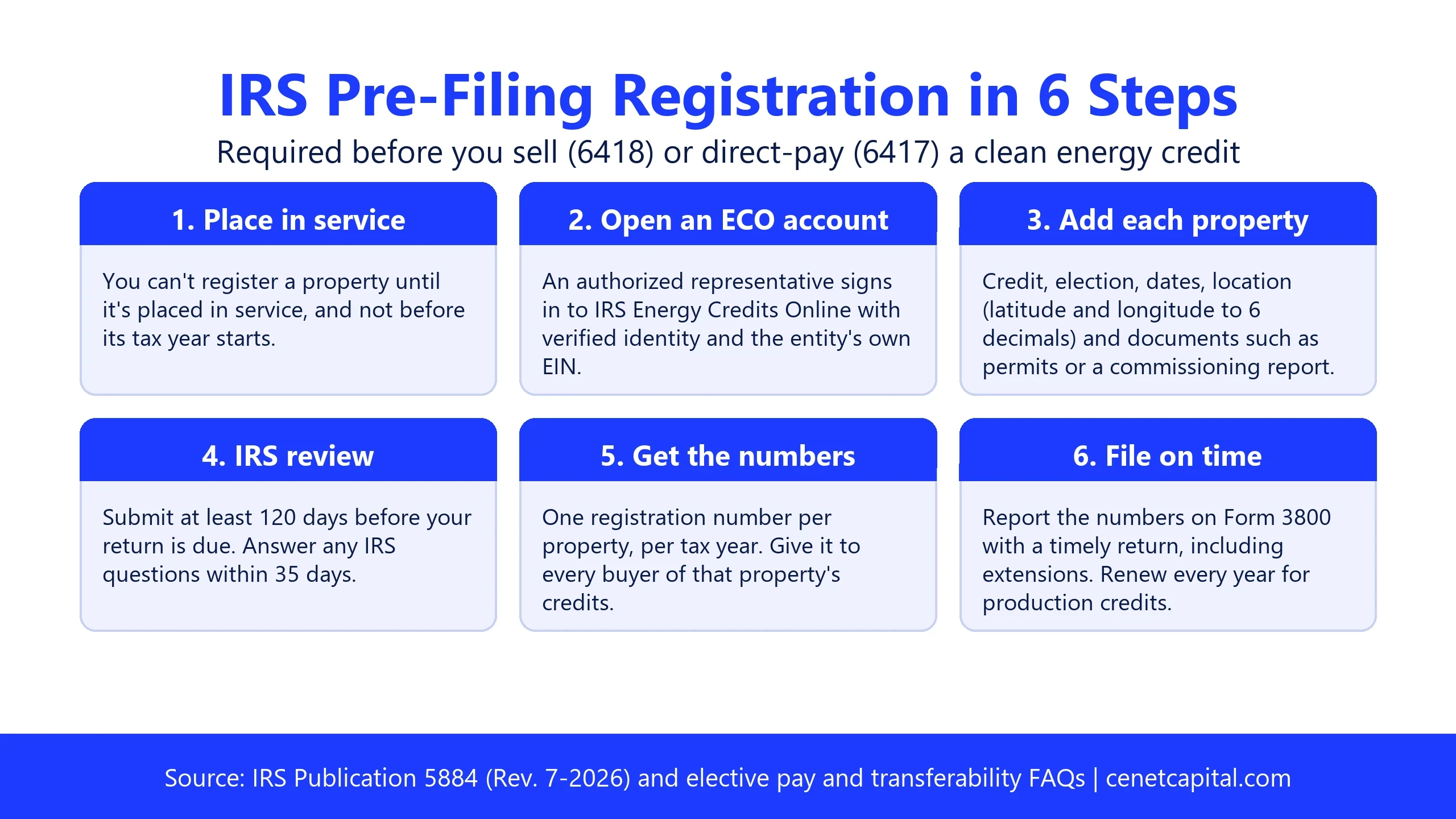
Large portfolios can bulk upload facilities for credits such as 45Y, 48E and 30C, up to 3,000 properties per package and 33 packages a year. If the IRS returns a package with questions, answer within 35 days or it closes and has to be resubmitted. Plan your dates with the tool below.
When do you need to register?
Uses the IRS's 120-day recommendation from Publication 5884 (Rev. 7-2026). Calendar-year filers.- The IRS opens registrations for a tax year early in that year's second quarter. You can't register a property until it's placed in service.
- A registration number is good for one tax year only. An ITC is claimed once, in the year the property is placed in service.
- Give the same registration number to every buyer of that property's credits. It must appear on your return and on the transfer election statement.
A general guide, not tax advice. Fiscal-year filers should count from their own due date. Weekend due dates move to the next business day.
Get help registering →How long does a registration number last?
One tax year. Publication 5884 says a registration number “is valid only for the year for which it was issued.” An investment tax credit is claimed once, so one number usually does it. A production tax credit is earned every year, so you renew the registration every year you sell or direct-pay it.
The tool helps with renewals by pulling renewable production properties from the prior year into the new year’s registration. That still means 10 renewals for a 10-year PTC such as 45Y or 45V. A for-profit company that elects direct pay for 45V still needs a new number each year of its five-year election.
Numbers don’t move with ownership. If a facility is sold, the new owner registers it again under its own EIN and can’t use the seller’s number. It can mention the earlier registration so the IRS knows the facility was reviewed before. Cancelling a registration can’t be reversed.
What happens after you get a registration number?
You report it on Form 3800 with your return. For a transfer, you also include it on the transfer election statement and give it to every buyer, who reports the same number on its own return. Registration doesn’t guarantee the credit: the IRS can still examine whether you qualified and how much you earned.
The same number goes to all transferees of credits from the same facility, and buyers and sellers can file in either order. Buyers check registration early in diligence, along with the evidence behind the credit. Our tax credit purchase checklist and Form 3800 guide show where the number is used.

If a transferred credit turns out to be overstated, the buyer bears the tax on the excess, plus a 20% penalty unless it can show reasonable cause. That’s why buyers price registration problems into the deal, and why many use tax credit insurance. Our guide to selling solar tax credits walks through a full sale.
What are the most common registration mistakes?
Registering too late, using the wrong EIN, registering under the wrong election, forgetting to renew production credits each year, and uploading thin documentation. Each one can delay the number past your filing date, and a missing number means a missed election that can’t be fixed on a late return.
Hydrogen producers have extra steps to line up, from emissions verification to the right forms, which our 45V tax credit guide covers. Wind and solar projects should file the evidence that construction began in time, especially after the court ruling on Notice 2025-42. If you’re selling credits for the first time, start registration as soon as the facility is placed in service.
Sources
Internal Revenue Service, Publication 5884 (Rev. 7-2026), Elective Pay and Transfer Election Pre-Filing Registration User Guide
Internal Revenue Service, Register for elective payment or transfer of credits
Internal Revenue Service, Elective pay and transferability frequently asked questions: Transferability
Legal Information Institute, 26 U.S. Code 6418 and 26 U.S. Code 6417
Frequently Asked Questions
What is IRS pre-filing registration?
It's the IRS process, run through the Energy Credits Online tool, that every entity must complete before it can sell a clean energy credit under section 6418 or receive it as a direct payment under section 6417. The IRS reviews each facility and issues a registration number, which must appear on the tax return for the election to be valid.
When should I complete IRS pre-filing registration?
Do I need to register every year?
Does a registration number guarantee my credit?
Can Cenet Capital help with pre-filing registration and a credit sale?
Get registered and get paid for your credits
Cenet Capital helps credit owners line up IRS pre-filing registration with a credit sale, so the registration number is ready before the buyer's deadline. Tell us your credit type, facility and filing date.

More Insights


