
Credit Guides
What renewable natural gas is, how biogas becomes RNG, what it costs to make, and how D3 RINs, the 45Z credit and the expired biogas ITC shape project revenue.
Author -
Paulestini Francois
Published -
READ TIME
Renewable natural gas turns landfill and manure methane into pipeline fuel, but it costs several times more than fossil gas to make. Here's how RNG is produced, what it costs, and how D3 RINs, the 45Z Production Tax Credit (PTC) and the old biogas Investment Tax Credit (ITC) fill the gap.
QUICK ANSWER
Renewable natural gas (RNG) is biogas from landfills, farms, wastewater plants and food waste that has been upgraded to 90% methane or more so it can replace fossil natural gas. It costs about $7 to $33 per MMBtu to make, so producers rely on D3 RINs, state clean fuel credits and the 45Z credit.
KEY FACTS
Is biomethane the same as RNG? Yes. Biomethane and renewable natural gas both mean biogas upgraded to replace fossil natural gas.
How much methane is in biogas? Raw biogas is 45% to 65% methane; landfill gas is roughly half methane, per EPA.
What is an anaerobic digester? A sealed tank or covered lagoon where microbes break down manure, sludge or food waste without oxygen and release biogas.
How many RINs is RNG worth? One D3 RIN per 77,000 Btu used as vehicle fuel, about 12.99 RINs per MMBtu.
Is there a renewable natural gas tax credit? Yes. The 45Z PTC pays up to $1.00 per gallon equivalent times the emissions factor for RNG sold through 2029.
What happened to the biogas ITC? The Section 48 ITC for qualified biogas property is closed to projects that began construction after 2024.
What is renewable natural gas (RNG)?
Renewable natural gas (RNG), also called biomethane, is biogas from landfills, farms, wastewater plants and food waste that has been cleaned up to replace fossil natural gas. It’s chemically the same fuel, so it moves through existing pipelines and burns in the same engines, boilers and power plants.
The U.S. Environmental Protection Agency describes RNG as biogas “upgraded for use in place of fossil natural gas.” It can be used on site, piped to one customer, or injected into the pipeline system.
RNG’s value comes from credits, not the gas. Methane traps at least 28 times more heat than CO2 over 100 years, so capturing it earns credits under the Renewable Fuel Standard (RFS), state programs and the 45Z clean fuel production credit.
How is renewable natural gas made?
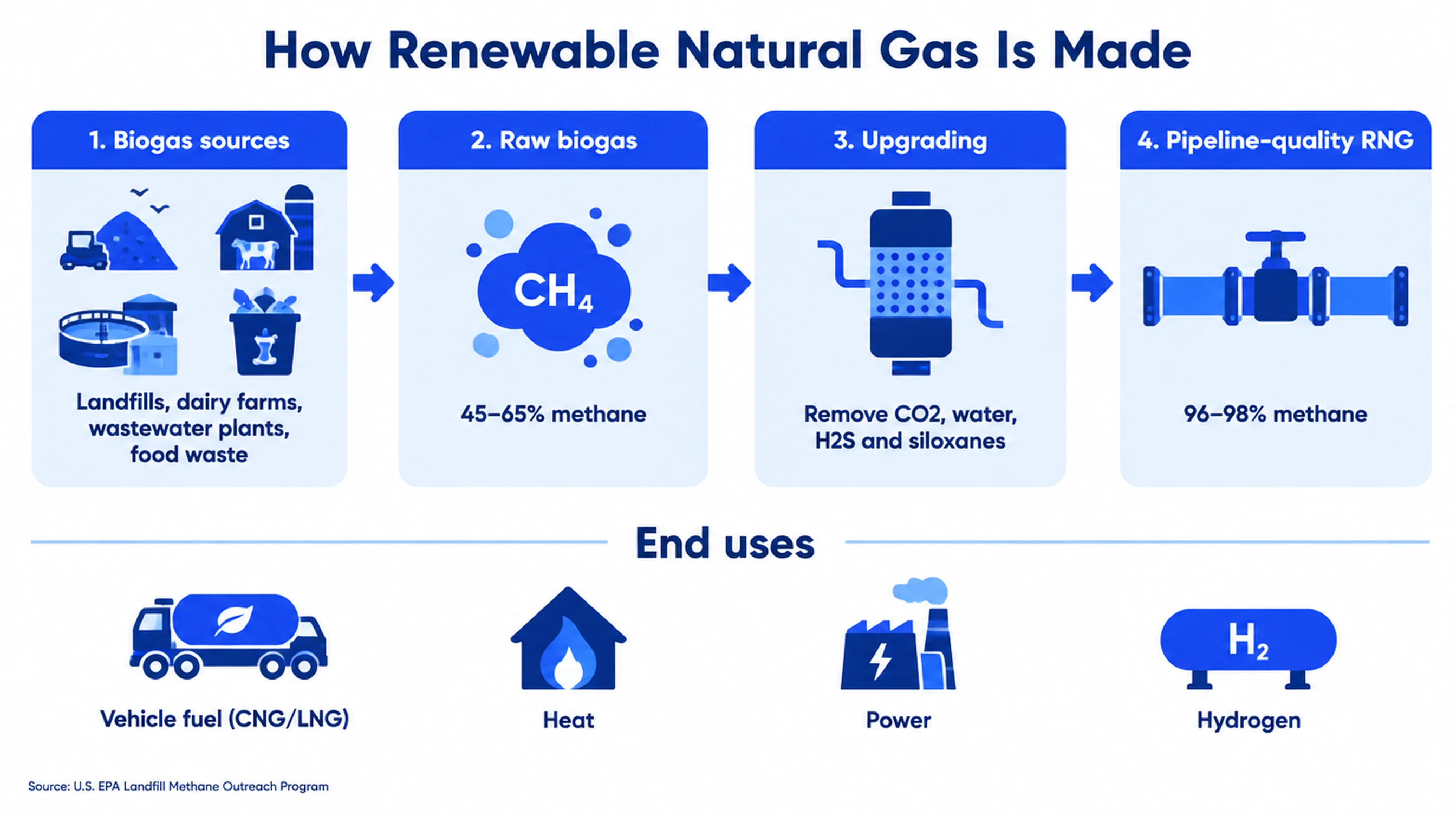
Bacteria break down organic waste without oxygen and release biogas, which is 45% to 65% methane. An upgrading system then strips out carbon dioxide, water, hydrogen sulfide and siloxanes, and cuts nitrogen and oxygen, until the gas is 90% methane or more. Pipeline-grade RNG is typically 96% to 98% methane.
At a landfill, wells collect gas that EPA says is roughly half methane and half carbon dioxide. On a dairy or at a wastewater plant, it comes from an anaerobic digester, a sealed tank or covered lagoon where microbes break down manure or sludge.
Upgrading is the expensive part of RNG production. Common technologies include membrane separation, pressure swing adsorption, amine scrubbing and water wash. The gas then needs compression and a pipeline interconnect, about $2 million on its own per ICF’s study for the American Gas Foundation.
Where does RNG come from in the United States?
Most U.S. RNG comes from landfills and livestock farms, with smaller volumes from wastewater plants and food waste digesters. EPA counted 237 RNG projects operating in 2023: 102 at landfills and 135 at farms. Farm projects grew almost tenfold in five years, from 14 in 2018.
EPA says municipal solid waste landfills are the third-largest source of human-related methane in the U.S., about 14.4% of the total in 2022.
Growth has continued since EPA’s last count. The RNG Coalition says North America reached 604 operating RNG facilities in July 2026, after passing 300 in 2023, 400 in 2024 and 500 in 2025. Explore the trend in the chart below.
Farm digesters went from 14 projects in 2018 to 135 in 2023 and overtook landfills, as D3 RINs and state clean fuel credits rewarded captured manure methane.
Sources: U.S. EPA LMOP, "RNG Projects Operating by Year" (landfill and agriculture, 2005–2023); RNG Coalition, July 2026 facility milestone release; EPA RFS Pathways II final rule (79 FR 42128, July 18, 2014).
What is the difference between biogas, biomethane and RNG?
Biogas is the raw gas from decomposing waste, about half methane and half carbon dioxide plus impurities. Biomethane and RNG mean the same thing: biogas upgraded to 90% methane or higher so it can replace fossil natural gas. Biogas usually gets burned on site; RNG can be piped and sold.
The difference matters for incentives. Biogas burned in an engine for electricity is a power project. Upgraded RNG sold as vehicle fuel is a fuel project, which opens up RINs, clean fuel credits and 45Z.
How much does it cost to produce RNG?
RNG costs several times more to make than fossil natural gas. ICF estimated landfill RNG starting near $7 per MMBtu, wastewater RNG at $7.40 to $26.10, food waste at $19.40 to $28.30 and animal manure at $18.40 to $32.60, in 2019 dollars. Henry Hub gas is forecast near $3.48 in 2026.
Scale explains most of the spread: a large landfill produces steadily, while a single dairy makes a small stream, so manure projects often cluster several farms. ICF also estimated RNG from thermal gasification of residues and waste at $17.30 to $44.20 per MMBtu, a route covered in our gasification guide.
With the EIA’s October 2026 outlook putting Henry Hub near $3.48, almost no RNG is sold as plain pipeline gas.
How do RNG producers make money?
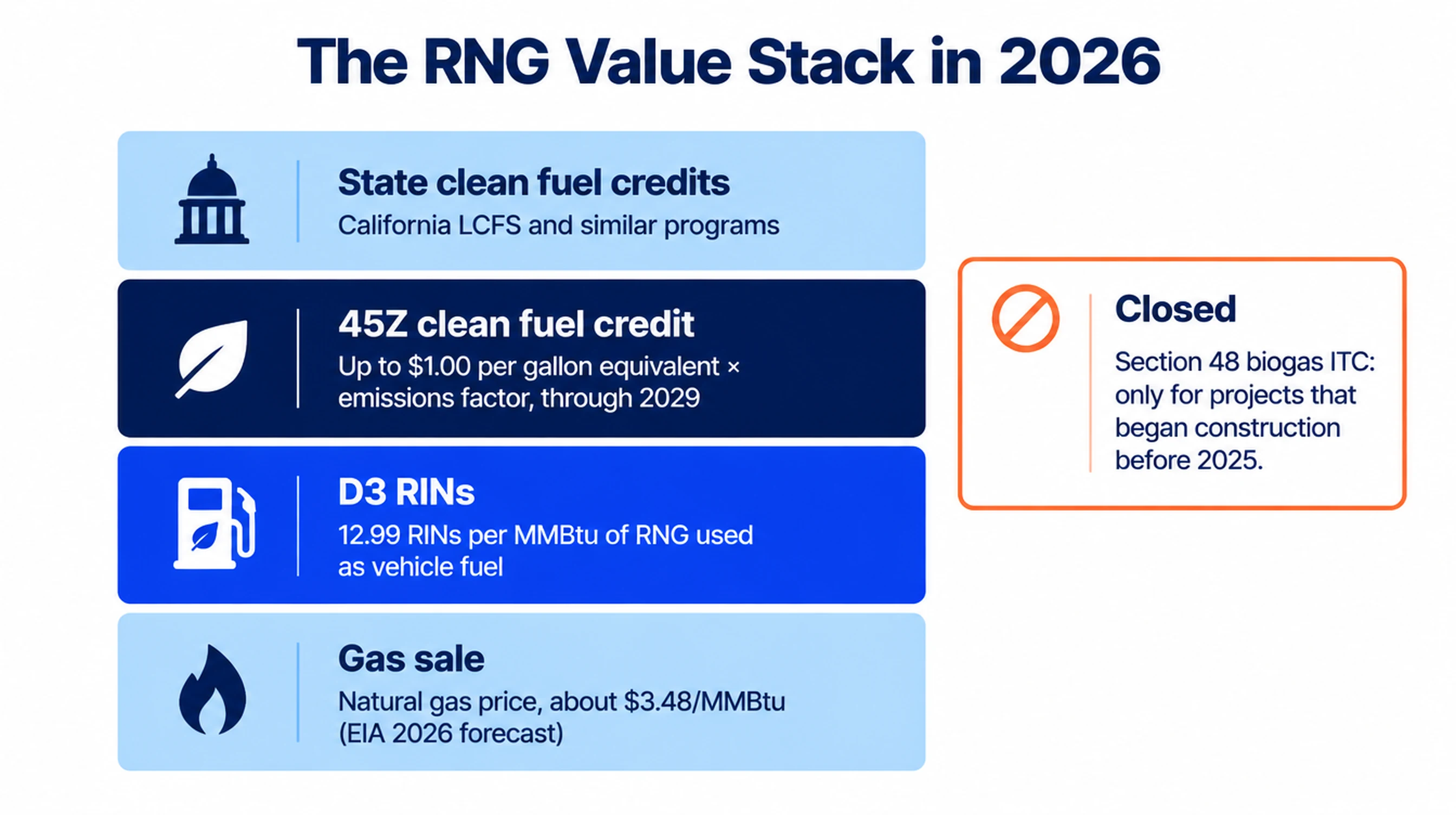
RNG producers stack several revenue streams on each MMBtu: the gas sale, D3 Renewable Identification Numbers (RINs) under the federal RFS, state clean fuel credits such as California’s Low Carbon Fuel Standard (LCFS), and the 45Z clean fuel production credit. Credits, not gas, usually supply most of the revenue.
RINs are the biggest piece. Under 40 CFR 80.1415, every 77,000 Btu of RNG used as transportation fuel equals one RIN, or about 12.99 RINs per MMBtu. EPA has treated landfill and digester biogas as a cellulosic D3 fuel since its 2014 Pathways II rule. D3 RINs traded around $2.40 in early 2026, according to Hoekstra Trading, which works out to about $31 per MMBtu.
EPA sets demand: its final 2026 and 2027 standards require 1.36 billion cellulosic RINs in 2026 and 1.43 billion in 2027. The calculator below shows how the stack shifts by source, carbon score and price.
Credits supply 91% of the value. That lifts revenue into or above ICF's cost range for this source.
Illustrative only. 45Z shown before the annual inflation adjustment and only for fuel sold through 2029; the rate comes from your 45ZCF-GREET result, and defaults are examples, not published rates. RIN value assumes RNG used as transportation fuel. Costs are ICF 2019 ranges in 2019 dollars. Excludes state LCFS credits. Confirm with your tax advisor.
Does RNG qualify for the 45Z tax credit?
Yes. RNG suitable for use as transportation fuel can earn the 45Z clean fuel production credit through 2029: up to $1.00 per gallon equivalent with prevailing wage and apprenticeship, multiplied by an emissions factor. The cleaner the gas, the bigger the credit, and manure-based RNG can earn more than $1.00.
Under 26 U.S.C. 45Z, the emissions factor is 50 kg CO2e per MMBtu minus the fuel’s emissions rate, divided by 50. The One Big Beautiful Bill Act extended the credit to fuel sold through December 31, 2029, banned negative emissions rates for fuel produced after 2025, and carved out one exception: fuel from animal manure. IRS Notice 2026-53 lists dairy and swine manure as distinct feedstocks in the 2026 emissions rate table.
The proposed 45Z regulations define a gallon equivalent as 116,090 Btu, about 8.61 per MMBtu, and treat the company that upgrades biogas as the producer. Producers must register before production and sell to an unrelated buyer. Our 45Z guide covers the rest, and 45Z credits can be sold for cash under transferability.
What happened to the RNG investment tax credit?
The Section 48 Investment Tax Credit (ITC) for qualified biogas property, which covered digesters and gas upgrading equipment, is closed to projects that began construction after 2024. Its successor, Section 48E, covers only equipment that generates electricity, so RNG upgrading for pipeline sale no longer qualifies.
The biogas ITC required a system producing gas of at least 52% methane, and final regulations issued in December 2024 confirmed that cleaning and conditioning equipment was included. As Baker Tilly explains, under Section 48E only engines, generators, fuel cells and similar power equipment count.
Projects that began construction in time can still claim the ITC when placed in service. For new RNG projects, 45Z is now the main federal tax credit.
Can RNG be used to make hydrogen that earns 45V?
Yes. The 45VH2-GREET model includes reforming of RNG from landfills, animal manure and wastewater plants, so RNG-fed hydrogen can qualify for the 45V clean hydrogen credit if construction begins before 2028. But a facility can’t claim 45V and 45Z in the same year.
The December 2025 45VH2-GREET manual lists steam methane reforming, autothermal reforming and partial oxidation fed by those three kinds of RNG. Our steam methane reforming guide explains the process, and the 45V guide covers the tiers, worth up to $3.28 per kg in 2026.
Section 45Z excludes any facility that claims 45V or 45Q for the year, so a project must pick a lane. California’s amended LCFS also keeps avoided-methane crediting for renewable hydrogen while phasing it out for biomethane burned as fuel.
Is renewable natural gas carbon negative?
Manure-based RNG can score below zero because it captures methane that would otherwise escape from open lagoons. Landfill and wastewater RNG usually score low but positive. Federal law now allows negative 45Z emissions rates only for animal manure, and California is phasing out its avoided-methane credit for new combustion projects.
The score depends on what would have happened to the methane. Notice 2026-53 lets manure producers set that baseline from documented farm practices, such as uncovered lagoons.
California is tightening. Under CARB’s amended LCFS, credit generation for RNG projects that break ground after 2029 phases out on December 31, 2040, according to AgProud. Leakage matters too: EPA publishes best practices for RNG facilities because escaped methane undoes the climate benefit.
Sources
U.S. EPA Landfill Methane Outreach Program, Renewable Natural Gas
U.S. EPA, Basic Information about Landfill Gas
RNG Coalition, RNG Coalition Marks 15 Years As North American Facility Count Passes 600 (July 2026)
ICF for the American Gas Foundation, Renewable Sources of Natural Gas: Supply and Emissions Reduction Assessment (2019)
U.S. Energy Information Administration, Short-Term Energy Outlook (October 2026)
40 CFR 80.1415, How are equivalence values assigned to renewable fuel?
U.S. EPA, Renewable Fuel Pathways II Final Rule (2014) and Final Renewable Fuel Standards for 2026 and 2027
Hoekstra Trading, RIN Price Outlook (2026)
26 U.S.C. 45Z, Clean fuel production credit; IRS Notice 2026-53; Proposed Section 45Z regulations (91 FR, February 4, 2026)
Mayer Brown, IRS Releases Final Energy Property Regulations Under Section 48; Baker Tilly, Changes to biogas tax credits in 2025
U.S. DOE, 45VH2-GREET User Manual (December 2025)
AgProud, CARB approves Low Carbon Fuel Standard program updates
Frequently Asked Questions
What is renewable natural gas made from?
RNG is made from biogas released when organic waste breaks down without oxygen. The main sources are municipal landfills, livestock manure in anaerobic digesters, wastewater treatment sludge and food waste. EPA counted 102 landfill and 135 farm RNG projects operating in the U.S. in 2023.
Is renewable natural gas better than natural gas?
How much does renewable natural gas cost?
Can RNG projects still get an investment tax credit?
Can Cenet Capital help sell RNG tax credits?
Making RNG? Turn your 45Z credits into cash
Cenet Capital helps RNG producers value their 45Z clean fuel credits and any remaining biogas ITC, and sell them to corporate tax buyers for cash. Tell us about your feedstock, volume and timeline.

More Insights