

Credit Guides
Geothermal tax credits in 2026: the 30% Section 48 heat pump credit, 48E and 45Y for power plants, phase-downs after the Big Beautiful Bill and how to sell them.
Author -
Paulestini Francois
Published -
READ TIME
The homeowner geothermal credit ended in 2025, but business geothermal credits survived the One Big Beautiful Bill Act almost untouched. Here's what commercial heat pumps and geothermal power plants can claim in 2026, through the Investment Tax Credit (ITC) or Production Tax Credit (PTC), and when each credit steps down.
QUICK ANSWER
Businesses can claim a 30% Section 48 credit for geothermal heat pumps that begin construction before 2033, stepping down to 26% and 22% before ending in 2035. Geothermal power plants can take the 30% Section 48E ITC or the Section 45Y PTC, at full value for construction starting through 2033.
KEY FACTS
Is there a geothermal tax credit in 2026? Yes, for businesses: Section 48 for heat pumps and Section 48E or 45Y for power plants. The homeowner 25D credit ended after 2025.
What is the geothermal heat pump tax credit for commercial buildings? 6% of cost, or 30% with prevailing wage or under 1 MW, for construction starting before 2033.
What is the geothermal ITC for power plants? The Section 48E ITC: 30% of eligible cost with prevailing wage, plus up to 20 points of bonuses.
What is the geothermal PTC? The Section 45Y PTC: about 3.0 cents per kWh for 10 years at 2025 inflation-adjusted rates.
When does the geothermal credit phase out? Power plants get 100% for 2033 starts, 75% for 2034 and 50% for 2035; heat pumps end for construction after 2034.
Did the Big Beautiful Bill cut geothermal credits? No for businesses. It ended the homeowner credit but kept full 48E and 45Y credits for geothermal power through 2033.
What geothermal tax credits are available in 2026?
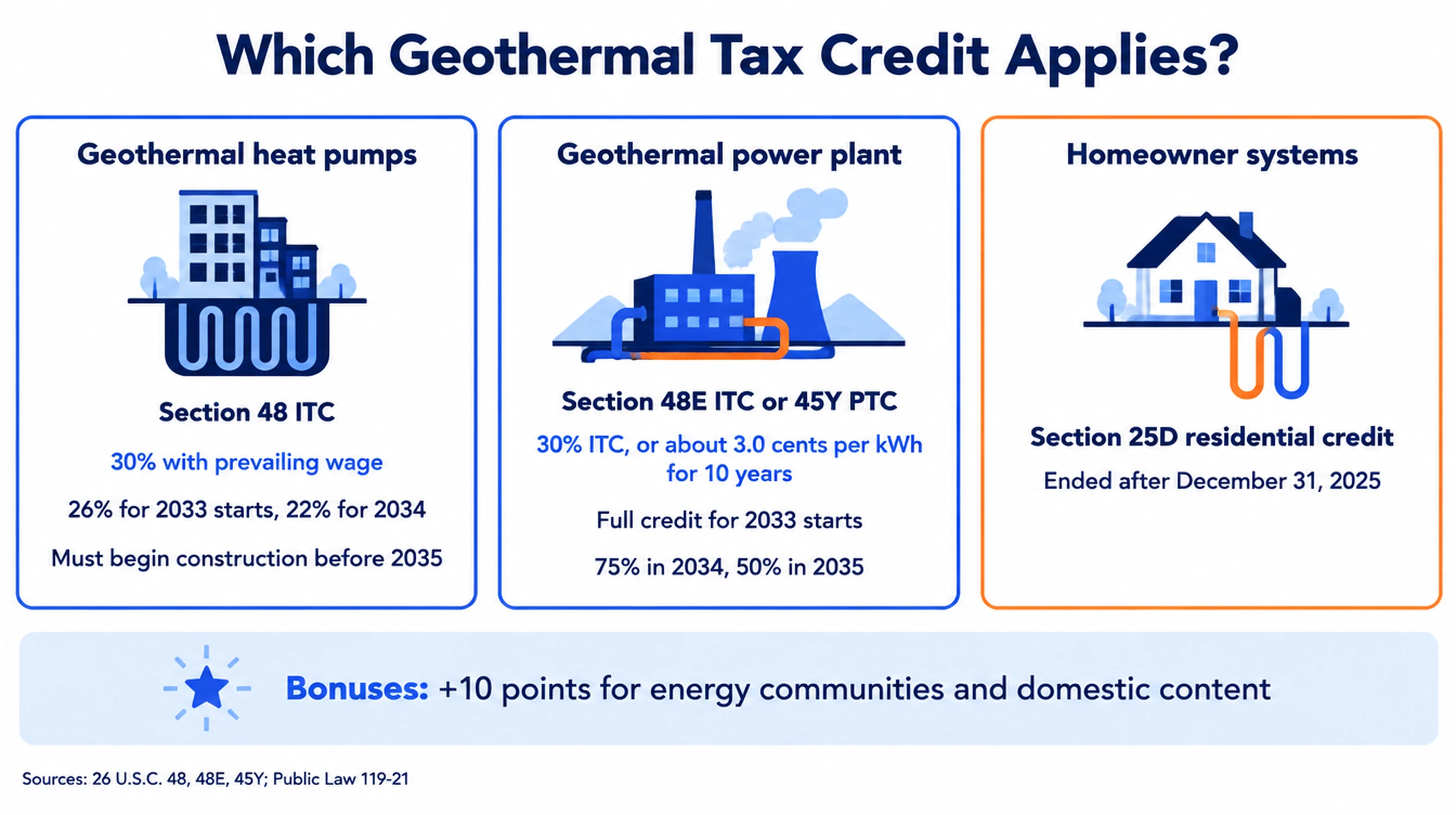
Businesses can claim a 30% Section 48 Investment Tax Credit (ITC) for geothermal heat pumps, and geothermal power plants can choose the Section 48E ITC or the Section 45Y Production Tax Credit (PTC). The homeowner credit under Section 25D ended after 2025, so new federal geothermal credits are now business credits.
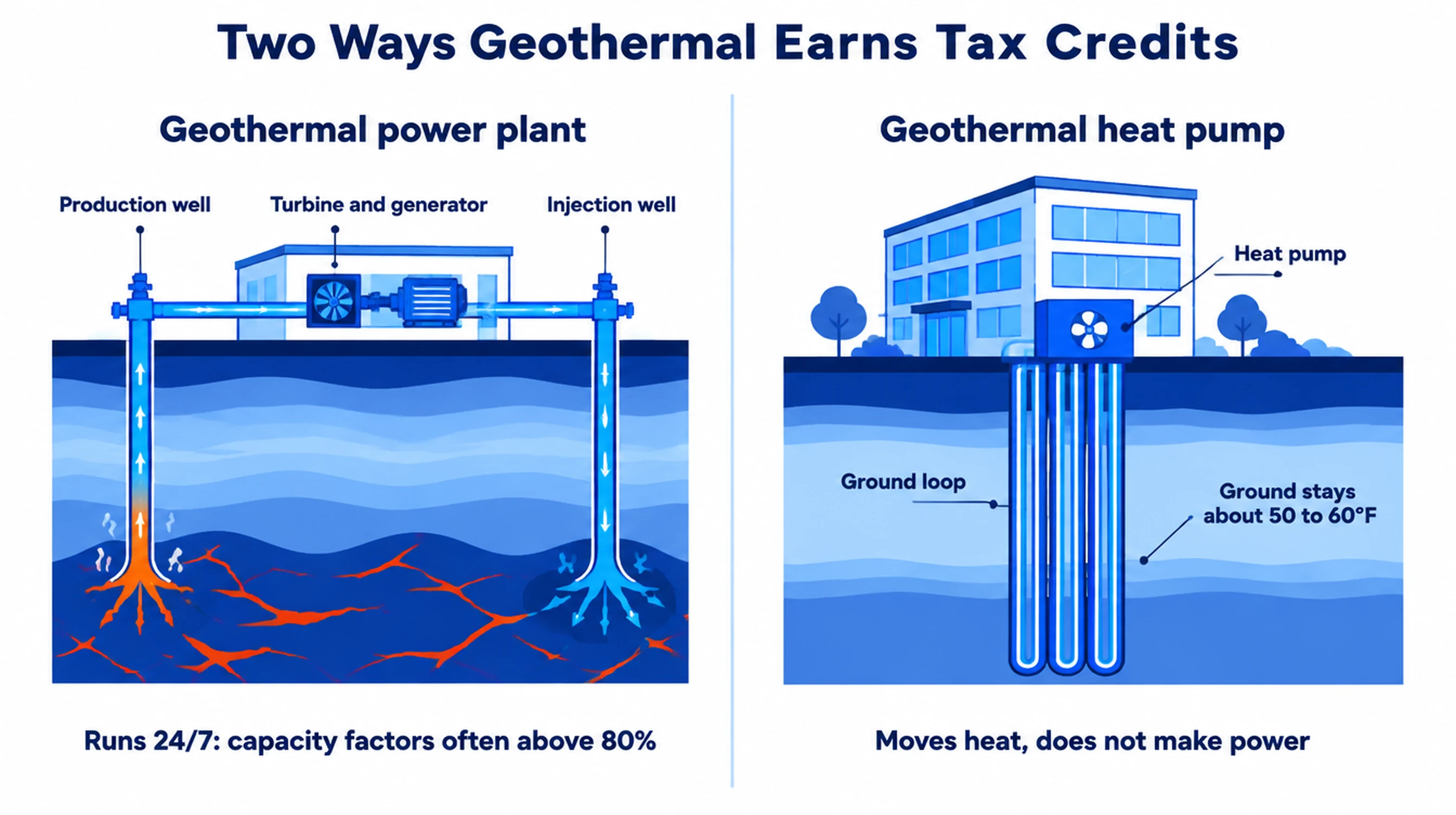
The two business paths cover very different projects. Geothermal heat pumps heat and cool buildings using stable ground temperatures. Geothermal power plants tap hot water and steam to make electricity around the clock.
Both kept strong incentives under the One Big Beautiful Bill Act (Public Law 119-21), unlike wind and solar. As Canary Media reported, geothermal and other baseload sources can still claim the full 48E or 45Y credit.
Is the federal tax credit for geothermal going away?
For homeowners, yes: the 30% Residential Clean Energy Credit covers geothermal heat pumps installed only through December 31, 2025. For businesses, no. Commercial geothermal heat pumps keep a credit for construction starting before 2035, and geothermal power plants keep the full credit for construction starting through 2033.
The IRS confirms the residential credit applied to property installed from 2022 through December 31, 2025. Business credits then phase down on set schedules, shown in the timeline chart later in this guide.
That means geothermal energy tax credits now flow almost entirely to businesses: the commercial geothermal tax credit for heat pumps in offices, schools and campuses, and the power plant credits for utilities and developers.

How does the geothermal heat pump tax credit work for businesses?
A business that installs a geothermal heat pump system, also called a ground-source heat pump, can claim the Section 48 energy credit on the cost of the ground loop, heat pumps and related equipment. The credit is a percentage of cost, claimed when the system is placed in service, on Form 3468.
Section 48 defines the property as equipment using the ground or groundwater as a thermal energy source to heat a structure or a sink to cool it, but only if construction begins before January 1, 2035.
The savings can be large. An NREL analysis of the U.S. commercial building stock found geothermal heat pumps cut total site energy by 34.5% in the buildings where they apply.
How much is the geothermal heat pump tax credit?
The base rate is 6% of cost, rising to 30% if the project meets prevailing wage and apprenticeship rules or is under 1 megawatt. The rate steps down to 26% for construction starting in 2033 and 22% in 2034. Energy community and domestic content bonuses can each add 10 percentage points.
Under Section 48(a)(7), the base energy percentage is 6% for construction beginning before 2033, 5.2% in 2033 and 4.4% in 2034. The 5x multiplier lifts those to 30%, 26% and 22%. Most building systems are small enough to qualify for the full rate without prevailing wage requirements.
A $3 million campus system starting construction in 2027 earns a $900,000 credit, or $1.2 million in an energy community. Plante Moran lays out the same 6%, 5.2% and 4.4% base-rate schedule for commercial systems.
What credits can a geothermal power plant claim?
Geothermal power plants qualify for the technology-neutral Section 48E ITC or Section 45Y PTC because they produce electricity with no greenhouse gas emissions. The ITC pays 30% of eligible cost with prevailing wage. The PTC pays about 3.0 cents per kilowatt-hour for 10 years at 2025 inflation-adjusted rates.
The statutory PTC is 0.3 cents per kWh, or 1.5 cents with prevailing wage, adjusted for inflation. The IRS set the 2025 inflation adjustment factor at 1.9971, which puts the rates near 0.6 and 3.0 cents. Our guides to Section 48E and Section 45Y cover the rules in depth.
Next-generation projects are now delivering power. Fervo Energy declared commercial operation at Cape Station in Utah ahead of schedule in fall 2026, an early test of enhanced geothermal at scale.
Should a geothermal power plant take the ITC or the PTC?
Geothermal plants run almost constantly, so the PTC often wins: high output earns more cents per kilowatt-hour over 10 years. The ITC suits plants with high drilling costs, lower output, or owners who want cash in year one. Compare both at your capacity factor and cost of capital before choosing.
Drilling risk matters too. The ITC is fixed once a plant is placed in service, while the PTC depends on how much the wells actually produce. Our ITC vs. PTC guide explains the tradeoff. Model your project in the calculator below.
Start construction by the end of 2032 to lock in the full 30% rate before it steps down to 26% and 22%.
Illustrative only. PTC uses 2025 inflation-adjusted rates for every year and no degradation; bonus treatment simplified. Excludes FEOC (prohibited foreign entity) limits, basis reduction and state incentives. Confirm with your tax advisor.
What did the One Big Beautiful Bill change for geothermal?
It left geothermal’s credits largely intact. Geothermal power keeps the full 45Y and 48E credit for construction starting through 2033, then 75% in 2034, 50% in 2035 and nothing after. Wind and solar, by contrast, must have begun construction by July 4, 2026 or be placed in service by the end of 2027.
The law fixed the phase-out’s “applicable year” at 2032 in Section 45Y(d), so the step-downs start with 2034 construction. The law also ended the homeowner credit after 2025. See our One Big Beautiful Bill guide for every credit it changed.
Full credit: geothermal kept the 48E and 45Y credits through 2033 starts.
Maximum rate with prevailing wage and apprenticeship, before energy community or domestic content bonuses. The 45Y PTC follows the same phase-out percentages. Sources: 26 U.S.C. 45Y(d), 48(a)(7), 48E; Public Law 119-21.
Do FEOC rules apply to geothermal projects?
Yes for geothermal power. Section 45Y and 48E projects that begin construction after 2025 must pass the prohibited foreign entity tests, including a cap on equipment and components from China and other foreign entities of concern. Owners that are themselves prohibited foreign entities can’t claim the credits at all.
Geothermal plants rely heavily on drilling services, steel and turbines, so supply chain records matter. Our FEOC rules guide explains the material assistance cost ratio.
Can you sell geothermal tax credits?
Yes. Section 48, 48E and 45Y credits are transferable under Section 6418, so a geothermal owner can sell them for cash to a corporate buyer. ITCs averaged about $0.913 per dollar and PTCs about $0.930 in 2026, according to Crux, and tax-exempt owners can use elective pay instead.
Sellers register the project with the IRS before transferring, through pre-filing registration. Buyers will check recapture risk and wage compliance, covered in our guide to buying clean energy tax credits.
Sources
26 U.S.C. 48 (energy credit, including 48(a)(7)), 48E and 45Y
IRS, Residential Clean Energy Credit; Internal Revenue Bulletin 2025-38 (Notice 2025-38, 45Y inflation adjustment)
NREL, geothermal heat pump analysis in the ComStock commercial building model (2024)
Plante Moran, Geothermal heat pump systems tax incentives (2026)
Canary Media, Geothermal survives in ‘big, beautiful’ budget bill (2025)
Energy Global, Fervo Energy declares commercial operation at Cape Station (2026)
pv magazine USA, Crux 2026 tax credit pricing
Frequently Asked Questions
Is the federal tax credit for geothermal going away?
The homeowner credit already ended for systems installed after December 31, 2025. Business credits continue: commercial geothermal heat pumps need to begin construction before 2035, and geothermal power plants keep the full credit for construction starting through 2033.
How does the 30% tax credit work for geothermal?
Can I get a tax credit for a geothermal heat pump at home in 2026?
Should a geothermal power plant choose the ITC or PTC?
Can Cenet Capital help sell geothermal tax credits?
Building geothermal? Turn your credits into cash
Cenet Capital helps geothermal developers and building owners value their Section 48, 48E or 45Y credits and sell them to corporate tax buyers. Tell us about your project size, cost and construction timeline.

More Insights