

Policy & Compliance
ITC recapture claws back 100% to 20% of an investment tax credit if a project is sold or stops qualifying within 5 years. Triggers, who pays after a sale, Form 4255.
Author -
Paulestini Francois
Published -
READ TIME
An investment tax credit arrives all at once, but it isn't fully yours for five years. Sell the project, bring in a new partner or change how the property is used too soon, and the IRS can take part of the credit back. Here's how ITC recapture works, what triggers it, who pays after a credit sale, and how to avoid it.
QUICK ANSWER
ITC recapture takes back part of an investment tax credit if the property is sold or stops qualifying within five full years of being placed in service. Under section 50(a), the recapture percentage is 100% in year one, then 80%, 60%, 40% and 20%. After a section 6418 credit sale, the buyer pays recapture on the credits it bought.
KEY FACTS
What is investment tax credit recapture? An added tax equal to a share of the ITC, owed when the property is disposed of or stops qualifying early.
How long is the recapture period? Five full years from the placed-in-service date. The recapture share drops 20 points each full year.
Where is tax credit recapture reported? On Form 4255, filed with the return for the year of the recapture event.
Which law sets the schedule? Section 50 of the Internal Revenue Code. Section 50(c) also adds half the recapture back to the property's basis for energy credits.
Does the 48E ITC have extra recapture rules? Yes. Some 48E projects face 100% recapture for payments to a prohibited foreign entity within 10 years of being placed in service.
Can a hydrogen ITC be recaptured? Yes. If a producer elects the ITC under section 48(a)(15), a missed annual verification or a worse emissions tier triggers recapture.
Who pays recapture on transferable tax credits? The buyer, on the credits it purchased. The seller must notify it, and pays recapture on any credit it kept.
What is ITC recapture?
ITC recapture is the IRS clawing back part of an investment tax credit (ITC) when the property stops qualifying within five years of being placed in service. Under section 50(a), selling the project or changing its use triggers it. The tax due increases by a share of the original credit that shrinks each year.
An ITC, such as the 48E clean electricity ITC or the legacy section 48 energy credit, is claimed all at once in the year a project is placed in service. Congress attached a five-year string to that upfront benefit. If the project is “disposed of, or otherwise ceases to be investment credit property” before the recapture period ends, part of the credit comes back as additional tax.
Production tax credits (PTCs) work differently. A PTC such as 45Y or 45V is earned each year as power or hydrogen is produced, so there’s nothing upfront to recapture. Our ITC vs. PTC guide explains the trade-off, and our investment tax credit guide covers how the ITC is calculated.
How does the ITC recapture schedule work?
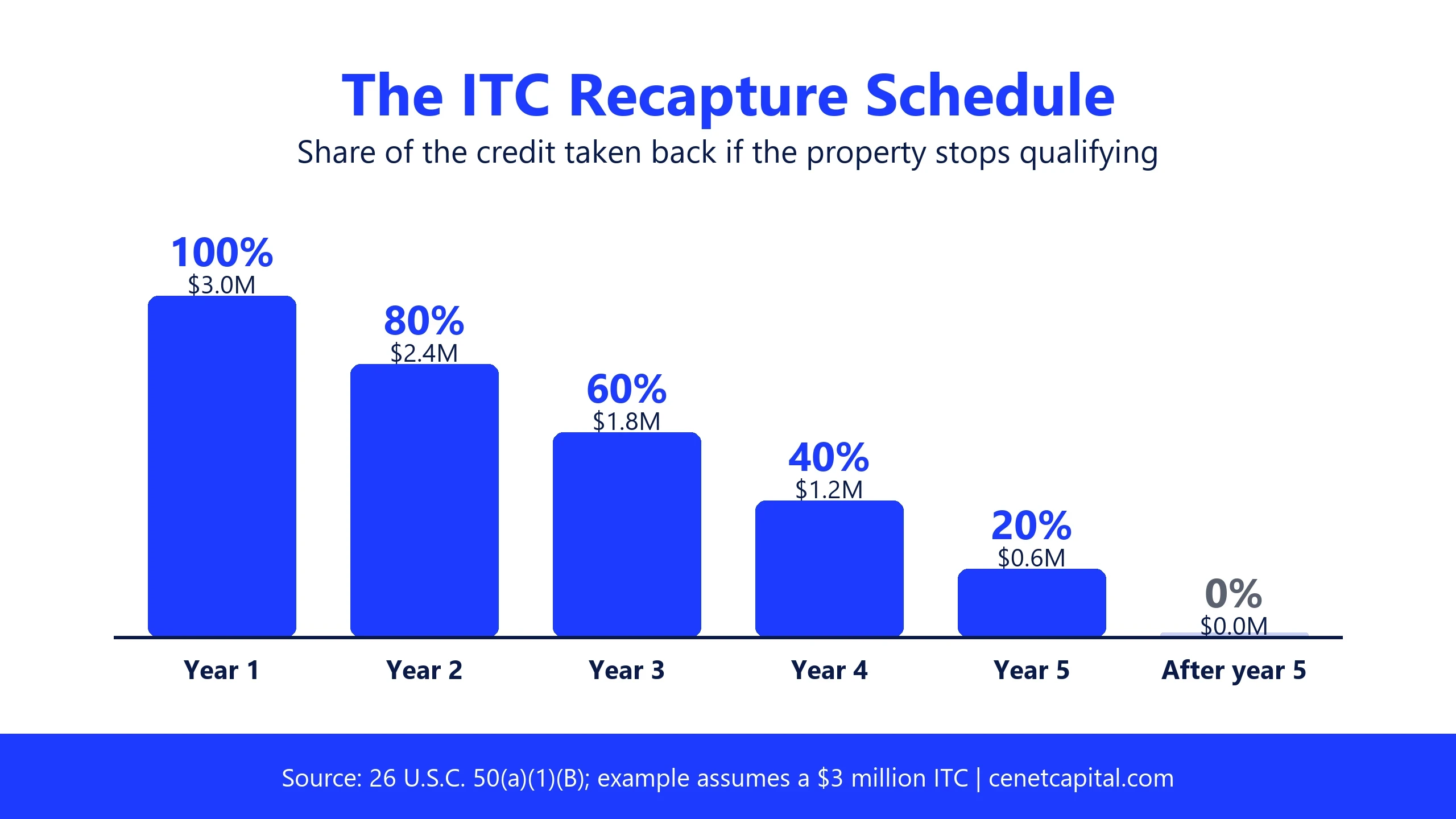
The recapture percentage drops by 20 points for each full year the property stays in service. A recapture event in the first year takes back 100% of the credit, then 80% in year two, 60% in year three, 40% in year four and 20% in year five. After five full years, nothing is recaptured.
The schedule is set out in section 50(a)(1)(B), and the years run from the placed-in-service date, not the calendar year. A solar project placed in service on June 1, 2026 and sold on August 1, 2028 has completed two full years, so it falls in the 60% bracket. On a $3 million ITC, that’s $1.8 million of added tax in the year of the sale.
Recapture also restores some basis. When an ITC is claimed, the property’s depreciable basis is reduced by half the credit. Under section 50(c), half the recapture amount is added back to basis immediately before the event, which partly offsets the gain on a sale.
What events trigger ITC recapture?
The main triggers are selling or disposing of the property, a partner’s stake dropping by more than one-third, moving the property outside the U.S., and leasing or transferring it to a tax-exempt or government user. Under Treasury rules, a transfer on foreclosure counts as a disposition too.
The IRS Form 4255 instructions list the common cases. For partnerships and S corporations, recapture applies when a partner’s or shareholder’s “proportionate interest was reduced by more than one-third” before the end of the recapture period. That makes the timing of investor exits and portfolio sales a recapture question, not just a deal question.
Some events don’t trigger recapture. Section 50(a)(6) exempts transfers by reason of death, section 381 reorganizations, and a “mere change in the form of conducting the trade or business” if the owner keeps a substantial interest. Two newer triggers apply to clean energy credits: failing prevailing wage rules on later repair or alteration work within five years, and, for some 48E projects, payments to a prohibited foreign entity within ten years.

Who pays ITC recapture after a tax credit transfer?
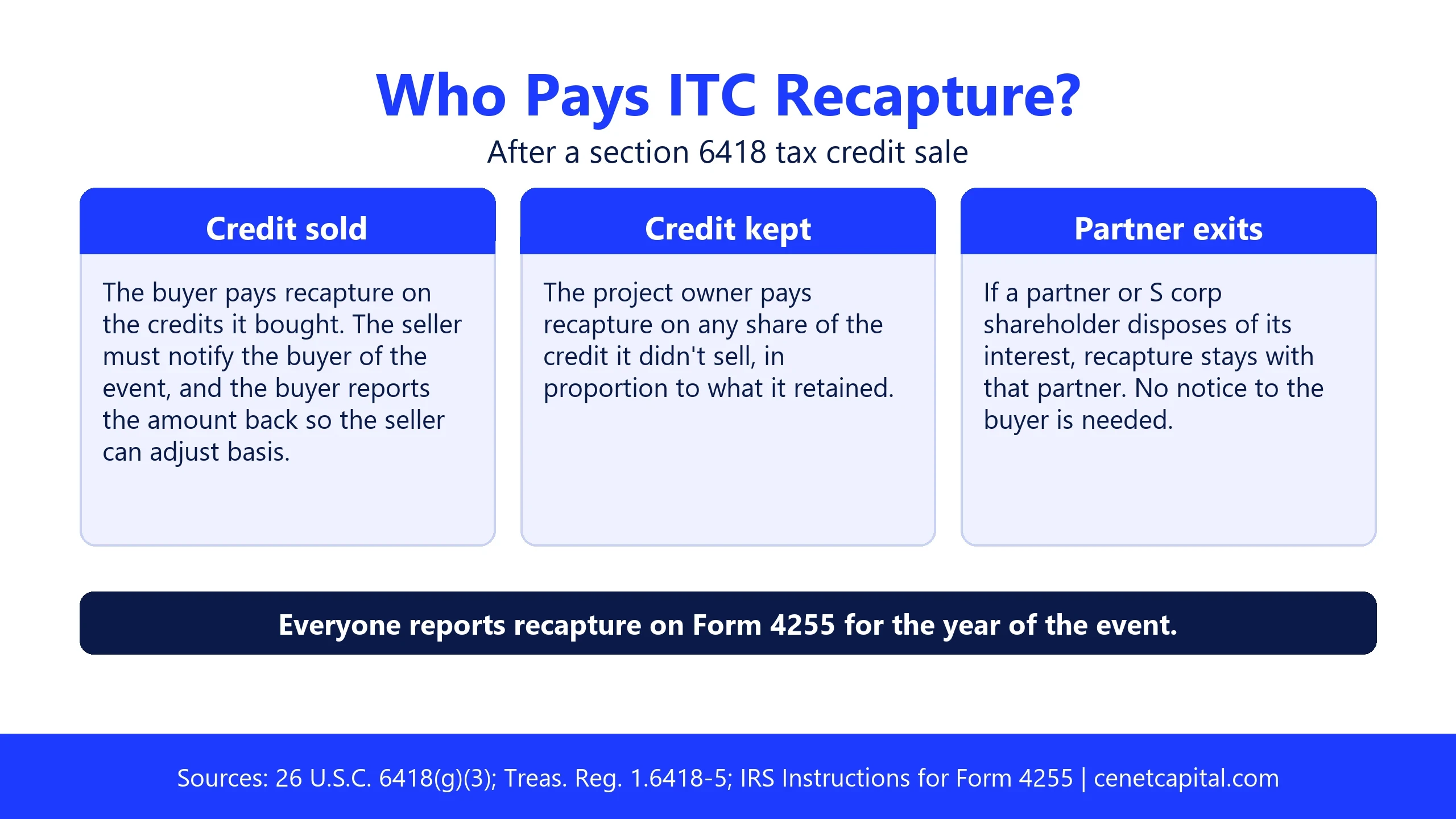
The buyer does. Under section 6418(g)(3), if a transferred ITC is recaptured, the seller must notify the buyer, and the buyer calculates and pays the recapture on the credits it bought. The seller pays recapture only on any portion of the credit it kept. Partner exits are the main exception.
The Form 4255 instructions spell this out: “The transferee taxpayer then must calculate and is subject to recapture on the recapture amount attributable to the transferred credit.” The buyer must also tell the seller the amount so the seller can adjust the property’s basis. When a partner in the selling partnership disposes of its interest, the recapture stays with that partner, and the buyer has no notice or calculation to do.
Because buyers carry the risk, they negotiate for it. Purchase agreements for transferable tax credits typically include seller covenants not to sell the project for five years, indemnities, and often tax credit insurance that covers recapture. Our tax credit purchase checklist shows what buyers review.
How do you calculate and report ITC recapture?
Multiply the original credit by the recapture percentage for the year of the event, then report the result on Form 4255 with your return for that year. The amount increases your tax for the year. You also adjust carrybacks and carryforwards if the credit hadn’t been fully used.
Form 4255 also handles excessive elective payments and excessive credit transfers. If a transferred credit turns out to be overstated, the buyer owes the excess plus a 20% penalty unless it shows reasonable cause. The Treasury regulations under section 6418 spell out how recapture and excessive transfers are split between buyers and sellers. Run your own numbers in the calculator below.
How much of your ITC could be recaptured?
Uses the section 50(a) schedule: 100% in year 1, then 80, 60, 40 and 20%. Years are full years after the property is placed in service.Selling the project, or losing it in a foreclosure, inside 5 full years triggers recapture. A mere change in business form generally doesn't, if the owner keeps a substantial interest.
A general guide, not tax advice. Recapture is reported on Form 4255. Transfers by reason of death and section 381 reorganizations are exempt.
Check my recapture risk →Does ITC recapture apply to hydrogen projects?
Yes, if the hydrogen producer elects the ITC instead of the 45V PTC. Under Treasury Regulation 1.48-15, the facility needs a verified emissions report every year for five years. A missed report, a lower emissions tier or emissions above 4 kg CO2e per kg each trigger recapture.
The rule in section 1.48-15(f) works year by year. If the facility’s verified emissions rate only supports a lower tier, 20% of the difference between the credit claimed and the credit that tier would have supported is recaptured for that year. If the producer misses the annual verification report or exceeds 4 kg, 20% of the entire credit is recaptured for that year. Our hydrogen electrolyzer guide compares the ITC election with the 45V PTC.
Can a 45V credit be disallowed even though it isn’t recaptured?
Yes. The 45V production tax credit isn’t subject to ITC recapture, but the IRS can disallow it on audit if the hydrogen didn’t meet its claimed emissions tier, verification was missing, or the clean power certificates didn’t qualify. A buyer of disallowed credits owes the tax plus a possible 20% penalty.
Disallowance risk for 45V usually traces back to the emissions calculation and the energy attribute certificates behind it. Annual third-party verification and clean documentation are the best defense. Our 45V tax credit guide covers the verification steps.
How can you avoid ITC recapture?
Hold the project for five full years after it’s placed in service, keep ownership changes below the one-third threshold, keep the property in qualifying use, and document prevailing wage on any repairs. Before a sale or refinancing, model recapture and get the buyer’s consent if credits were transferred.
That’s why tax equity partnerships usually keep the investor in place through the recapture period, and why lenders review recapture in any foreclosure scenario. If you’re planning to sell credits now and the project later, line up the timing before you sign. Cenet Capital helps owners structure credit sales so recapture risk is priced and covered.
Sources
Legal Information Institute, 26 U.S. Code 50, Other special rules
Internal Revenue Service, Instructions for Form 4255
Legal Information Institute, 26 CFR 1.48-15, Election to treat clean hydrogen production facilities as energy property
Legal Information Institute, 26 CFR 1.6418-5, Special rules for partnerships and S corporations
Legal Information Institute, 26 U.S. Code 6418, Transfer of certain credits
Frequently Asked Questions
What triggers ITC recapture?
Selling or otherwise disposing of the property, a partner's or shareholder's interest dropping by more than one-third, moving the property outside the U.S., or leasing it to a tax-exempt or government user, all within five full years of being placed in service. A transfer on foreclosure counts as a disposition.
How much ITC is recaptured if I sell in year 3?
Does selling the tax credit itself trigger recapture?
Do production tax credits get recaptured?
Can Cenet Capital help me sell an ITC with recapture protection?
Sell your ITC without the recapture surprise
Cenet Capital helps ITC owners sell credits with the recapture covenants, indemnities and insurance buyers expect. Tell us your credit amount, placed-in-service date and any planned sale.

More Insights