
Credit Guides
E-fuels are synthetic fuels made from clean hydrogen and captured CO2. How they're made, what they cost per gallon, who makes them, and 45V vs. 45Z credits.
Author -
Paulestini Francois
Published -
READ TIME
Planes, ships and trucks can't easily run on batteries, so the race is on to make their fuel from electricity, water and captured carbon instead of crude oil. Here's what e-fuels are, how they're made, what they cost, who's producing them in the U.S., and how the 45V and 45Z tax credits change the math.
QUICK ANSWER
E-fuels are synthetic fuels made by combining hydrogen from electrolysis with captured CO2, producing drop-in e-kerosene, e-diesel, e-methanol and more. The IEA puts e-kerosene at about $80 per gigajoule, or roughly $10.50 a gallon. U.S. producers can claim 45V on the hydrogen or 45Z on the fuel, but not both at one facility in the same year.
KEY FACTS
What is synthetic fuel? Fuel built from hydrogen and carbon rather than refined from crude oil. E-fuels are synthetic fuels made with electricity.
Are electrofuels and e-fuels the same thing? Yes. Electrofuels is the full name. Efuel, e-fuel and power-to-liquid fuel are common variants.
What is e-SAF? Sustainable aviation fuel made by the power-to-liquid route, also called e-kerosene or e-jet fuel.
Is there a sustainable aviation fuel tax credit in 2026? Yes, through 45Z, which pays up to $1.00 a gallon. The One Big Beautiful Bill removed the extra SAF premium for 2026 fuel.
How much does e-methanol cost? The IEA expects low-emission e-methanol could fall to about $35 per gigajoule, or $700 a tonne, by 2030.
Does the 45V PTC apply to e-fuels? It applies to the hydrogen. Top-tier 45V is worth up to $3.28 per kg in 2026, about $6.25 per gallon of e-kerosene.
What are e-fuels?
E-fuels, short for electrofuels, are synthetic fuels made from hydrogen produced with electricity and carbon dioxide captured from industry or the air. They’re chemically the same as gasoline, diesel, jet fuel, methanol or methane, so they work in today’s engines and infrastructure. Made with clean power, they can cut lifecycle emissions by 90% or more.
You’ll also see them called synthetic fuels, power-to-liquid (PtL) fuels or, for aviation, e-SAF. The idea is simple: use electricity to make hydrogen, then combine it with carbon to rebuild the hydrocarbon molecules that fossil fuels provide today. Burning an e-fuel still releases CO2, but if that carbon was captured to make the fuel and the power was clean, the cycle is close to carbon neutral.
That’s why aviation and shipping care most. Batteries are too heavy for long-haul flights, and a drop-in liquid fuel can use existing aircraft, pipelines and airport tanks with no changes. Infinium says its eSAF can cut lifecycle greenhouse gas emissions by more than 90% compared with petroleum jet fuel.
How are e-fuels made?
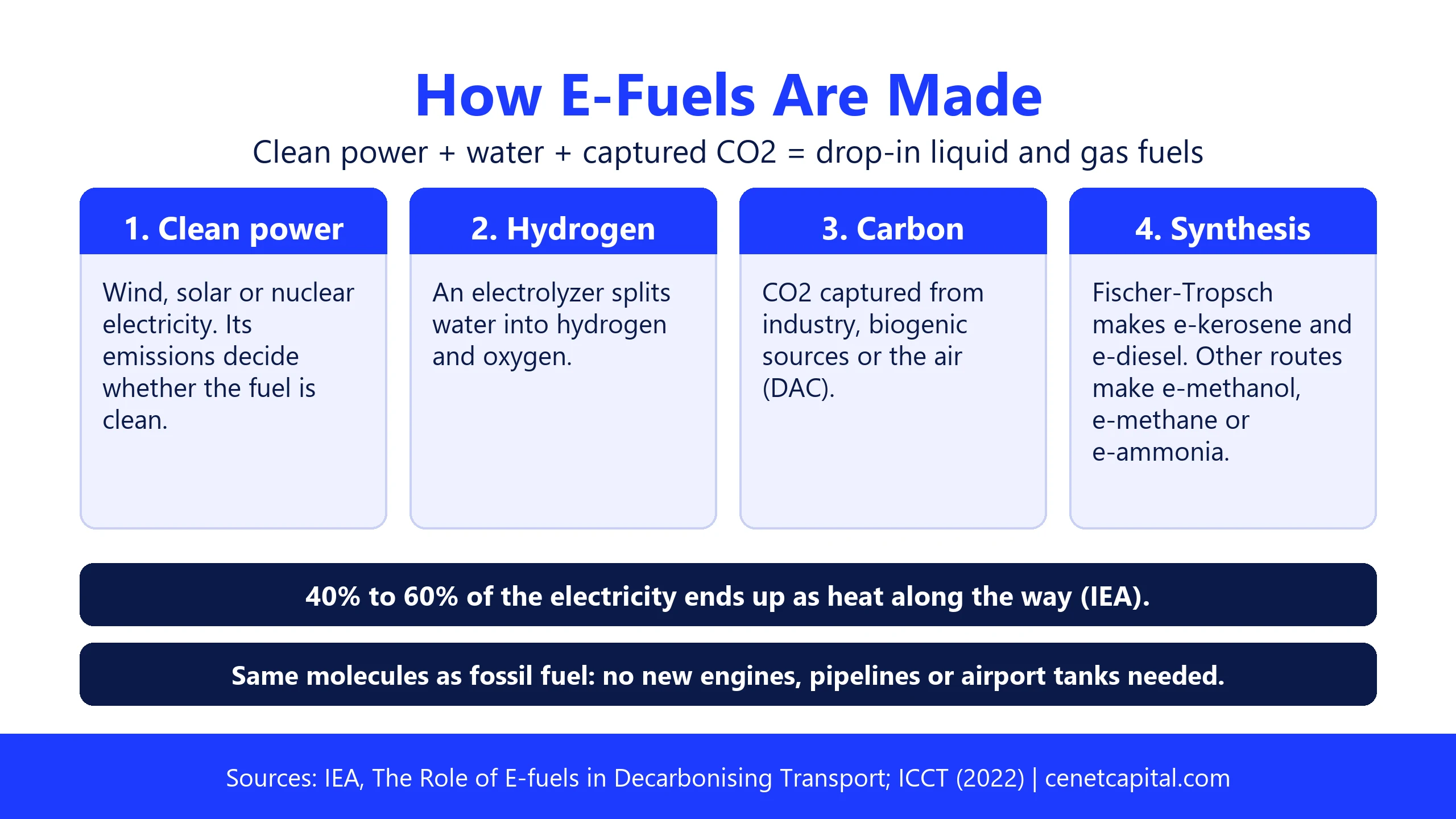
E-fuels are made in three steps. An electrolyzer splits water into hydrogen using electricity. CO2 is captured from an industrial plant, a biogenic source or directly from the air. Then a synthesis process, most often Fischer-Tropsch or methanol synthesis, combines the hydrogen and carbon into a liquid or gaseous fuel.
Electricity is the biggest input, and most of it doesn’t end up in the fuel. The International Energy Agency’s report The Role of E-fuels in Decarbonising Transport estimates that 40% to 60% of the electricity input is converted to heat. Its cost model assumes 69% electrolyzer efficiency and 57% efficiency from hydrogen to synthetic crude.
Hydrogen is the expensive part. At that efficiency, a gallon of e-kerosene needs roughly 1.9 kg of hydrogen, so a $1 change in the hydrogen price moves the fuel cost by about $1.90 a gallon. Our hydrogen electrolyzer guide covers how electrolyzers work and what they cost, and our hydrogen price per kg guide covers current prices.
What types of e-fuels are there?
The main e-fuels are e-kerosene for jets, e-diesel, e-gasoline, e-methanol, e-methane and e-ammonia. Fischer-Tropsch synthesis yields a crude that’s refined into e-kerosene, e-diesel and e-naphtha. Methanol synthesis makes e-methanol for ships. E-methane replaces natural gas, and e-ammonia uses nitrogen instead of carbon.
Each product has a different conversion efficiency and cost. The IEA finds ammonia is the most efficient to make, followed by methanol and then Fischer-Tropsch fuels. That’s why shipping is leaning toward e-methanol and e-ammonia, while aviation, which needs a certified drop-in jet fuel, is betting on e-kerosene.
E-ammonia contains no carbon at all, so it overlaps with clean ammonia made from low-emission hydrogen. Fischer-Tropsch plants also produce by-products. Twelve’s first plant sells E-Naphtha for plastics and chemicals alongside its jet fuel.
Are e-fuels carbon neutral?
Only if the electricity is clean. The IEA calculates that Fischer-Tropsch e-fuels break even with fossil fuels at about 130 g of CO2 per kWh of electricity, and e-methanol and e-ammonia at about 200 g. The average U.S. grid emits about 366 g per kWh, so e-fuels made on average grid power are dirtier than fossil fuels.
The U.S. grid figure comes from the Energy Information Administration, which reported 0.81 pounds of CO2 per kWh in 2023. That’s why the U.S. tax rules for clean hydrogen require producers to prove their power is clean, using energy attribute certificates that meet the three pillars: new generation, in the same region, and matched hourly starting in 2030.
The carbon source matters too. CO2 captured from the air or from biogenic sources closes the loop. CO2 captured from a fossil plant still reaches the atmosphere when the fuel burns, so only part of its emissions are avoided, and lifecycle models treat it differently.
How much do e-fuels cost?
E-fuels cost several times more than fossil fuels today. The IEA puts e-kerosene from an optimized plant at about $80 per gigajoule, or roughly $10.50 a gallon, four to five times the price of conventional jet fuel. It expects that could fall to about $50 per gigajoule, or roughly $6.50 a gallon, by 2030.
An earlier ICCT analysis estimated the average U.S. e-kerosene cost at $8.80 a gallon in 2020, about seven times fossil kerosene, falling to $4 a gallon by 2050. The IEA expects other e-fuels to get cheaper sooner: e-methanol could reach $35 per gigajoule and e-ammonia $30 per gigajoule by 2030.
Cheap, clean electricity and high plant utilization drive the cost down. The IEA found that at $50 per MWh, electricity alone adds $25 to $35 per gigajoule before any equipment cost. That’s where tax credits come in: in the U.S., they can close a large part of the gap.
Which U.S. tax credits apply to e-fuels?
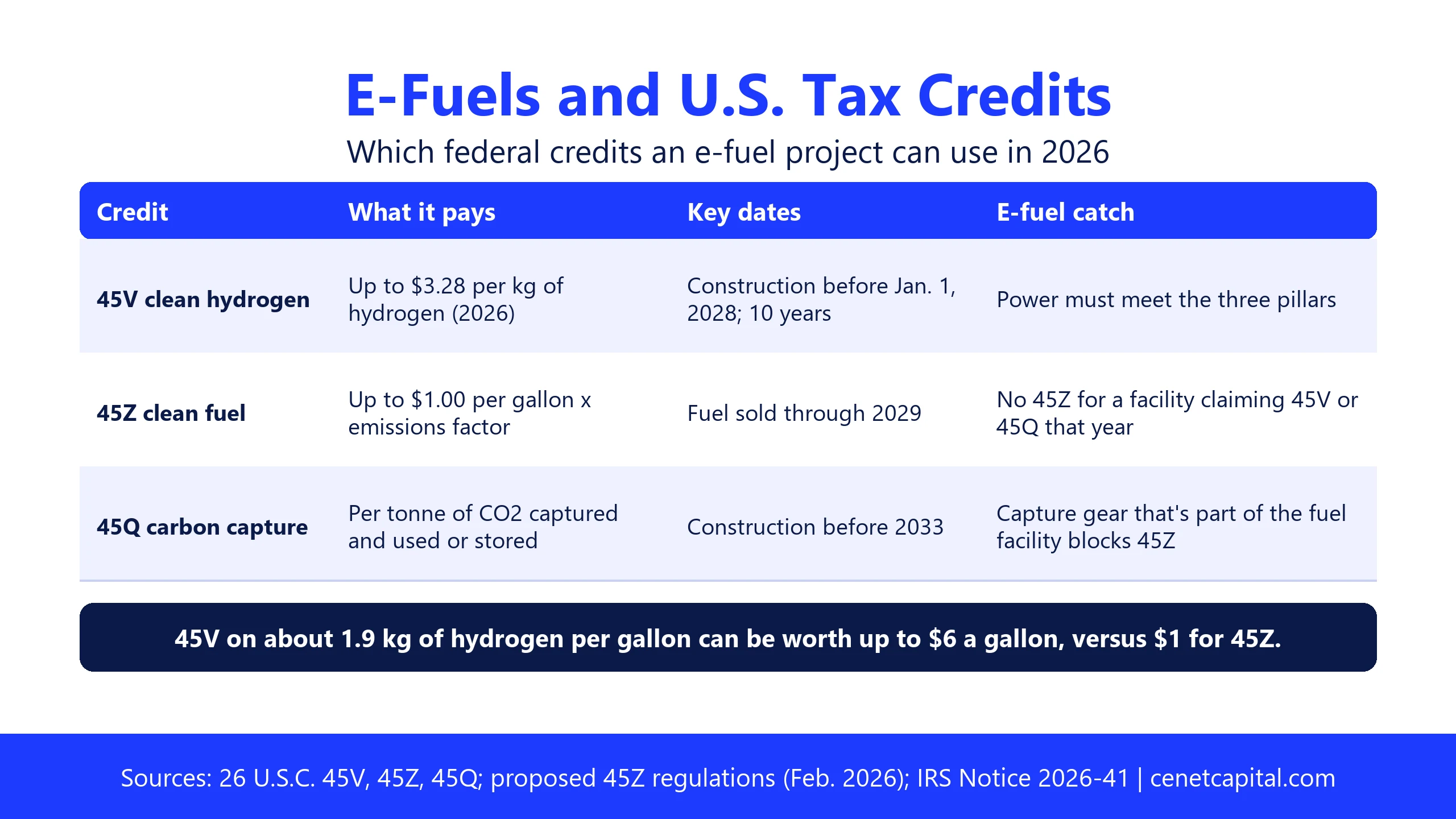
Three federal credits can apply. The 45V clean hydrogen production tax credit (PTC) pays up to $3.28 per kg of hydrogen in 2026. The 45Z clean fuel production credit pays up to $1.00 per gallon. The 45Q credit pays per tonne of captured CO2. But a facility claiming 45V or 45Q in a year can’t claim 45Z that year.
That anti-stacking rule is in the statute itself. Section 45Z(d)(4) says a qualified facility doesn’t include any facility for which the 45V or 45Q credit is allowed for the taxable year. 45Z covers transportation fuel sold through 2029, and the fuel must be made in the U.S. from feedstock produced in the U.S., Mexico or Canada. Our 45Z tax credit guide walks through the formula.
45V has its own deadline. Facilities must begin construction before January 1, 2028 to earn the credit for 10 years, as our 45V tax credit guide explains. Captured CO2 can earn the 45Q tax credit, but under the proposed 45Z rules, capture equipment that affects the fuel’s emissions rate counts as part of the fuel facility, so claiming 45Q on it would block 45Z.
Should an e-fuel producer claim 45V or 45Z?
For most e-fuel projects, 45V is worth far more. At the top tier, 45V on the roughly 1.9 kg of hydrogen in a gallon of e-kerosene is worth about $6.25, while 45Z tops out at $1.00 a gallon. Treasury’s February 2026 proposed rules let a facility switch between 45V and 45Z from year to year.
The proposed 45Z regulations define a facility as a single production line whose parts work interdependently to make the fuel. An electrolyzer feeding an integrated fuel plant is likely part of that line. Treasury specifically asked for comments on facilities with multiple owners, so a structure where one company makes hydrogen and another makes the fuel isn’t settled yet. Baker Botts also notes that a facility that ever takes the hydrogen ITC election is permanently barred from 45Z.
Timing can flip the answer. A plant that can’t begin construction before 2028 loses 45V, leaving 45Z, which itself ends after 2029. Fuel pathways missing from the 45ZCF-GREET model need a provisional emissions rate, which starts with a DOE emissions value request. Both 45V and 45Z credits can be sold to corporate tax buyers for cash. Use the calculator below to compare the two.
What does a gallon of e-fuel cost, and which credit helps more?
E-kerosene per gallon from your hydrogen, CO2 and conversion costs, compared with fossil jet fuel. 45V and 45Z can't both be claimed at one facility in the same year.45V on the hydrogen is worth $5.46 more per gallon than 45Z here. It needs construction to begin before 2028 and power that meets the three pillars.
Illustrative only. 2026 45V rates with prevailing wage met; 45Z before inflation adjustment. Ignores by-products such as e-naphtha and e-gasoline.
Price my e-fuel credits →Who is producing e-fuels in the U.S.?
Two companies lead U.S. production. Infinium has made e-diesel and e-naphtha at its Pathfinder plant in Corpus Christi, Texas since 2023 and is building Project Roadrunner for 2027. Twelve opened AirPlant One in Moses Lake, Washington in June 2026, the first U.S. commercial-scale plant making e-jet fuel.
In August 2026, American Airlines and Infinium flew a commercial flight on eSAF from Corpus Christi to Dallas Fort Worth. Roadrunner is financed by Breakthrough Energy Catalyst and Brookfield, and American has an offtake agreement for its eSAF. Twelve’s AirPlant One opened with Alaska Airlines and Microsoft as partners, and Alaska plans regular domestic flights on its E-Jet fuel.
Much of the demand comes from Europe. The EU’s ReFuelEU Aviation rules require synthetic aviation fuel to make up 1.2% of jet fuel at EU airports in 2030 and 2031, rising to 5% in 2035 and 35% in 2050. U.S. producers with low-cost clean power and federal credits are positioned to supply it.
Sources
International Energy Agency, The Role of E-fuels in Decarbonising Transport
ICCT, Current and future cost of e-kerosene in the United States and Europe (2022)
Legal Information Institute, 26 U.S. Code 45Z and 26 U.S. Code 45V
Federal Register, Section 45Z Clean Fuel Production Credit (proposed regulations, February 4, 2026)
Baker Botts, IRS Issues Proposed Regulations Regarding 45Z Clean Fuel Production Tax Credit
American Airlines, American Airlines and Infinium announce commercial passenger flight powered by eSAF (August 6, 2026)
Renewable Carbon News, AirPlant One Opens in Moses Lake (June 2026)
Clean Hydrogen Partnership Observatory, ReFuelEU Aviation
U.S. Energy Information Administration, How much carbon dioxide is produced per kilowatthour of U.S. electricity generation?
Frequently Asked Questions
What are e-fuels made of?
E-fuels are made of hydrogen and carbon. The hydrogen comes from splitting water with electricity, and the carbon comes from CO2 captured at an industrial plant, a biogenic source or directly from the air. E-ammonia uses nitrogen from the air instead of carbon.
Are e-fuels better than electric vehicles?
Can you claim 45V and 45Z on the same e-fuel?
How much do e-fuels cost per gallon?
Can Cenet Capital help sell e-fuel tax credits?
Making e-fuels? Get paid for every credit
Cenet Capital helps e-fuel and hydrogen producers choose between 45V and 45Z and sell their credits to corporate tax buyers. Tell us your fuel, output and start date.

More Insights