
Credit Guides
The wind production tax credit pays 3.1 cents per kWh in 2026. Rates by placed-in-service year, how to calculate it, the 2027 deadline and selling wind PTCs.
Author -
Paulestini Francois
Published -
READ TIME
The wind production tax credit pays a wind farm for every kilowatt-hour it sells, for 10 years. In 2026 that's 3.1 cents per kWh at the full rate, but a new deadline now decides which wind farms get it. Here are the 2026 rates, how to calculate the wind Production Tax Credit (PTC), when it expires, and how to sell it.
QUICK ANSWER
The wind production tax credit (PTC) pays 3.1 cents per kWh in 2026 for electricity a wind farm sells, for 10 years after it's placed in service. Wind placed in service from 2022 to 2024 earns 3.0 cents. New wind farms must begin construction by July 4, 2026 or be in service by the end of 2027.
KEY FACTS
What is the 2026 PTC rate for wind? 3.1 cents per kWh under Section 45Y and for pre-2022 wind; 3.0 cents for wind placed in service from 2022 to 2024 under Section 45.
How long does the wind PTC last? 10 years from the date the wind farm is placed in service.
Is there still a wind energy tax credit for new projects? Yes, if construction began by July 4, 2026 or the project is placed in service by December 31, 2027.
Is there a wind turbine tax credit for homeowners? No. The Section 25D credit for small wind turbines ended for expenditures after 2025, and leased small wind can't claim 48E.
How does capacity factor affect the production tax credit for wind? Credits scale with output: a 100 MW wind farm at a 37% capacity factor earns about $10 million a year.
Which is bigger, the wind PTC or the investment tax credit (ITC)? Usually the PTC for strong-wind sites; a 30% ITC can win for smaller or costlier projects.
What is the wind production tax credit?
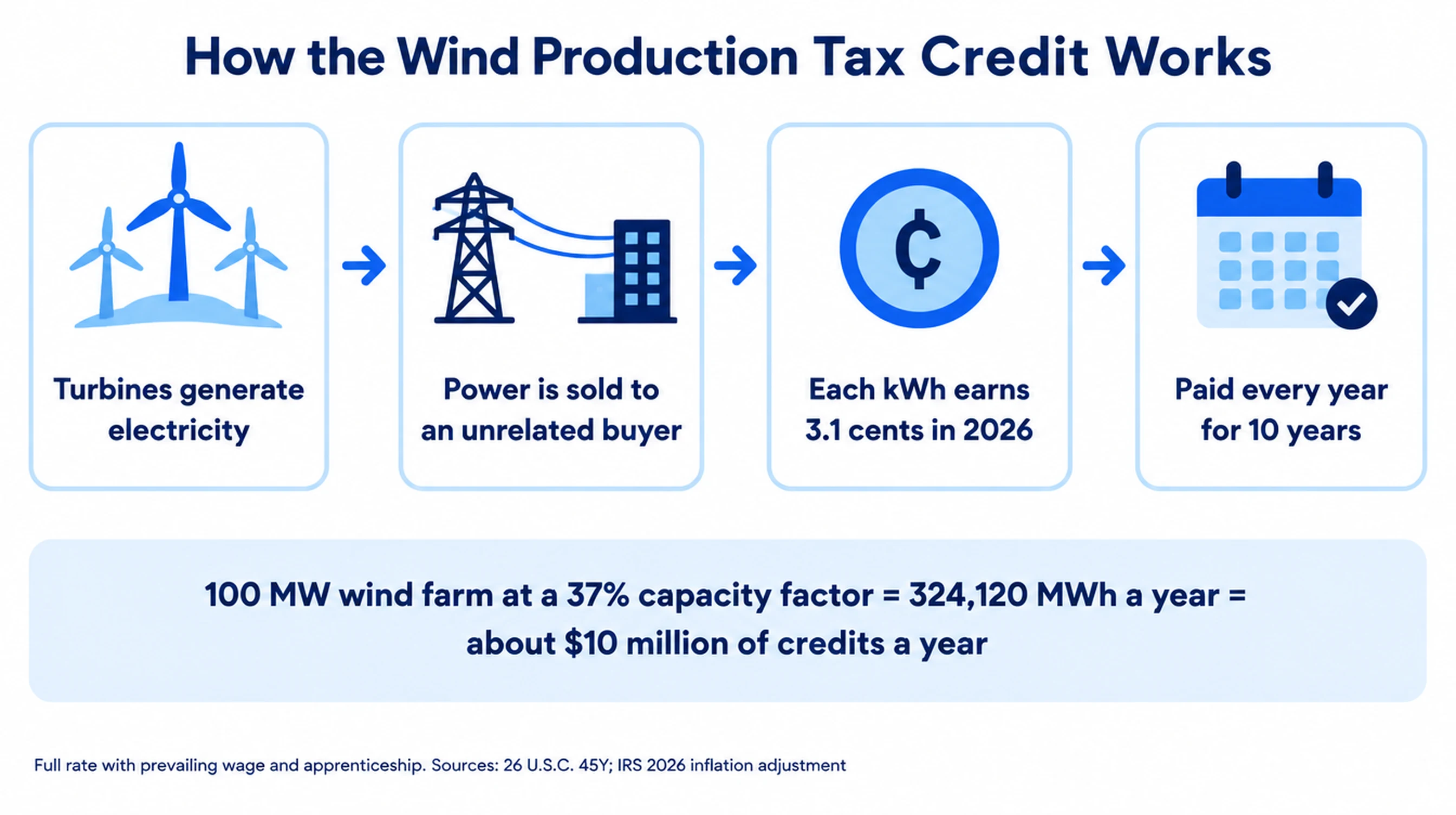
The wind production tax credit (PTC) is a federal tax credit paid for each kilowatt-hour of electricity a wind farm produces and sells to an unrelated buyer, for 10 years after it’s placed in service. In 2026 it’s worth 3.1 cents per kWh at the full rate. Wind farms placed in service after 2024 claim it under Section 45Y.
The wind PTC has been the main federal incentive for U.S. wind power since 1992. It’s earned on output, not cost, so a well-sited wind farm with strong winds earns more than an identical one in a weaker spot. That’s why wind developers have usually preferred it to the Investment Tax Credit (ITC).
Wind is now a large part of the grid. The U.S. had 161 GW of wind capacity at the end of 2025, supplying 10.3% of the nation’s electricity, according to Berkeley Lab’s 2026 wind technology data update. For production credits generally, see our production tax credit guide.
How much is the wind PTC in 2026?
The 2026 wind production tax credit is 3.1 cents per kWh for wind farms placed in service in 2025 or later under Section 45Y, and for older wind farms placed in service before 2022. Wind placed in service from 2022 to 2024 earns 3.0 cents: a 0.6 cent base rate multiplied by five for prevailing wage compliance.
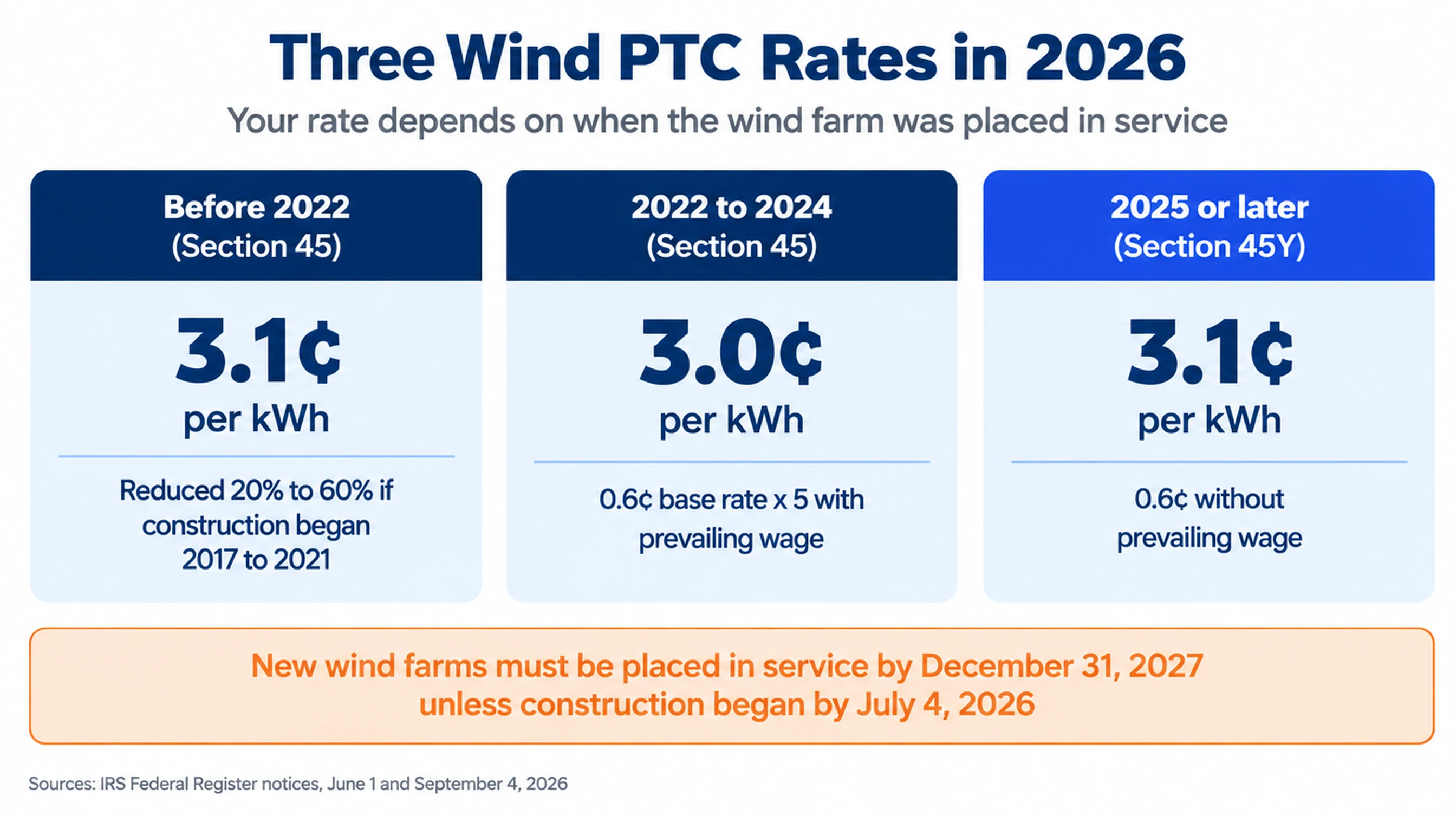
The split comes from rounding. The IRS’s June 2026 notice for Section 45 sets 3.1 cents for wind placed in service before 2022 and 0.6 cents for later wind, which becomes 3.0 cents at five times. The September 2026 notice for 45Y applies the same 2.0570 inflation factor to its 1.5 cent amount, giving 3.1 cents.
Wind farms placed in service after 2022 can add 10% for an energy community and 10% for domestic content, so a new wind farm can earn about 3.72 cents. Older wind farms that started construction from 2017 to 2021 take a 20% to 60% cut under Section 45(b)(5). The same June notice put the 2026 wind reference price at 3.17 cents per kWh, below the level that would trigger a phase-out.
How do you calculate the wind PTC?
Multiply the kilowatt-hours sold during the year by the rate. Annual output equals capacity in MW times 8,760 hours times the capacity factor. A 100 MW wind farm at a 37% capacity factor produces 324,120 MWh a year, worth about $10 million in production tax credits at 3.1 cents.
Over 10 years that’s roughly $100 million before inflation adjustments. Berkeley Lab found a 37.1% capacity factor in 2025 for wind projects built in 2024, and 34% across the fleet built from 1998 to 2024, so newer, taller turbines earn more credits per megawatt.
Use the calculator below to estimate your wind farm’s annual and 10-year PTC, see what it would sell for, and compare it with taking the investment credit instead.
Over 10 years the PTC ($100.5M) beats a 30% ITC ($63.0M) before discounting. At this output it passes the ITC in year 7.
Illustrative only. Holds the 2026 rate flat for 10 years; the real rate is inflation-adjusted each year. Output must be sold to an unrelated person. Defaults from Berkeley Lab (2026 edition). Confirm with your tax advisor.
Should a wind farm take the PTC or the ITC?
Most utility-scale wind farms come out ahead with the PTC, because strong output over 10 years beats a one-time 30% investment credit. The ITC can win for smaller, costlier or lower-wind projects. A wind farm placed in service after 2024 chooses between Section 45Y and Section 48E, and can’t claim both.
With Berkeley Lab’s 2025 average installed cost of $2,100 per kW, a 100 MW wind farm costs about $210 million, so a 30% ITC is about $63 million. At a 37% capacity factor, the PTC passes that in under seven years. At a 28% capacity factor it takes over eight, and discounting narrows the gap further.
Our ITC vs. PTC comparison, Section 48 vs. 48E guide and Section 45Y guide cover the trade-off in more depth.

When does the wind production tax credit expire?
New wind farms must begin construction by July 4, 2026, or be placed in service by December 31, 2027, to earn the PTC. Projects that began construction by July 4, 2026 generally have four years to finish under the continuity safe harbor. Existing wind farms keep collecting for the rest of their 10-year periods.
The deadline was added by the One Big Beautiful Bill Act to Section 45Y and 48E. The legacy Section 45 credit already required construction to begin before January 1, 2025. Wind projects starting construction after 2025 must also clear the foreign entity of concern rules.
How you prove construction began also matters. A court vacated IRS Notice 2025-42 in June 2026, restoring the 5% safe harbor that wind developers rely on, as our Notice 2025-42 guide explains.
How has the PTC shaped U.S. wind development?
U.S. wind builds have risen and fallen with PTC deadlines for two decades. Developers added 13.1 GW in 2012 ahead of an expiration, then just 1.1 GW in 2013. A record 17.2 GW came online in 2020 as projects raced to keep the full credit before a phase-down.
Additions slowed to about 4 GW in 2024 before recovering to 6.9 GW in 2025, according to Berkeley Lab and American Clean Power data. The OBBBA deadline is likely to produce another rush through 2027, followed by a drop for projects that miss it.
The chart below shows each year’s additions alongside the tax credit events that drove them.
The credit lapsed briefly and came back with a start-construction test; builds fell to about 1.1 GW
Source: Lawrence Berkeley National Laboratory, Land-Based Wind Energy Technology Data Update: 2026 Edition (ACP data); 26 U.S.C. 45(b)(5), 45Y.
Can you sell wind production tax credits?
Yes. Wind PTCs are transferable under Section 6418, so owners can sell each year’s credits to corporate buyers for cash. Production tax credits averaged about 93 cents per dollar in 2026, slightly more than investment credits, because there’s no recapture risk. Tax-exempt owners can take elective pay instead.
Crux reported 2026 transfer pricing of about $0.93 for PTCs and $0.913 for ITCs. PTC sales usually run as multi-year forward contracts, since the credits arrive every year for a decade. Our guides to transferable tax credits, tax credit pricing and tax equity cover the main ways wind developers turn credits into capital.
How do you claim the wind PTC?
Wind farms placed in service after 2024 claim the Section 45Y credit on Form 7211. Older wind farms claim legacy Section 45 on Form 8835. Both flow to Form 3800. To sell credits or use elective pay, register through IRS pre-filing registration every year you plan to transfer.
Keep revenue-grade meter data, sales records showing an unrelated buyer, and prevailing wage records for any repairs during the 10-year period. The IRS’s clean electricity production credit page lists the requirements, and our energy credit forms guide and pre-filing registration guide walk through the filings.
Sources
IRS, Section 45 inflation adjustment factor and reference price for 2026 (Federal Register, June 1, 2026)
IRS, Section 45Y inflation adjustment factor and applicable amounts for 2026 (Federal Register, September 4, 2026)
Lawrence Berkeley National Laboratory, Land-Based Wind Energy Technology Data Update: 2026 Edition
pv magazine USA, Clean energy capital expenditures on track for $180 billion in 2026, reports Crux
Frequently Asked Questions
How much is the wind production tax credit in 2026?
3.1 cents per kWh for wind farms placed in service in 2025 or later under Section 45Y, and for wind placed in service before 2022. Wind placed in service from 2022 to 2024 earns 3.0 cents. Bonuses can add up to 20%.
Is the wind PTC ending?
How do you calculate the wind PTC?
Can wind PTCs be sold?
Can Cenet Capital help me sell wind production tax credits?
Earning wind PTCs? Sell them for cash
Cenet Capital helps wind owners and developers price Section 45 and 45Y production tax credits and sell them to corporate buyers, including multi-year forward deals. Tell us your capacity and expected output.

More Insights