Credit Guides
Section 48 vs. 48E explained: which projects can still claim the Section 48 investment tax credit, what 48E covers, how to choose, and which technologies lost out.
Author -
Paulestini Francois
Published -
READ TIME
Section 48 and Section 48E are both investment tax credits (ITC) worth up to 30% or more of a project's cost, but they cover different projects. Which one applies depends on the technology and when construction began. Here's how the Section 48 investment tax credit compares with 48E, when you can choose, and which technologies were left out.
QUICK ANSWER
Section 48 is the original energy investment tax credit for named technologies that began construction before 2025, plus geothermal heat pumps through 2034. Section 48E is the technology-neutral clean electricity ITC for zero-emission power and storage placed in service after 2024. Both pay 6% base or 30% with prevailing wage.
KEY FACTS
What is the Section 48 ITC? The energy credit for listed property such as solar, geothermal, fuel cells and CHP, now limited to construction that began before 2025, except geothermal heat pumps.
What is the Section 48 vs 48E difference in one line? Section 48 lists eligible equipment; 48E covers any zero-emission electricity facility or energy storage placed in service after 2024.
Can a project claim both? No. A facility that took a Section 48 credit is excluded from 48E, but projects in the 2024-start, 2025-service overlap can choose either.
Which technologies stay in Section 48? Geothermal heat pumps, for construction beginning before 2035.
What happened to fuel cells? Fuel cells beginning construction after 2025 get a flat 30% 48E credit with no bonus adders.
What is the legacy ITC? Another name for the Section 48 energy credit. It and the clean electricity investment credit are both claimed on Form 3468.
What’s the difference between Section 48 and 48E?
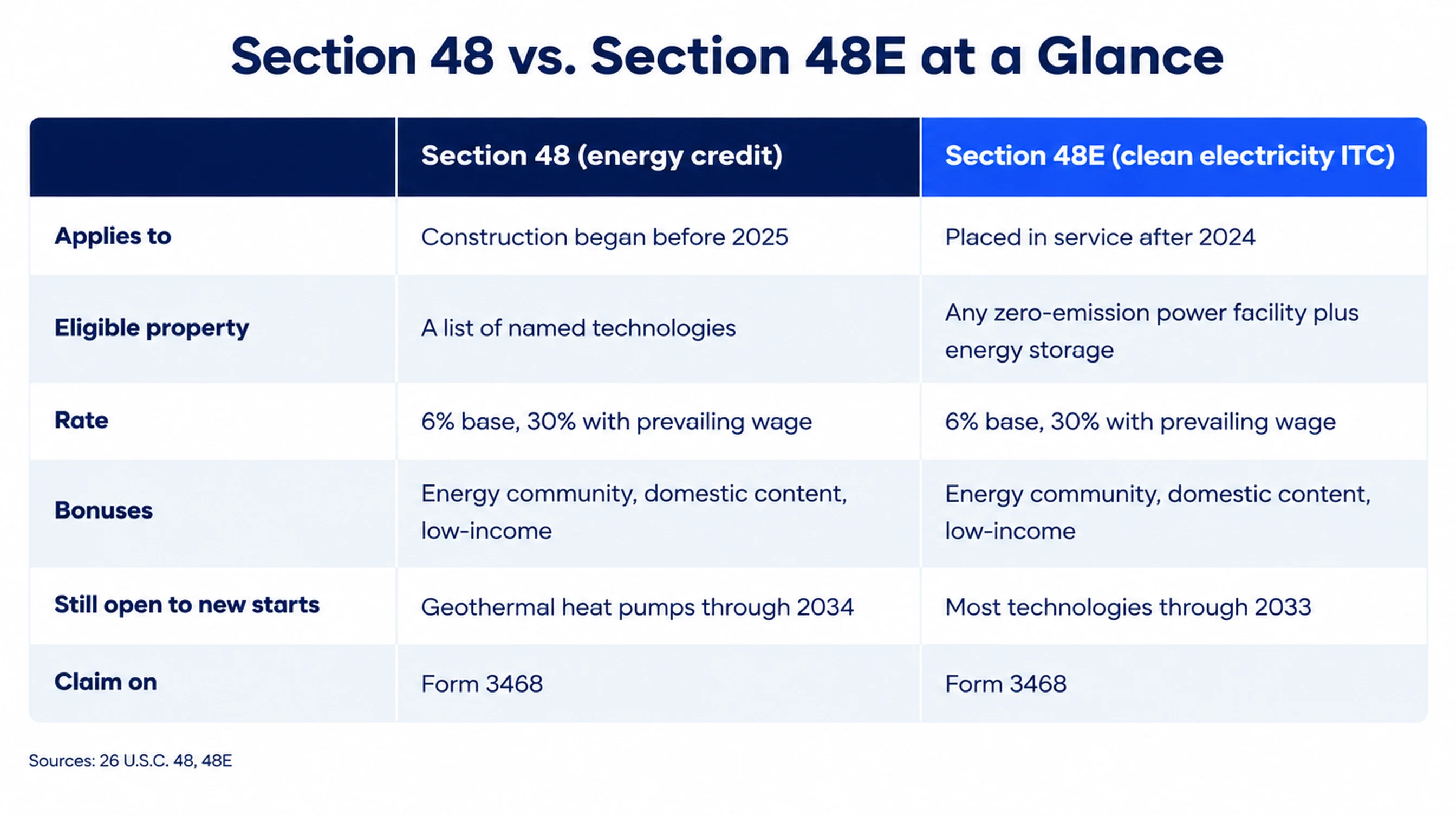
Section 48 is the original energy Investment Tax Credit (ITC), available for a list of named technologies whose construction began before 2025. Section 48E is the technology-neutral clean electricity ITC for zero-emission power and energy storage placed in service after 2024. Both pay 6% base, or 30% with prevailing wage and apprenticeship.
The rates, bonuses and claim form are nearly identical. What changed is the test for eligibility. Section 48 asks what the equipment is: solar, geothermal, fuel cells, combined heat and power and so on. Section 48E asks whether the facility generates electricity with a greenhouse gas emissions rate of zero or less, or stores energy.
The Inflation Reduction Act created 48E in 2022 to replace Section 48 for most projects. The IRS describes it as the credit that replaces the energy investment credit once it phases out at the end of 2024. For background on investment credits generally, see our investment tax credit guide.
Which projects can still claim the Section 48 ITC?
Projects whose construction began before January 1, 2025 can still claim the Section 48 investment tax credit when placed in service, even years later. Geothermal heat pumps are the only property still open to new starts: they keep Section 48 for construction beginning before 2035, at 30% through 2032 starts, then 26% and 22%.
Every other category in Section 48 now carries a “construction begins before January 1, 2025” cutoff: fuel cells, microturbines, combined heat and power, small wind, waste energy recovery, energy storage, biogas property and microgrid controllers. Solar and geothermal equipment that started after 2024 kept only a residual 2% energy percentage (up to 10% with prevailing wage), and the One Big Beautiful Bill Act cut that to 0% for construction beginning on or after June 16, 2025.
That’s why the Section 48 investment tax credit still shows up on 2025, 2026 and 2027 returns. A project that started construction in 2024 and is placed in service in 2026 claims it in 2026. Our geothermal tax credit guide covers the heat pump rules in detail.
What does Section 48E cover?
Section 48E covers any facility that generates electricity with an anticipated greenhouse gas emissions rate of zero or less, plus energy storage technology, if placed in service after December 31, 2024. That includes solar, wind, hydropower, geothermal power, nuclear and batteries. Fuel cells starting construction after 2025 get a special flat 30%.
Treasury’s final 45Y and 48E regulations list technologies deemed to have zero emissions, so solar and wind developers don’t need a lifecycle analysis. The full credit runs through 2033 construction starts for most technologies, then drops to 75% in 2034 and 50% in 2035.
Our Section 48E guide goes deeper on the emissions test, and the Section 45Y guide covers its production credit twin.
Can a project choose between Section 48 and 48E?
Yes, in the overlap. A project whose construction began before 2025 and that is placed in service after 2024 can qualify under both, but it can claim only one. Section 48E excludes any facility that has taken a Section 48 credit, so owners should model both and pick the higher value.
The exclusion is in Section 48E(b)(3)(C), which also bars 48E for facilities that took the Section 45, 45Y, 45Q or 45U production credits. In practice the rates are usually the same, so the choice turns on details: 48E’s emissions test, its stricter FEOC rules for later starts, and which credit a buyer prefers when you sell.
Use the checker below to see which credit your project can claim, based on its technology, construction start and service date.
Construction began before 2025 and the project goes into service after 2024, so it can claim either credit, but not both. 48E bars any facility that took a Section 48 credit.
Illustrative only. Assumes the facility meets the zero-emissions test where 48E applies. Ignores the low-income bonus, FEOC rules for 2026 starts, and basis rules. Confirm with your tax advisor.
Which technologies lost the investment credit?
Combined heat and power, microturbines, biogas property, microgrid controllers, solar water heating and geothermal direct-use heating have no investment credit for new construction. They don’t generate zero-emission electricity, so they can’t move to 48E, and their Section 48 credit ended for construction starting after 2024 or, for solar and geothermal heating, after June 15, 2025.
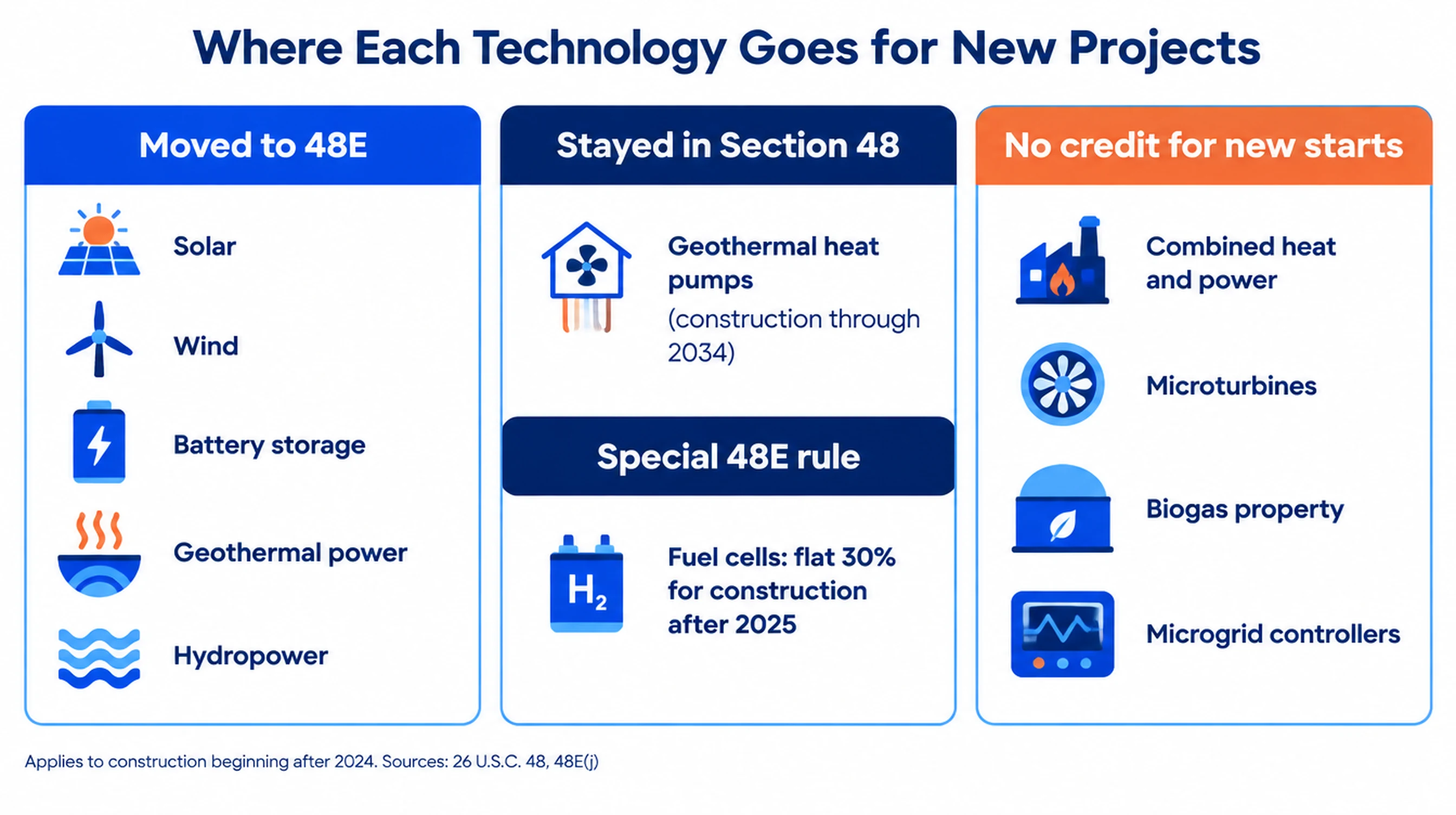
This is the biggest practical difference between Section 48 vs 48E. Solar thermal and geothermal heating used to earn a 30% ITC under Section 48 because the list included equipment that heats a structure. 48E covers only electricity generation and energy storage, though thermal energy storage still qualifies as storage.
Fuel cells were nearly in the same position. The One Big Beautiful Bill Act added Section 48E(j), giving fuel cells that begin construction after 2025 a flat 30% credit regardless of emissions, with no bonus adders. Our data center fuel cell cost guide shows what that means for on-site power.
How do the rates and bonuses compare?
They match. Both credits start at 6% and rise to 30% with prevailing wage and apprenticeship compliance or for projects under 1 MW. Both add 10 points for an energy community and 10 for domestic content, and both offer the 10 or 20 point low-income bonus by allocation. Half the credit reduces depreciable basis.
The difference is in the phase-outs. Section 48 ends by technology and start date. Section 48E phases down for everything starting after 2033 and, since 2025, ends early for wind and solar placed in service after 2027 unless construction began by July 4, 2026. Our prevailing wage guide and energy community map cover the bonus rules.
The chart below maps which credit each technology can claim by the year construction begins.
Projects that started before 2025 and finish after 2024 sit in the overlap: they can choose Section 48 or 48E. After that, only geothermal heat pumps stay in Section 48.
Sources: 26 U.S.C. 48(a)(2)-(3), 48(a)(7), 48(c), 48E(b)(3), 48E(e), 48E(j); Pub. L. 119-21 sec. 70513. Assumes zero-emission facilities where 48E applies; ignores FEOC rules.
How did the One Big Beautiful Bill change 48 and 48E?
For Section 48 it cut the residual credit for solar and geothermal equipment to 0% for construction starting on or after June 16, 2025. For 48E it added the 2027 placed-in-service deadline for wind and solar, foreign entity of concern restrictions, the flat 30% fuel cell rule, and a ban on leased solar water heating and small wind.
The wind and solar deadline matters most. A project that starts construction after July 4, 2026 must be in service by December 31, 2027 to earn 48E, as our solar tax credit 2026 guide and wind production tax credit guide explain. Storage, geothermal power and hydropower keep the full credit through 2033 starts.
Our One Big Beautiful Bill guide and FEOC rules guide explain the changes in full.
How do you claim Section 48 or 48E?
Both credits are claimed on Form 3468 for the tax year the property is placed in service, then carried to Form 3800 as part of the general business credit. Both are transferable under Section 6418 and eligible for elective pay, after IRS pre-filing registration. Both carry a five-year recapture period.
If you can’t use the credit, selling it is common: Crux put average 2026 ITC pricing at $0.913 per dollar. Our guides to Form 3468, transferable tax credits and ITC recapture cover each step.
Sources
Treasury and IRS, Section 45Y and Section 48E final regulations (January 15, 2025)
pv magazine USA, Clean energy capital expenditures on track for $180 billion in 2026, reports Crux
Frequently Asked Questions
Is Section 48 still available in 2026?
Yes, for projects whose construction began before January 1, 2025, whenever they are placed in service, and for geothermal heat pumps starting construction through 2034. New solar, wind and storage projects use Section 48E.
What is the difference between the Section 48 and 48E investment tax credits?
Do combined heat and power systems qualify for 48E?
Which form do you use for Section 48 and 48E?
Can Cenet Capital help with a Section 48 or 48E credit?
Not sure which ITC fits your project? We'll check
Cenet Capital helps developers confirm whether a project falls under Section 48 or 48E, model the credit, and sell it to corporate buyers. Tell us your technology, cost and construction dates.

More Insights