

Credit Guides
Is there a solar tax credit in 2026? The homeowner credit ended, but businesses and leased systems still get 30%. Rates, deadlines and how to claim it.
Author -
Paulestini Francois
Published -
READ TIME
The 30% solar tax credit didn't disappear in 2026, but it moved. Homeowners who buy panels lost it on December 31, 2025, while businesses and solar leasing companies can still claim a 30% Investment Tax Credit (ITC) under Section 48E. Here's what ended, what's left, and the deadlines that decide who gets it.
QUICK ANSWER
The federal solar tax credit for homeowners who buy a system ended for costs paid after December 31, 2025. In 2026, businesses, nonprofits and solar leasing companies can still claim a 30% Section 48E credit, if construction began by July 4, 2026 or the system is placed in service by December 31, 2027.
KEY FACTS
Is the solar tax credit going away? For homeowners who buy, it already has. Solar tax credits going away for businesses means no credit for systems placed in service after 2027, unless construction began by July 4, 2026.
When does the solar tax credit expire? The residential solar tax credit (Section 25D) expired for expenditures after December 31, 2025. The commercial solar tax credit expires for projects placed in service after 2027 that start construction after July 4, 2026.
What is the solar tax credit expiration date for leases? A solar lease or PPA follows the business deadline, because the leasing company claims the solar ITC under Section 48E.
How much is the solar ITC in 2026? 30% with prevailing wage or under 1 MW, 6% otherwise, plus 10 points each for energy community and domestic content.
What did the One Big Beautiful Bill change? It ended Section 25D after 2025 and added the 2027 placed-in-service deadline for wind and solar under 48E and 45Y.
What is the solar tax credit 2026 rate? 0% for homeowners who buy a system; 30% for business-owned and leased systems, before bonus adders.
Can unused 25D credit still be used? Yes. Credit from 2025 or earlier carries forward on Form 5695.
Is there a solar tax credit in 2026?
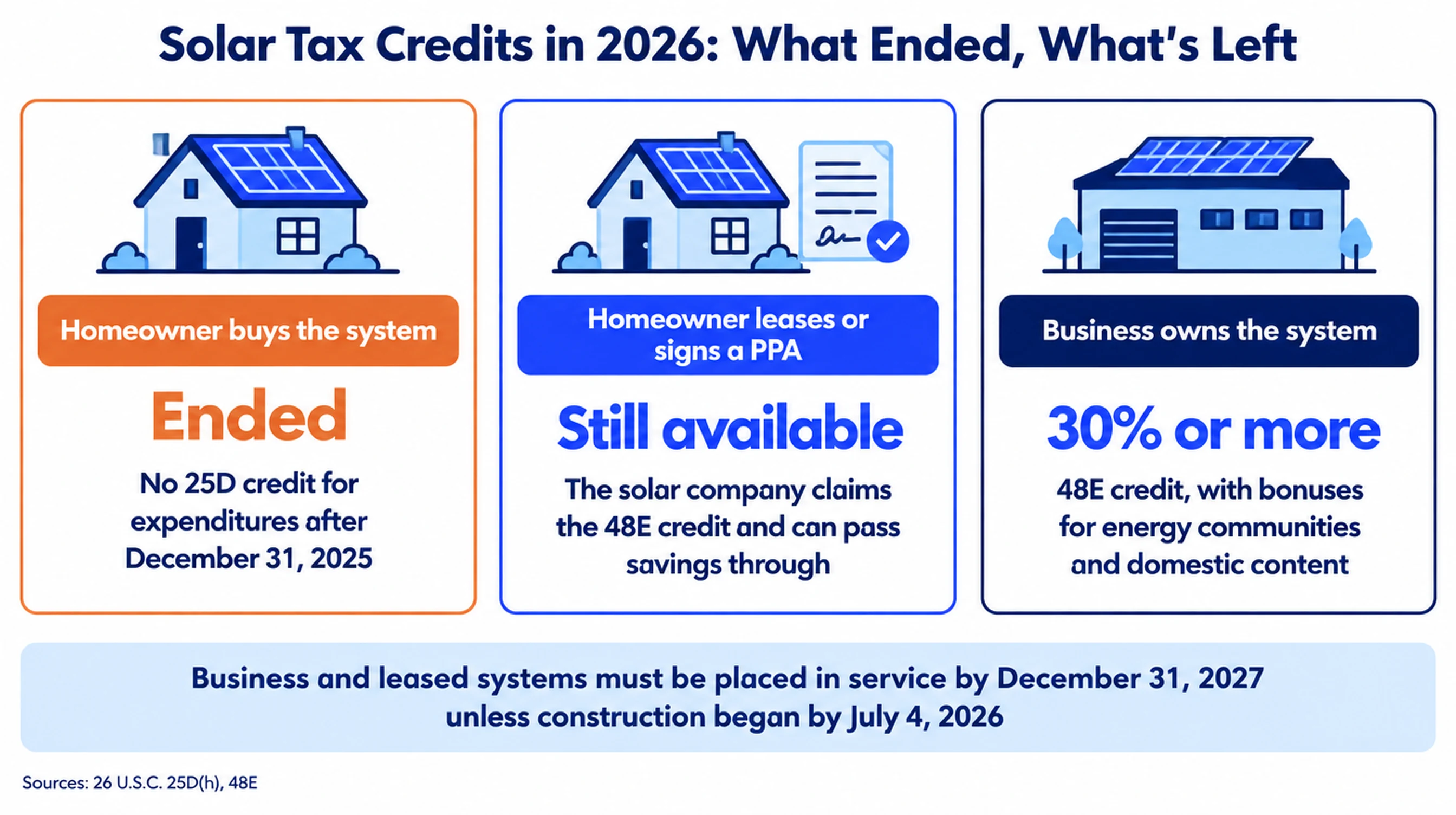
Yes, but not for homeowners who buy their own panels. The 30% residential credit under Section 25D ended for costs paid after December 31, 2025. In 2026 the federal solar credit goes to businesses and to companies that lease or sell power from home systems, through the Section 48E Investment Tax Credit (ITC).
That split is the whole story of the solar tax credit in 2026. If you own the system and it sits on your house, there’s no federal credit for new purchases. If a business, landlord, nonprofit or leasing company owns it, a 30% credit is still available, as long as the system meets the new deadlines.
The IRS confirms the residential credit covered property installed from 2022 through December 31, 2025 and isn’t available for property placed in service after that. The companion home improvement credit under Section 25C, for heat pumps, windows and insulation, also ended for improvements made after 2025.
Why did the residential solar tax credit end?
The One Big Beautiful Bill Act, signed July 4, 2025, rewrote Section 25D’s end date. Under the Inflation Reduction Act, homeowners would have kept a 30% credit through 2032, then 26% and 22%. The new law ended it for any expenditure made after December 31, 2025, nine years early.
The change sits in Section 25D(h), which now reads that the credit “shall not apply with respect to any expenditures made after December 31, 2025.” Section 25D treats an expenditure as made when the original installation is completed, so a system paid for in 2025 but installed in 2026 doesn’t qualify.
Unused 25D credit from 2025 or earlier isn’t lost. It still carries forward to future tax years on Form 5695. Our guide to the One Big Beautiful Bill’s clean energy changes covers every credit the law touched.

Can you still get a solar credit by leasing?
Indirectly, yes. When a solar company owns the system on your roof under a lease or power purchase agreement (PPA), the company claims the 30% Section 48E credit as a business. It may pass part of that value to you through a lower monthly payment, but you don’t claim anything on your own return.
The law closes this door for some home equipment. Section 48E(i) denies the credit when solar water heating or small wind property is leased to a homeowner, but solar electric panels aren’t on that list. That’s why, as NPR reported, rooftop installers shifted customers toward leases after the purchase credit ended.
Leased systems still face the same business deadlines below, so the leasing company has to get them in service by the end of 2027 unless construction began by July 4, 2026.
How much is the business solar tax credit in 2026?
For businesses, the solar tax credit in 2026 is 30% of eligible system cost when the project meets prevailing wage and apprenticeship rules or is under 1 MW AC, and 6% otherwise. Energy community and domestic content bonuses each add 10 percentage points, so a solar ITC can reach 50%.
On a 500 kW rooftop system at the second-quarter 2026 commercial benchmark of $1.77 per watt, the 30% credit is about $265,500. Our commercial solar tax credit guide shows the full net-cost math, our Section 48 vs. 48E guide explains why new projects use 48E, and the energy community map and domestic content guide explain the bonuses.
Try your own numbers below: pick who owns the system and when it starts construction, and the calculator shows which credit applies and what it’s worth.
The 48E credit is worth $265,500. Selling it at 91¢ on the dollar returns about $241,605 in cash.
Illustrative only. Uses the 2026 rules in 26 U.S.C. 25D(h) and 48E. Ignores the low-income bonus, FEOC material assistance tests and state incentives. Confirm with your tax advisor.
When does the solar tax credit expire for businesses?
A business solar project that began construction by July 4, 2026 keeps the full credit if it’s placed in service within the four-year continuity window, generally by the end of 2030. Any project that starts later must be placed in service by December 31, 2027, or it gets no credit.
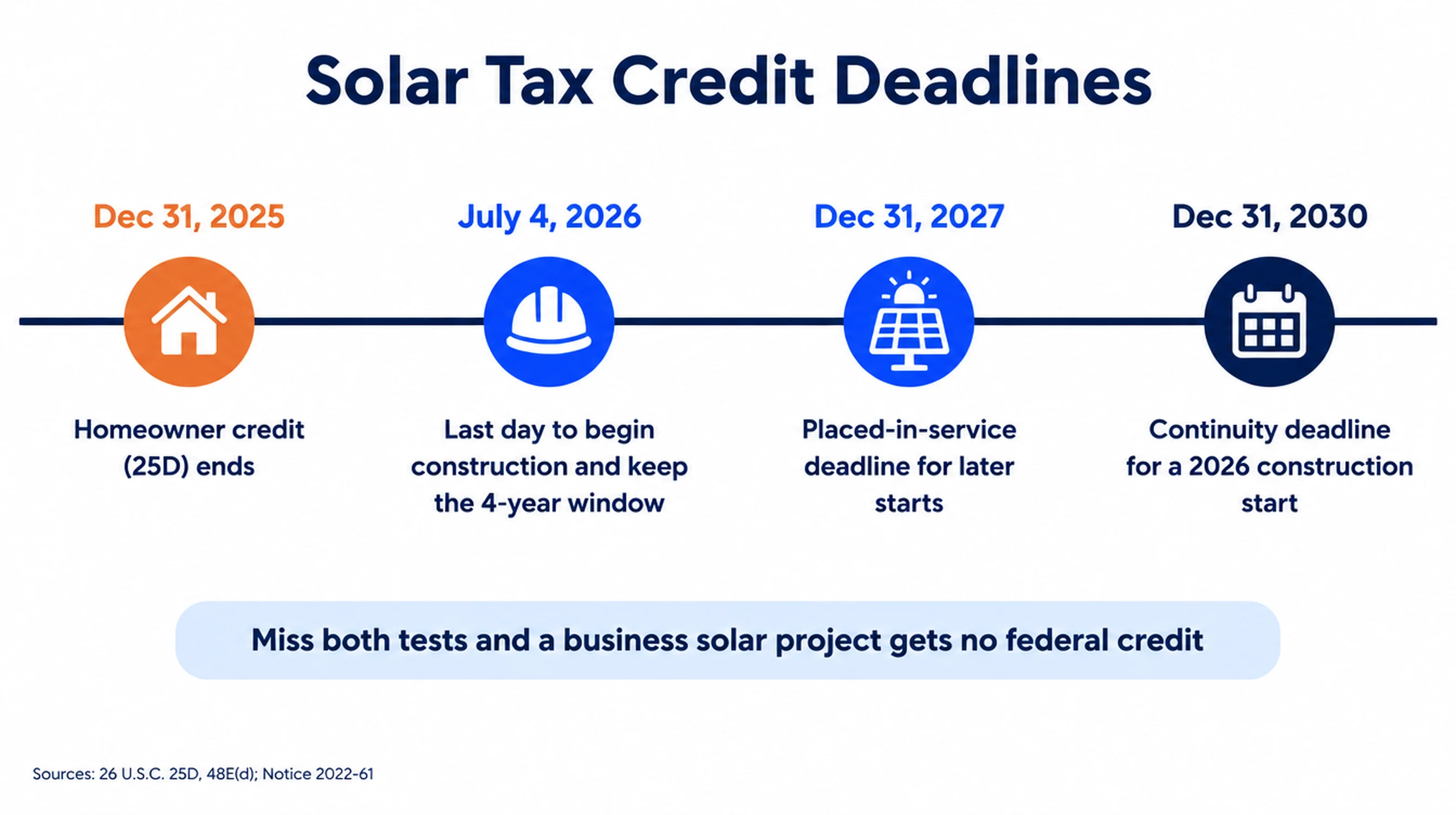
So when does the solar tax credit expire? For homeowners, it already has. For new business projects starting today, the practical expiration is the end of 2027. The rule comes from the wind and solar termination added to Section 48E, and the parallel rule in Section 45Y for the production credit.
How a project proves it began construction matters too. A court vacated IRS Notice 2025-42 in June 2026, restoring the 5% safe harbor, as our Notice 2025-42 guide explains. Projects starting construction after 2025 must also pass the foreign entity of concern rules.
Are solar tax credits going away completely?
Mostly, on the current schedule. The homeowner credit is already gone, and the business solar credit ends for projects placed in service after 2027 unless construction began by July 4, 2026. Solar paired with battery storage is different: the storage portion keeps its own 48E credit for construction starting through 2033.
The chart below compares the solar tax credit rate by year for homeowners and businesses, against the schedule the Inflation Reduction Act had set before the 2025 law. Searches for “solar tax credits going away” peaked in late 2025 as homeowners rushed to finish installs before the December 31 cutoff.
Storage is the bright spot. Our battery storage tax credit guide covers the 2033 timeline, and many developers are now adding batteries to existing solar sites.
Business solar that starts construction now must be in service by December 31, 2027. Homeowner-owned systems lost the credit entirely after 2025, nine years before the old schedule ran out in 2034.
Sources: 26 U.S.C. 25D(g)-(h), 48, 48E; Pub. L. 119-21 secs. 70506, 70513. Business line assumes prevailing wage and apprenticeship compliance or a system under 1 MW, with no bonus adders.
What can homeowners do without the federal credit?
Homeowners can still lease a system or sign a PPA so the installer claims the business credit, look for state tax credits and utility rebates, and use property tax exemptions some states offer for solar. Solar can still pay back without the federal credit where electricity rates are high and net metering is generous.
The trade-off with a lease is ownership. You don’t build equity in the system, and the savings depend on the contract’s escalator and term. Compare a lease’s 20- or 25-year cost with a cash or loan purchase at today’s prices before signing.
Business owners, landlords and farms have better options. A system owned by your business qualifies for the 48E credit and depreciation, as our commercial solar financing guide shows.
Can businesses sell solar tax credits?
Yes. Section 48E credits are transferable under Section 6418, so a business without enough tax liability can sell its solar ITC to a corporate buyer for cash. Investment tax credits averaged about 91 cents per dollar in 2026, according to Crux, and tax-exempt owners can take the credit as elective pay instead.
Crux put average 2026 ITC pricing at $0.913. Smaller rooftop deals often price lower, so owners commonly aggregate credits from several projects. Our guide to selling commercial solar tax credits walks through the process, and schools, cities and nonprofits can use elective pay.
How do you claim the solar tax credit in 2026?
Businesses claim the 48E solar credit on Form 3468 for the tax year the system is placed in service, then carry it to Form 3800. To sell the credit or take elective pay, register the project through IRS pre-filing registration first. Homeowners file Form 5695 only to use carryforwards from 2025 or earlier.
Keep records of the construction start date, prevailing wage and apprenticeship compliance, bonus eligibility and FEOC sourcing. Buyers ask for all of it, and the credit can be recaptured if the system is sold within five years, as our ITC recapture guide explains.
See our Form 3468 instructions and pre-filing registration guide for the steps.
Sources
Frequently Asked Questions
Is there a federal solar tax credit in 2026?
Not for homeowners who buy their own system: Section 25D ended for expenditures after December 31, 2025. Businesses, nonprofits and solar leasing companies can still claim the 30% Section 48E Investment Tax Credit (ITC) in 2026.
Can I get the solar tax credit if I install panels in 2026?
When does the commercial solar tax credit end?
Is solar still worth it without the tax credit?
Can Cenet Capital help me sell my solar tax credit?
Own a solar project? Turn the credit into cash
Cenet Capital helps businesses, developers and solar lessors value their 2026 Section 48E solar credits and sell them to corporate buyers. Tell us your system size, cost and construction timeline.

More Insights